Why This Is Not a Navy Problem, but an American One
This essay explores why the current debate over rust and warfighting readiness is not an internal Navy issue, but a national one. The real problem is not cosmetic—it is systemic. Sailors are capable. The American public is supportive. What often fails is alignment upstream—where Congress, the Department of Defense, and senior leadership decide what gets funded, staffed, scheduled, and rewarded.

From the Founder
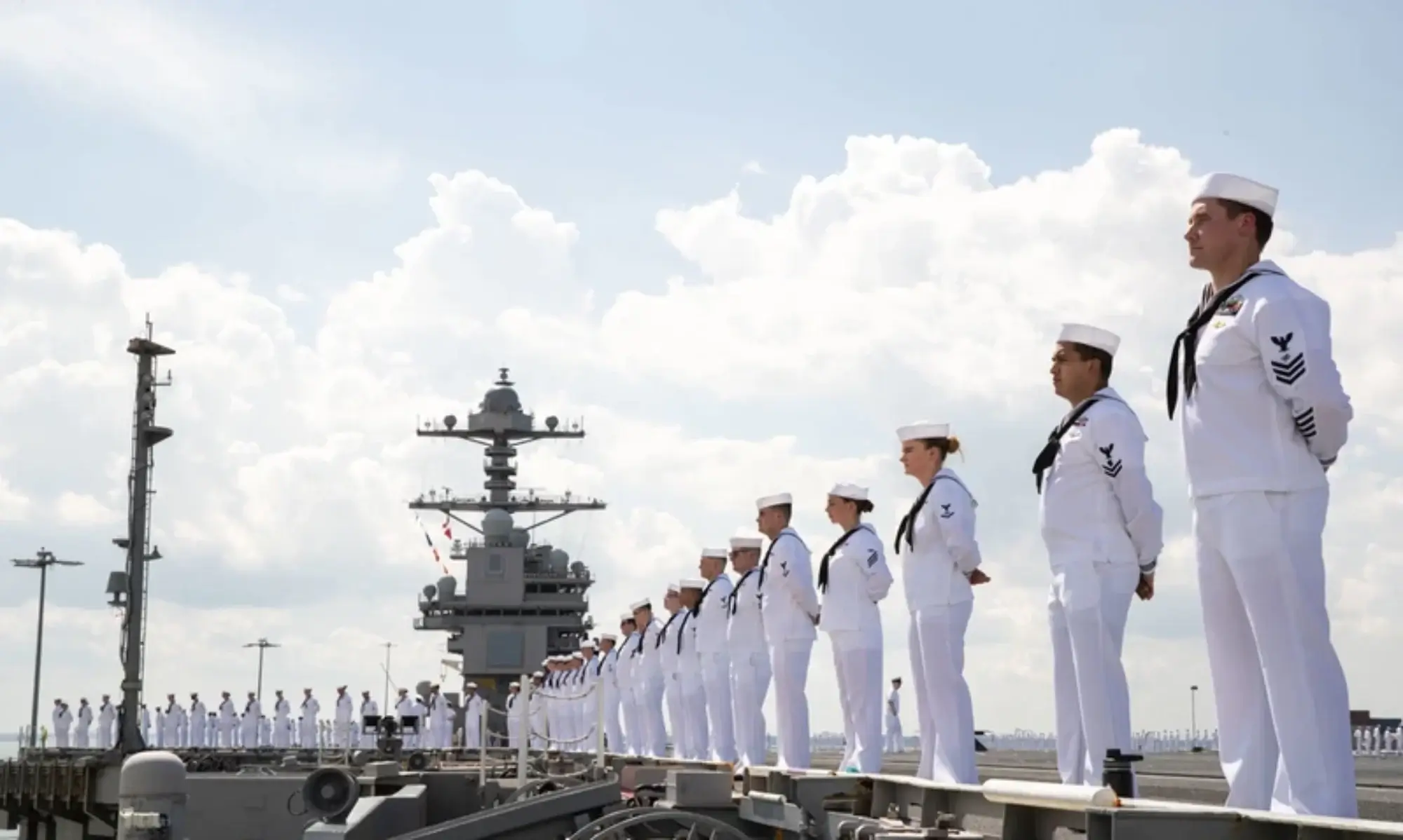
I served on a U.S. Navy destroyer in the 1970s. Some of the hardest-working, most capable people I’ve ever known wore Navy uniforms—officers and enlisted, engineers and operators, deckplate sailors and watchstanders. They weren’t lazy. They weren’t careless. And they weren’t disconnected from the mission.
They were doing the best they could inside a system that constantly forced tradeoffs.
That experience is why I’m paying close attention to the public debate about rust, preservation, and warfighting readiness. Because this is not a Navy culture fight. It’s not a generational fight. And it’s not an internal matter.
It’s a national readiness issue.
What Sparked This Debate
A recent article by LT Spike Dearing, published on the Center for International Maritime Security (CIMSEC), argued that today’s surface fleet is being inspected more for preservation than for warfighting. His point was not that preservation doesn’t matter—it absolutely does—but that what leaders choose to inspect shapes what sailors prioritize.
His concern is simple and serious: if warfighting performance is rarely inspected, it will inevitably become secondary.
The article prompted multiple responses in the CIMSEC comment section, including from naval historian and analyst Steven Wills, and was later republished on other defense platforms—signaling that its themes are resonating beyond its initial posting.
This is not a closed-door conversation. This is a public one—because the consequences of readiness, or the lack of it, do not stay inside the Navy.
What Steven Wills Gets Right
Steven Wills made an important point: corrosion is not cosmetic. Rust is not superficial. Preservation reflects discipline. And visible neglect often signals deeper organizational decay.
He’s right.
Saltwater destroys steel. Systems fail. Neglect spreads. No serious warfighting force can afford to treat material condition as optional.
But this is where people often misframe the issue.
This is not a choice between paint and warfighting.
It is about whether the system enables both.
What LT Dearing Gets Right
LT Dearing is also right.
People respond rationally to what leaders inspect.
If leaders inspect surfaces, crews will optimize for surfaces. If leaders inspect tactics, crews will optimize for tactics.
That’s not laziness. That’s survival.
After the USS Bonhomme Richard fire, the Navy made fire safety non-negotiable. Inspections changed. Behavior changed. Training changed.
That’s how priorities shift.
Standards Matter — But Systems Decide Whether They Are Achievable
When defense analyst Brent Sadler says that a clean ship is a well-run ship and a combat-ready ship, he is pointing to something real: discipline, standards, and leadership signals matter. Order reflects process. Process reflects leadership. And leadership shapes behavior.
But that truth only holds when the system supporting those standards is aligned.
A ship can only be clean, disciplined, and well-run if crews are given the time, manpower, training windows, maintenance access, and parts availability needed to meet those standards. Without that support, expectations become performative instead of operational.
This is where the problem becomes systemic.
When standards are enforced without the resources to meet them, discipline turns into distortion. Crews are not failing — they are adapting. And adaptation is not weakness. It is rational behavior inside a misaligned system.
This is why this is not a deckplate problem.
This is a governance problem.
Who sets the priorities? Who controls the budgets? Who defines the metrics? Who decides what gets inspected, rewarded, and penalized? Readiness is not free. It is built—or it is hollowed out—by budgets, manpower decisions, and time allocations.
Those decisions are made upstream.
Sadler’s point about cleanliness is not wrong — it is incomplete without a systems lens. A clean ship should reflect readiness. But that only works when leadership designs a system that makes real readiness possible, not just presentable.
This is why LT Spike Dearing’s argument about what leaders choose to inspect matters. And it is why Steven Wills is right to warn that visible neglect often signals deeper organizational decay. Both are describing the same thing from different angles: signals versus systems.
Signals matter. But systems decide outcomes.
My Experience
When I served, my shipmates worked relentlessly. We fought corrosion while underway. We knew what mattered. But we also knew what inspectors looked for.
So when inspections came, we painted.
Not because we didn’t care about readiness. But because we cared about protecting our command inside the system.
And a lot has changed since the 1970s. The Navy is smaller now and stretched even further. The systems are more complex, the demands are higher, and many of the sailors and officers carrying this load today could be my children. In many cases, they may not even have the time to paint over rust—because they are busy keeping the ship running, the systems online, and the mission moving.
That doesn’t weaken this argument. It strengthens it.
That’s not moral failure.
That’s a warning sign.
Hardworking people will always try to do everything. When they can’t, they triage based on what leadership rewards.
This Is Not a Navy-Internal Problem
This is not about sailors. This is not about pride. This is not about tradition.
This is about alignment.
Sailors are capable. Sailors are disciplined. Sailors are supported by the American people.
What they often lack is consistent backing from those who control resources, manpower, time, and priorities.
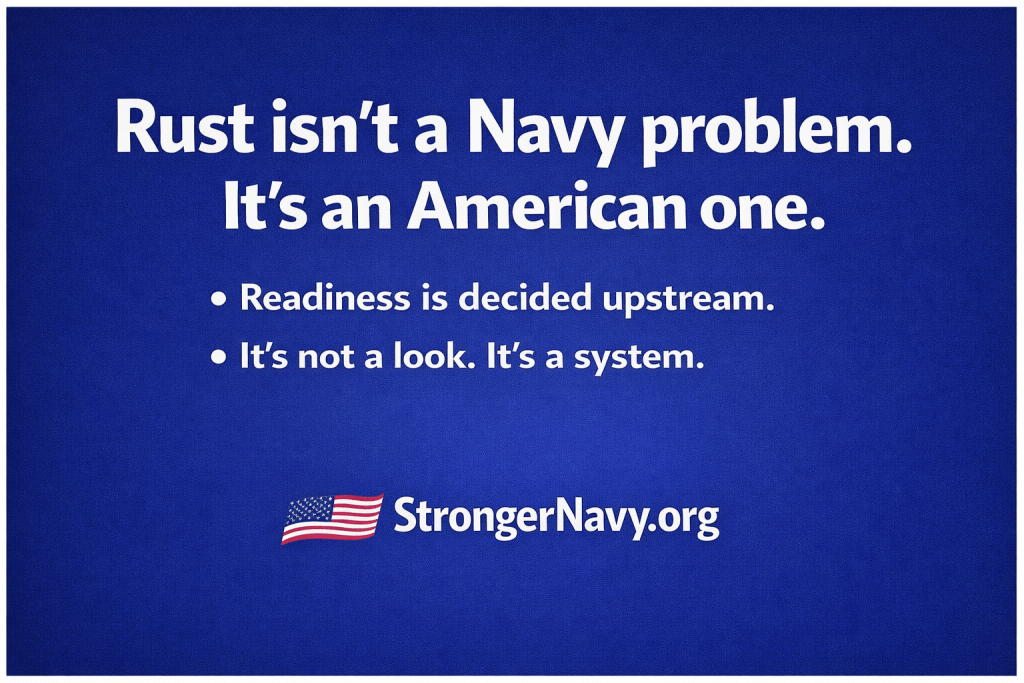
Readiness is not a slogan. It’s a system.
And when that system is misaligned, people adapt.
Why Americans Should Care
The Navy does not exist for the Navy. It exists for the American people.
If we want deterrence, we must prepare seriously. If we want peace, we must be credible. If we want stability, we must invest in real readiness—not performative readiness.
You cannot paint your way to warfighting competence.
Implications for the Navy
This debate exposes a dangerous risk: a force that looks ready but is not consistently evaluated for the conditions it will actually face.
War does not care about inspections. Adversaries do not grade on appearance. And there are no do-overs.
Implications for Our Allies
Our allies don’t just watch our ships. They watch our seriousness.
Credibility comes from demonstrated competence under stress—not polish.
The Bottom Line
Preservation matters. Warfighting matters more. Both must be enabled.
This is not about rust. It is about readiness design.
Real readiness cannot be painted on.
That’s why we launched Charting the Course: Voices That Matter — a 24-part educational series breaking down how we got here, what went wrong, and what must happen next. Our goal is simple: educate the public, connect the dots, and build the support needed to close the readiness gap before it’s too late.
Let’s roll.