A Path to the Navy Force Structure the Nation Needs — And Who Pays for It

Vice Admiral Thomas J. Moore, U.S. Navy (Retired), ran the command that builds and sustains the fleet. As the 44th Commander of Naval Sea Systems Command, he spent more than 20 years in the design, acquisition, and sustainment of the Navy’s CVN fleet — and served as the CNO’s Director of Fleet Readiness for more than three years.

In February 2025, he published one of the most important — and most honest — assessments of American naval power to appear in recent years. The title says it plainly: “A Path to the Navy Force Structure the Nation Needs.”
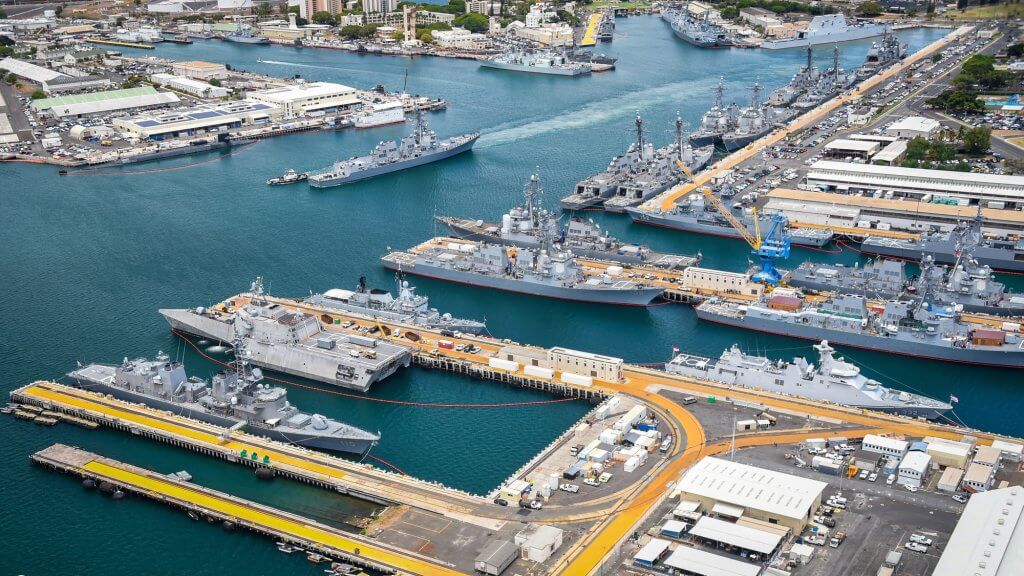
U.S. Navy ships moored at Joint Base Pearl Harbor-Hickam, Hawaii, July 3, 2024, during RIMPAC 2024. Vice Admiral Thomas J. Moore’s February 2025 Proceedings analysis concludes the Navy needs 381 ships to meet current security requirements — nearly 90 more than today’s fleet. (U.S. Navy/DVIDS)

His thesis is equally plain: “The Navy’s force structure is inadequate because the service has been unable to effectively manage new construction and ship retirements.”

Not China’s fault. Not Congress’s fault. The Navy’s own management failures — documented in detail, with receipts.

What follows is a summary of Moore’s argument, why it matters now more than when he wrote it, and what the Shipbuilding Economic Acceleration and Security (SEAS) Act offers as the funding answer his analysis demands.

Three Self-Inflicted Wounds

Moore identifies three compounding problems — each within the Navy’s control, each making the others worse.

1. An insatiable requirements appetite. The Navy has a persistent pattern of designing ships that are too complex, too expensive, and take too long to build. The Zumwalt-class destroyer is Moore’s primary exhibit — a ship whose cost ballooned so dramatically that the Navy decided to decommission several hulls early, before they had delivered their intended service life. The Gerald R. Ford-class carrier required hundreds of millions in unplanned investment after delivery. The Freedom-class Littoral Combat Ship was decommissioned early. In each case, the Navy’s desire for next-generation capabilities produced platforms that couldn’t be sustained at the numbers the force structure required.

His conclusion: “The fits and starts cannot get to 313, let alone 381 ships.”

2. A workforce the industrial base cannot sustain. This is where Moore’s analysis becomes most specific — and most sobering. From 1993 to 2027, the Navy built an average of just 5.5 ships per year. The industrial base shaped itself around that signal. Growing to the 12 ships per year required to reach 381 ships means growing the skilled shipbuilding workforce by a commensurate amount — and that takes years, not months.

Moore is direct about where the constraint actually lies: the problem is not physical shipyard capacity. It is skilled workers. His highlighted conclusion: the current industrial base does not lack the physical capacity to build the required number of ships annually. What it lacks is a skilled workforce in the numbers needed to meet that increase in demand.

That is a critical distinction. More shipyards don’t solve it. More cranes don’t solve it. Only a stable, predictable, multi-year demand signal — giving industry the confidence to hire, train, and retain the workforce — solves it.

3. Procurement whipsaw. Moore’s Table 1 — Battle Force Ships Procured or Requested, FY1982–FY2028 — is the most damning exhibit in the article. The numbers bounce from 28 ships in a single year down to single digits, back up, down again. Wildly. Decade after decade. His point: a rapid downsizing of shipbuilding creates structural consequences that take 5 to 7 years to reverse. When demand drops, senior workers retire, younger workers leave for other industries, suppliers consolidate or close. The experience and productivity levels needed to support a surge take years to rebuild — far longer than the short-term political signal that caused the drawdown in the first place.

This is the procurement whipsaw. And it has been the dominant feature of American shipbuilding policy for forty years.

The Math Behind 381

Moore’s proposed solution is elegant in its simplicity. Rather than chasing arbitrary ship counts, he proposes building force structure from the bottom up using a “build center” mechanism: divide the required number of ships by service life to determine the steady annual production rate each platform requires. Apply that rate consistently. Give industry a stable and predictable demand 10 to 15 years out.

The resulting force structure requirement — Table 2 in the article — totals 381 ships:

66 fast-attack submarines requiring 2 per year. 87 large surface combatants requiring 2.5 per year. 73 small surface combatants requiring 3 per year. 12 ballistic-missile submarines and 12 aircraft carriers anchoring the deterrent and power projection triad. Amphibious, logistics, and support vessels completing the force.

Today’s fleet sits at roughly 291 — below the 325-ship floor identified in the 2016 Force Structure Assessment as the minimum acceptable risk threshold. We are not approaching a gap. We are in one.

The annual shipbuilding budget required: $40 billion. Moore addresses the affordability objection directly and dismisses it:

Some will argue the nation cannot afford $40 billion or more per year for shipbuilding and the attendant costs to operate, maintain, and man the ships. But of course the nation can afford it. It has a multitrillion dollar annual budget and spends far more than $40 billion per year on many things it deems important. The real question is, should the United States do this?

And then the warning that should be on every policymaker’s desk:

The Navy the nation has today is the Navy it will fight with — and it is not big enough. There are parallels to World War II, but unlike in that war, this time the United States will not have the luxury of waiting for industry to catch up in a conflict with China or other adversaries as it did then when labor and large-scale manufacturing facilities were plentiful. The time to start is now.

That is not analysis from a think tank. That is a judgment from the man who ran NAVSEA.

A Lot Has Changed Since He Wrote This. The Gap Hasn’t.

Moore published in February 2025. The policy environment has shifted significantly since then — almost entirely in the direction of validating his urgency while making execution harder.

The FY2027 shipbuilding budget request came in at $68.5 billion — a 57% increase over the prior year. Moore’s $40 billion floor wasn’t an overreach. It was a minimum. The administration confirmed his math and raised it.

The 381-ship goal has since been superseded by the “Golden Fleet” concept — though the full force-level details remain unpublished. Moore’s analysis remains the most precise public accounting of what naval adequacy actually requires.

The Constellation-class frigate — one of the surface combatant programs Moore’s build-rate math depended on — was cancelled in November 2025 after cost overruns made it unsustainable. One more self-inflicted wound, confirming Moore’s requirements appetite diagnosis.

The SHIPS for America Act — the workforce and industrial base legislation Moore’s analysis implicitly requires — has held only one congressional hearing since reintroduction in April 2025. The legislative environment has not caught up to the threat.

And the fleet is still at roughly 291 ships.

Moore Defines the Problem. The SEAS Act Answers It.

Moore’s article diagnoses three problems: requirements creep, workforce collapse, and procurement whipsaw. All three share a common root cause — the absence of a stable, mandatory, multi-year funding signal that industry can plan around.

Annual appropriations cannot solve this. A single large budget request cannot solve this. What Moore’s analysis demands — whether he frames it this way or not — is a funding mechanism that operates outside the political cycle, delivers a consistent signal to the industrial base, and cannot be raided for other priorities when the next fiscal crisis arrives.

That is precisely what the Shipbuilding Economic Acceleration and Security (SEAS) Act proposes.

The SEAS Act establishes a 2% Strategic Technology Responsibility Contribution (STRC) from U.S. companies earning $5 billion or more annually from China operations revenue, directed into a dedicated Naval Modernization account outside the standard appropriations cycle. Estimated annual yield: $4 to $4.4 billion.

The anchor logic: the companies that built billion-dollar China revenue models — enabled by U.S. Navy forward presence, freedom of navigation operations, and Indo-Pacific security architecture — bear a proportional responsibility for sustaining the force that makes that access possible.

The Defense Reinvestment Credit (DRC) allows qualifying companies to offset up to 80% of their STRC obligation through verified domestic defense investment — in shipyard capacity, workforce development, supply chain, or related industrial base priorities. This transforms the mechanism from a contribution into a reinvestment strategy. And critically, it directs capital toward exactly the workforce problem Moore identifies as the binding constraint.

The SHIPS Act asks who builds the ships. The SEAS Act answers who pays for them.

The Reagan Precedent — In Moore’s Own Footnotes

Moore’s Table 1 shows what sustained investment actually produced: the Reagan naval buildup from 1982 to 1992 — the last period of consistent, multi-year shipbuilding commitment — delivered the fleet that won the Cold War. His article cites Jerry Hendrix and Brent Sadler’s October 2024 National Review piece, “Restoring Our Maritime Strength,” as foundational context. Sadler — Senior Research Fellow at the Heritage Foundation — has since published the TRUMP Act proposal calling for presidential sponsorship of the SHIPS for America Act to break the current legislative logjam.

The through-line is clear: Moore establishes the force structure requirement. Sadler maps the legislative path. The SEAS Act provides the funding mechanism that makes either sustainable across administrations.

The Time to Start Is Now

Moore’s closing line is not rhetorical. It is a planning constraint.

The industrial base does not have the skilled workforce to execute a surge today. Building that workforce requires years of stable demand signal. The procurement whipsaw of the last four decades has to stop — and stopping it requires a funding mechanism that outlasts any single budget cycle or administration.

381 ships. $40 billion per year. A force structure derived from service lives and build rates — not politics. Three self-inflicted wounds that a dedicated, mandatory funding stream begins to address structurally.

Admiral Moore has charted the path. The SEAS Act is one serious answer to the funding question that path demands. Washington needs to move from debating whether to rebuild the fleet to deciding how to pay for it — and who has been benefiting most from the security that fleet provides.

The time to start is now.

Americans for a Stronger Navy advocates for a modern, capable fleet capable of deterring conflict and protecting American interests worldwide. Learn more at StrongerNavy.org.


REFERENCES

[1] Vice Admiral Thomas J. Moore, U.S. Navy (Ret.), “A Path to the Navy Force Structure the Nation Needs,” Proceedings, U.S. Naval Institute, February 2025, pp. 22–25.

[2] 2016 Force Structure Assessment — 325-ship minimum acceptable risk threshold; confirmed in multiple subsequent CNO assessments.

[3] SEAS Act STRC mechanism and Naval Modernization account structure — Americans for a Stronger Navy framework documentation, 2025–2026. Published: “Defense Reinvestment as Naval Strategy,” Center for Maritime Strategy, March 16, 2026.

[4] Reagan naval buildup (1982–1992) — Congressional Budget Office historical shipbuilding analysis; Moore Table 1, Battle Force Ships Procured or Requested, FY1982–FY2028.

[5] Jerry Hendrix and Brent Sadler, “Restoring Our Maritime Strength,” The National Review, 24 October 2024. Cited by Admiral Moore as footnote 1 of the Proceedings article.

[6] FY2027 Navy shipbuilding budget request — $68.5 billion, released May 11, 2026.

[7] Constellation-class frigate cancellation — Secretary of the Navy John Phelan, November 2025.

[8] SHIPS for America Act legislative status — one Senate Commerce Committee hearing, October 28, 2025; bill reintroduced April 2025 following EO 14269.

Inside the Navy’s Future: The Questions Americans Deserve Answered

Bill Cullifer, Founder

As a former blue water sailor and founder of Americans for a Stronger Navy, I learned early that naval strength is not defined by speeches or strategies alone. It is defined by readiness—by ships that work, sailors who are trained, and shipyards that can sustain them.

Over the past two years, through Americans for a Stronger Navy and StrongerNavy.org, I have worked to better understand the forces shaping the future of our Navy. What I have discovered is both reassuring and sobering.

Reassuring because the Navy’s leadership clearly understands the changing threat environment. Sobering because serious professionals—inside and outside the Navy—are actively debating how best to prepare for it.

This series is designed to help Americans understand that debate.

A Navy in Transition

The United States Navy is undergoing one of its most significant strategic transitions since the end of the Cold War. For decades, our Navy operated in an environment where it could project power with relative freedom. That era is over.

China now operates the world’s largest navy by ship count and continues expanding its industrial capacity at a pace unmatched in modern times. Russia remains a capable undersea competitor. Meanwhile, unmanned systems, artificial intelligence, and directed-energy weapons are changing how naval warfare may be conducted in the decades ahead.

The Navy’s leadership recognizes this reality. They are adapting strategy, exploring new technologies, and rethinking how naval forces will operate in the future. But within that effort, there are important and healthy debates—and Americans deserve to understand them.

Different Perspectives, Shared Purpose

Some leaders emphasize the continued importance of traditional crewed ships—destroyers, submarines, and aircraft carriers—as the backbone of naval power. Others emphasize the growing role unmanned systems may play in extending reach and enhancing survivability. Still others focus on the industrial foundation that makes both possible: shipyards, maintenance infrastructure, and workforce capacity.

These are not disagreements about the mission. They are discussions about how best to ensure the Navy remains ready, effective, and capable in a changing world. What unites these perspectives is a shared recognition that readiness requires sustained national support.

Ships must be built. Shipyards must be modernized. Sailors must be trained. Infrastructure must be maintained. None of this happens automatically.

Why Industrial Capacity Matters

One of the most important lessons from this work is that naval power is built on industrial strength. Strategy determines what the Navy needs to do. Industrial capacity determines whether it can do it.

Naval Sea Systems Command (NAVSEA), our public and private shipyards, and the skilled workforce that supports them form the foundation of naval readiness. Without their ability to build, maintain, and modernize ships, even the best strategy cannot succeed.

This is not a criticism. It is simply reality—and it is why public understanding matters. Americans deserve to know how their Navy works, what challenges it faces, and what is required to sustain it for future generations.

From Understanding to Sustained Support: The Strategic SEAS Act

Understanding the challenge is the first step. Sustaining readiness over time requires structural solutions.

That is why Americans for a Stronger Navy developed the Strategic SEAS Act—a framework designed to provide predictable, sustained funding for shipbuilding capacity, shipyard modernization, workforce development, and allied maritime infrastructure. Its purpose is straightforward: to help ensure that the Navy and the maritime industrial base have the long-term support necessary to meet national security requirements.

The Strategic SEAS Act complements legislative efforts like the SHIPS Act by addressing a critical question: how to provide sustained, reliable funding to support the Navy’s long-term readiness. Readiness is not built in a year. It is built over decades.

Why This Matters Now

The decisions being made today—about ships, shipyards, technology, workforce, and sustained funding—will define America’s naval strength for the next generation. These decisions are being made now, in budget cycles and legislative sessions that most Americans never see.

Meanwhile, serious questions are being raised by experienced naval professionals, defense analysts, and members of Congress about whether America’s shipbuilding capacity and industrial base can support the strategy at the pace required. Those questions deserve honest, public answers.

This series is intended to provide that clarity—directly, responsibly, and in plain English.

The Questions This Series Will Address

Among them:

•  Are traditional ships like destroyers, submarines, and carriers still essential in the age of drones and autonomous systems?

•  Can unmanned systems truly enhance naval power—or are they being asked to do too much, too soon?

•  Is America’s shipbuilding and repair infrastructure strong enough to sustain the Navy the nation requires?

•  What role does Naval Sea Systems Command (NAVSEA) play in ensuring readiness—and what challenges does it face?

•  How does America’s shipbuilding capacity compare to China’s—and what does that mean strategically?

•  Can the Navy realistically surge its fleet when needed?

•  What role do Congress, industry, and the American people play in sustaining naval strength over time?

•  And most importantly: what must be done—practically, responsibly, and sustainably—to ensure the United States Navy remains ready to protect American interests for decades to come?

These are not political questions. They are national questions. And Americans deserve clear, honest answers.

Why Americans Should Care

The U.S. Navy protects far more than military interests. It safeguards global commerce, deters conflict, reassures allies, and protects the economic system Americans depend on every day. When the Navy is ready, it helps preserve peace through strength. When industrial capacity declines, readiness becomes harder to sustain.

The decisions being made today will shape America’s naval strength for decades to come. Americans deserve to understand those decisions.

What This 8-Part Series Will Explore

In the weeks ahead, this series will examine why traditional naval ships remain essential, how unmanned systems are changing naval operations, the critical role of NAVSEA and America’s shipyards, the industrial and workforce foundation behind naval readiness, how China and other nations are approaching maritime power, how naval strength is sustained over time, and what must be done to ensure continued readiness.

This is not about choosing sides in a debate. It is about understanding the full picture—because an informed public is essential to sustaining a strong Navy.

Let’s get to work.

When Sanctions Need Ships: How Two U.S. Destroyers Chased a Dark Fleet Tanker Across the Atlantic

Introduction

Two U.S. Navy destroyers just spent weeks tracking, shadowing, and supporting the seizure of a runaway oil tanker in the North Atlantic.

This was not a combat mission.
It was not a press event.
It was not symbolic.

It was enforcement.

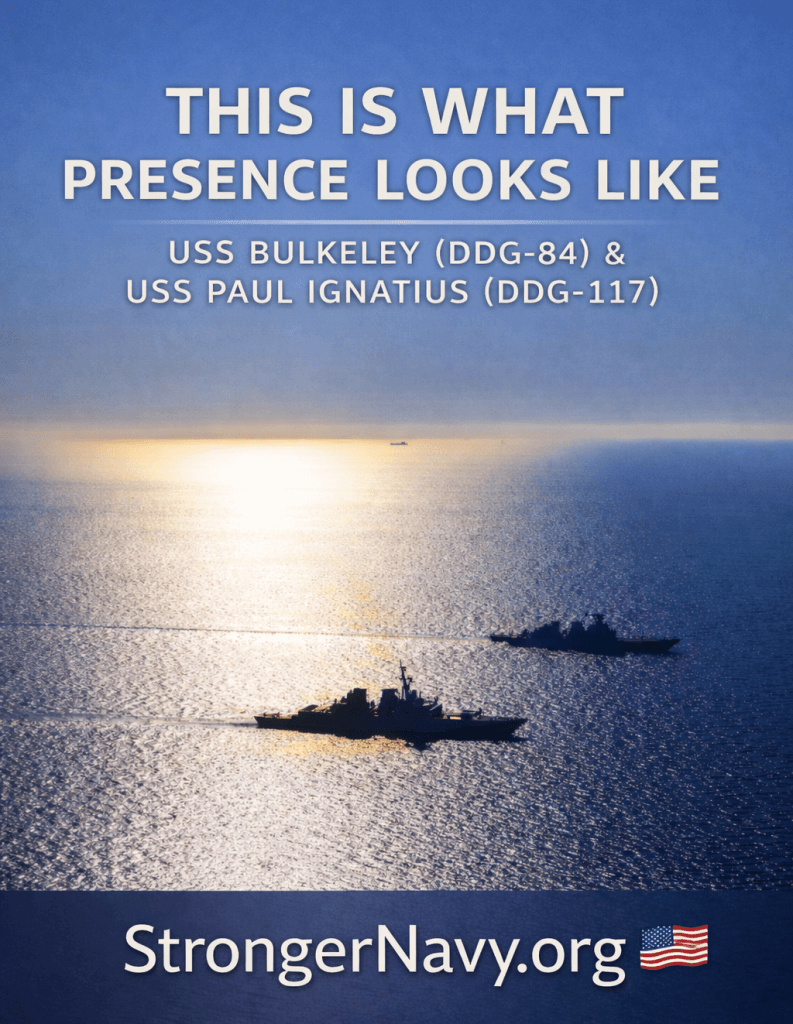
USS Bulkeley (DDG-84) and USS Paul Ignatius (DDG-117) helped support an operation that ultimately boarded and seized a Russian-flagged tanker that had been actively evading authorities across thousands of miles of open ocean.

This is what maritime power looks like in 2026. And most Americans never see it.

What Happened
The vessel—initially named Bella 1—was operating as part of what U.S. officials describe as a “dark fleet,” a network of tankers designed to evade sanctions through deceptive practices.

Over the course of its escape, the tanker:
• Changed its name
• Reflagged as Russian
• Painted a new national tricolor on its hull
• Altered its identity
• Evaded a U.S. naval blockade
• Attempted to disappear into the Atlantic

After weeks of pursuit, U.S. forces—supported by Navy destroyers, Coast Guard assets, special operations forces, and allied surveillance—seized the vessel in waters between the UK and Iceland.

The UK provided support. NATO was not involved.

This was a multinational, multi-domain enforcement operation.

Not war. Not peace. Enforcement.

Why This Matters
Sanctions do not enforce themselves.

Every time a government announces new sanctions, it implies something most people never think about:

Someone has to physically enforce them.

That means:
• Ships
• Crews
• Surveillance
• Boarding teams
• Legal frameworks
• Sustainment
• Allies
• Weeks of continuous presence

Sanctions without maritime power are just words on paper.

The Rise of the Dark Fleet
So-called “dark fleet” vessels use identity laundering to move oil, weapons, and sanctioned goods across the world.

They:
• Reflag repeatedly
• Change names
• Operate under shell companies
• Transmit false data
• Disable tracking systems
• Exploit legal gray zones

This is modern maritime gray-zone warfare.

And the U.S. Navy is now its primary counterforce.

Attrition Isn’t Just Combat
A Navy captain once wrote: “Wars at sea are wars of attrition.”

What most people miss is that attrition doesn’t only happen during wars.

It happens during:
• Blockades
• Sanctions enforcement
• Freedom of navigation patrols
• Counter-smuggling missions
• Persistent surveillance
• Shadowing operations

Weeks of pursuit burn:
• Fuel
• Maintenance cycles
• Crew endurance
• Parts
• Readiness margins

Every ship tied up on one mission is unavailable for another. Presence has a cost.

Why Americans Should Care
This mission protected more than a legal principle.

It protected:
• The credibility of sanctions
• The integrity of maritime law
• The security of global trade routes
• The idea that rules still matter

If the U.S. Navy cannot enforce order at sea, someone else will rewrite the rules. And they will not do it in our favor.

This Is What Presence Looks Like
Destroyers aren’t just warfighting platforms.

They are:
• Law enforcement tools
• Diplomatic signals
• Deterrence mechanisms
• Economic stabilizers
• Crisis responders

This mission never trended. But it kept the system from breaking.

The Bigger Picture
The Navy is being asked to do more:
• With fewer ships
• With aging hulls
• With shrinking margins
• With rising global demand

This operation was a success. But success should not blind us to strain.

Global Risks to Undersea Infrastructure and the Growing Need for Defense

All Hands on Deck by StrongerNavy.org

Undersea cables are the unseen arteries of modern communication, carrying 99% of the world’s internet and telecommunications traffic. Yet, as geopolitical tensions rise, these vital systems are becoming frequent targets of sabotage and hybrid warfare. Incidents from the Baltic Sea to the Taiwan Strait highlight both their strategic importance and vulnerabilities.

The Stakes: Why Undersea Cables Matter

  • Global Communication: These cables carry 99% of international data, enabling everything from financial transactions to government communications.
  • Economic Lifeline: Damaging these cables can disrupt trillions of dollars in daily transactions, impacting economies and businesses globally.
  • Military and Security Concerns: Undersea cables are vital for military communication, making them high-value targets in hybrid warfare strategies.

Recent Incidents and Their Implications
Baltic Sea

  • October 2023: The Hong Kong-registered containership Newnew Polar Bear dragged its anchor across the seabed, damaging the Balticconnector natural gas pipeline and data cables in the Gulf of Finland. The ship fled toward Russia, evading investigation.
  • December 2024: A power cable between Finland and Estonia was severed, and suspicion fell on a Russian “shadow fleet” tanker, the Eagle S. Finnish authorities found specialized surveillance equipment on board, allegedly used to monitor naval activity.

Taiwan Strait

  • February 2023: Two undersea cables connecting Taiwan to the Matsu Islands were severed by a Chinese fishing boat and cargo vessel, leaving the island without internet for weeks.
  • January 2025: The freighter Shunxin-39 severed a cable off Taiwan’s northern coast. Although the ship escaped investigation, Taiwan suspects deliberate sabotage. Herming Chiueh, Deputy Head of Taiwan’s Digital Ministry, said the cable-cutting was likely intentional: “You need to accidentally [drop your] anchor on the cable, and then you need to accidentally turn on your engine with the anchor down, and even [if] you realize your anchor is down, you need to keep the engine moving until you cut the cable.”

Red Sea

  • Houthi rebels were suspected of damaging cables belonging to four major telecom networks, though the group denied involvement.

The Strategic Significance of Undersea Infrastructure

  • Economic Importance: These cables carry trillions of dollars in financial transactions daily. Disruptions can cripple economies, hinder communication, and destabilize global markets.
  • Military Implications: Reliable undersea communications are vital for military operations and coordination. Sabotage could cripple responses during crises, delaying information flow and strategic decisions.
  • Geopolitical Pressures: Russia and China employ unorthodox tactics to assert dominance and destabilize their adversaries.

U.S. Navy and Allied Responses

  • Enhanced Patrols: NATO and allied nations are increasing naval presence in the Baltic and other regions to monitor suspicious activity.
  • Technological Investments: AI-driven systems and underwater sensors are being deployed to detect and deter sabotage.
  • Policy and Collaboration: Strengthened international legal frameworks and collaborative efforts among allies are essential for defending undersea infrastructure.

The Way Forward

  • Mitigating Risks: Building redundant systems, deploying advanced monitoring technologies, and fostering public-private partnerships are key steps to reduce vulnerabilities.
  • A Call for Action: Safeguarding undersea cables requires prioritization at the highest levels of government and international collaboration to counter hybrid threats.

Undersea cables, often taken for granted, are critical to the global economy, security, and military operations. The recent spate of incidents underscores the need for vigilance, innovation, and collaboration. For the U.S. and its allies, safeguarding these invisible lifelines is not just a technical challenge—it’s a strategic imperative.

U.S. Navy News Wednesday- July 17, 2024

Introduction

On behalf of Americans for a Stronger Navy, I’m pleased to present this comprehensive update on recent developments and activities involving the U.S. Navy. As highlighted in Navy News Wednesday, these stories showcase the dedication and resilience of our naval forces in various challenging and strategic scenarios. From cutting-edge technological advancements to crucial international collaborations, the following summaries provide insight into the pivotal role the Navy continues to play in safeguarding our nation’s security and interests.

Sweden’s Gotland-Class Submarine

Sweden’s Gotland-class submarines, known for their stealth and advanced propulsion, have become a priority since Russian incursions in 2014. These submarines, which include three vessels, have significantly bolstered Swedish security and have even “sunk” a US aircraft carrier during a 2005 wargame. Now, as a NATO member, Sweden’s sophisticated submarines will better support allied efforts against increasing maritime threats from Russia.

Allied P-8 Poseidon and US Navy Submarine Drill

An Australian P-8A Poseidon tracked and targeted a US Navy nuclear submarine with training torpedoes off Hawaii during RIMPAC 2024. The exercise tested the Poseidon’s surveillance and anti-submarine capabilities, involving sonobuoys and Mark 54 torpedoes. This was the first time an Australian P-8A used this torpedo variant in such an exercise, highlighting enhanced interoperability and advanced anti-submarine warfare tactics.

Navy Aircraft Carrier ‘Armed’ With F-35C Fighters Near China

The USS George Washington (CVN-73) arrived in California for a hull swap with the USS Ronald Reagan (CVN-76), which has been in Japan since 2015. The George Washington, equipped with F-35C fighters, will head to Japan, while the Ronald Reagan will undergo maintenance in Washington. This hull swap aims to maintain a continuous US carrier presence in strategic regions, enhancing combat capabilities and marking a significant shift in US naval deployment in the Indo-Pacific.

USS Mason’s Engagement with Anti-Ship Ballistic Missiles

The USS Mason, an Arleigh Burke-class destroyer, faced anti-ship ballistic missiles for the first time while countering Houthi pirates in the Gulf of Aden. This incident demonstrated the evolving threat landscape in maritime operations and tested the Mason’s combat readiness. The Navy’s ability to adapt to new threats is critical for future engagements, underscoring the importance of readiness and advanced defense systems.

USS Gerald R. Ford Undergoing Deperming

The USS Gerald R. Ford (CVN 78) is undergoing a scheduled magnetic calibration process, known as deperming, at Lambert’s Point Deperming Station near Norfolk Naval Shipyard. Deperming changes the magnetic signature of the ship to reduce its vulnerability to sea mine detection. This routine maintenance is part of ensuring the carrier’s operational readiness and enhancing its stealth capabilities.

Hotline Between China and the Philippines to Prevent Clashes

China and the Philippines have signed an agreement to open a direct line of communication between their presidential offices to prevent clashes in the disputed South China Sea. The hotline aims to manage disputes and prevent conflicts from escalating, especially in contested shoals. This agreement includes plans to enhance cooperation between coast guards and establish a maritime forum for scientists and academics from both countries.

USS Dwight D. Eisenhower Returns After Extended Deployment

The USS Dwight D. Eisenhower returned to Norfolk after a 275-day deployment, primarily spent in the Middle East as part of Operation Prosperity Guardian. The carrier and its strike group engaged in kinetic operations against Houthi drones and missiles, marking one of the Navy’s most intense conflicts since World War II. The crew’s professionalism and resilience were praised, highlighting the strategic importance of their mission in maintaining regional stability and security.

These stories underscore the critical role of the U.S. Navy in addressing global challenges and ensuring the safety and security of maritime operations. Stay tuned for more updates and insights from Americans for a Stronger Navy.

Guiding Stars: The Remarkable Journey of Gladys West and Her Pivotal Role in Shaping GPS Technology

Gladys West and Sam Smith look over data from the Global Positioning System, which West helped develop at the Naval Proving Ground in Dahlgren, Va., March 16, 1985.

Global positioning and Gladys West

In the annals of military and technological advancements, the contributions of certain individuals have paved the way for groundbreaking innovations that not only revolutionize defense strategies but also fundamentally transform our everyday lives.

One such unsung hero is Gladys West, whose mathematical genius and dedication were instrumental in developing the technology that underpins the Global Positioning System (GPS).

This blog post delves into West’s journey from a mathematician to a pivotal figure in modern navigation systems, shedding light on her remarkable contributions and the profound impact they’ve had on both military operations and civilian conveniences.

Why It Matters

Understanding the contributions of individuals like Gladys West matters profoundly, as it highlights the intersection of innovation, and perseverance. Recognizing West’s role not only honors her work but also serves as a beacon of inspiration for future generations, particularly women in STEM fields.

Her story is a testament to the idea that talent and determination know no bounds and that contributions to crucial technological advancements can come from the most unexpected places.

Breaking Barriers in the Navy

Gladys West’s story begins in Sutherland, Virginia, where she was born into a modest family. Despite the challenges of her early life on a family farm, West’s aspirations soared beyond the agricultural horizon. Her academic excellence earned her a scholarship to Virginia State College, where she graduated with a degree in mathematics. In 1956, the Navy recognized her talent and hired her as a mathematician at the Naval Proving Ground in Dahlgren, Virginia. There, her work would lay the groundwork for one of the most crucial technological tools of the modern era

Pioneering Work for GPS

During the 1970s and 1980s, West embarked on a project that would change the world. Using complex algorithms, she accounted for gravitational, tidal, and other forces affecting the Earth’s shape, programming the IBM 7030 computer to refine calculations for an accurate Earth model. This model became the foundation for the GPS orbit, a tool now integral to navigation, whether at sea, in the air, or on the ground.

Personal Insights and Legacy

Despite her monumental contributions to digital navigation, West maintains a fondness for traditional paper maps, a charming reminder of her roots in a pre-digital world. Retiring in 1998 after a distinguished 42-year career, West continued to break barriers, completing a doctorate in public administration. Her legacy is adorned with numerous accolades, including induction into the Air Force Space and Missile Pioneers Hall of Fame and the Prince Philip Medal by the Royal Academy of Engineering, underscoring her indelible impact on science and technology.

Implications For the Navy

West’s contributions have had a lasting impact on naval operations. The precision and reliability of GPS technology have revolutionized navigation, missile guidance, and strategic planning, enhancing the Navy’s capability to execute missions with unprecedented accuracy and efficiency.

For the Public

The ripple effects of West’s work extend far beyond military applications. Today, GPS technology underpins various aspects of civilian life, from navigation apps on smartphones to global logistics, emergency response systems, and even financial transactions, showcasing the pervasive influence of her work.

Conclusion

Gladys West’s journey from a mathematician to a linchpin in the development of GPS technology is a powerful narrative of innovation, perseverance, and the breaking of societal barriers. Her story serves as a crucial reminder of the hidden figures in our history whose contributions have shaped the modern world.

As we navigate our daily lives, often with the help of the technology West helped create, it’s essential to remember and celebrate the diverse minds and hands that have built the foundations of our contemporary conveniences. In doing so, we not only honor their legacy but also inspire future generations to dream big and break barriers, just as Gladys West did.


Honoring Dan Maloney with Lifetime Achievement Award

Bill Cullifer, founder

When: February, 12, 2024 at 1:00 pm.

Where: Pearl Harbor, HI

Today in Honolulu, I have the honor of presenting an award to Dan Maloney, a distinguished U.S. Navy veteran whose life embodies the Navy’s spirit and values. His likeness, immortalized in the Lone Sailor statue, symbolizes the courage, dedication, and sacrifices of sailors across naval history. This ceremony celebrates not only his remarkable journey but also his invaluable contributions to our naval heritage.

We are honored to recognize Dan Maloney for his outstanding service and dedication. His journey encapsulates the essence of resilience, commitment, and patriotism. Presenting this award at the Lone Sailor statue, a landmark of profound significance, adds a layer of depth to this already meaningful occasion.

The ceremony will be a small, intimate gathering with close friends and members of the local community. It will feature a personal tribute to Dan Maloney’s exceptional naval career and the presentation of the Lifetime Achievement Award. This event is not just a recognition of Mr. Maloney’s remarkable service but is also a symbol of the enduring spirit and dedication inherent to all who have served in the Navy.

For further details about the event, please contact Bill Cullifer #strongernavy on Twitter.

Americans for a Stronger Navy is a community-driven, membership-supported organization committed to promoting the strength and readiness of the U.S. Navy. Our mission is to educate the public and policymakers on the critical importance of a powerful Navy for America’s security and to advocate for policies that bolster the Navy’s capacity to face the dynamic challenges of today’s global security landscape.

A New Navy Destroyer Is Already Flying a ‘Badass’ Pirate-Inspired Battle Flag

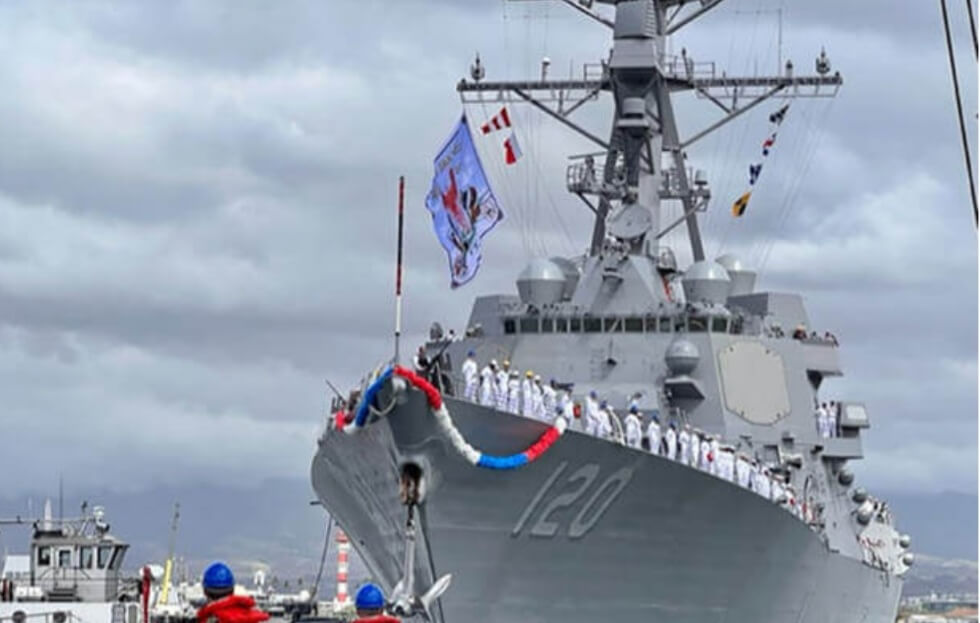
Shown arriving at Joint Base Pearl Harbor-Hickam, Hawaii, on Aug. 7, 2023, the USS Carl M. Levin was named after a longtime senator from Michigan who championed veterans’ rights. (Lt. Autumn Estrada/U.S. Navy photo)


Hello, fellow Navy supporters and enthusiasts! Today, I want to share with you an amazing story about the newest Navy destroyer, the USS Carl M. Levin, and its unique and awesome battle flag. If you are a fan of pirates, sea monsters, and phoenixes, you will love this story!

Who is the USS Carl M. Levin?
The USS Carl M. Levin is an Arleigh Burke-class guided missile destroyer that was commissioned on June 26, 2023, in Baltimore, Maryland. It is the 76th destroyer of its class and the first Navy ship to be named after the late Senator Carl Levin, who served in Congress for 36 years and was a longtime champion of the military and defense affairs. He was also a strong advocate for veterans’ rights, fiscal responsibility, bipartisanship, and the repeal of “Don’t Ask, Don’t Tell”. He died in 2021 at age 87.

The USS Carl M. Levin arrived at its homeport of Joint Base Pearl Harbor-Hickam, Hawaii, on August 7, 2023. It is assigned to the U.S. Pacific Fleet and will conduct missions in support of the U.S. national security interests and the Free and Open Indo-Pacific strategy.

What is the battle flag of the USS Carl M. Levin?
The battle flag of the USS Carl M. Levin is a stunning and striking design that features a fearsome pirate ship, a legendary sea monster, and a mythical phoenix. It was designed by Damage Controlman 3rd Class Hector Mendoza, who was inspired by telling his nieces about his job in the Navy as a pirate. He said he wanted to design a “pretty badass battle flag to display for everyone to see”.

The pirate ship represents the heritage and history of sailing the seven seas as a Navy sailor. The kraken, a large and terrifying sea creature of yore, symbolizes the power and might of the Navy and its ability to destroy any enemy that threatens it. The phoenix, the ship’s mascot, rises out of the destruction, symbolizing how the crew will persevere through any hardships or challenges.

The battle flag also pays tribute to the ship’s namesake and his home state. In the lower left corner, there is an ivory gavel that marks Levin’s 36 years of service in Congress and his role as the chairman of the Senate Armed Services Committee. In the lower right corner, there is the Michigan flag that honors Levin’s home state and his connection to the Great Lakes region.

Why is the battle flag important?
The battle flag is important because it reflects the identity and spirit of the ship and its crew. It shows their pride, courage, resilience, and dedication to their mission and their nation. It also shows their respect and gratitude for their namesake and his legacy. It also adds some flair and fun to their arrival at port.

The battle flag is also part of a growing tradition in the Navy of flying unique and creative flags on newly commissioned warships. Some examples of other Navy warships’ battle flags are:

• The USS John S. McCain flies a flag that features a silhouette of its namesake senator giving a thumbs-up gesture and his motto “Country First”.

• The USS Michael Monsoor flies a flag that depicts a Medal of Honor ribbon and a trident, honoring its namesake Navy SEAL who sacrificed his life to save his teammates in Iraq.

• The USS Rafael Peralta flies a flag that shows a pair of crossed rifles and a helmet with a bullet hole, commemorating its namesake Marine who used his body to shield his comrades from a grenade in Iraq.

• The USS Paul Ignatius flies a flag that displays a pair of crossed swords and a pair of wings, symbolizing its namesake secretary of the Navy’s service as both an Army officer and an Air Force pilot.

What do you think?
I hope you enjoyed this story about the USS Carl M. Levin and its battle flag. I think it is a great example of how the Navy celebrates its history, culture, and heroes through its ships and flags. I also think it is a great way to show our support and appreciation for our Navy sailors who serve our country with honor and excellence.

What do you think? Do you like the design and meaning of the battle flag? Do you have any other favorite Navy warships’ battle flags? Do you have any suggestions or ideas for future battle flags? Please share your thoughts and opinions in the comments section below. I would love to hear from you!

Thank you for reading this blog post and for following #AmericansforaStrongerNavy. Stay tuned for more updates and stories about our Navy and its amazing ships and sailors. Until next time, stay safe and stay Navy!

Source: [Military.com]

Safeguarding Seas and Shores: A New Era of Naval Leadership

Admiral Samuel Paparo

Introduction

As the winds of change sweep across the oceans, the United States Navy remains a steadfast anchor of security and peace. The recent recommendation of Admiral Samuel Paparo, a seasoned naval officer with extensive experience in the Indo-Pacific, as the next Chief of Naval Operations marks an exciting evolution in the Navy’s leadership. This appointment reaffirms the Navy’s commitment to fortifying its presence in key maritime regions, ensuring the security and prosperity of America and its allies. With Paparo’s imminent leadership, the Americans for a Stronger Navy find an ally who reflects the very core of our mission.

Summary

Admiral Samuel Paparo, who has built an illustrious career as a naval aviator and a strategist, has been recommended for the position of the next Chief of Naval Operations. With over 6,000 flight hours in Navy fighter jets and deep understanding of the Indo-Pacific, Admiral Paparo is poised to provide visionary leadership. His nomination showcases the Navy’s unwavering dedication to safeguarding our seas and shores, while upholding the values cherished by the Americans for a Stronger Navy.

The Man of the Hour: Admiral Samuel Paparo

A Pennsylvania native and a Villanova University graduate, Admiral Samuel Paparo was commissioned into the Navy in 1987. He’s not just a seasoned aviator, but also a TOPGUN graduate, having logged more than 6,000 flight hours and 1,100 aircraft carrier landings. His previous postings include commander of naval forces in the Middle East and director of operations at U.S. Central Command in Florida. His experience makes him an ideal choice for this vital position.

Why Indo-Pacific Matters

The Indo-Pacific region holds immense geopolitical significance. With growing global tensions, the Navy’s role in maintaining stability and ensuring freedom of navigation is critical. Admiral Paparo’s vast experience in the Indo-Pacific equips him with the understanding necessary to navigate the intricacies of this region.

The Path to Confirmation

While Admiral Paparo’s nomination comes highly recommended by Defense Secretary Lloyd Austin, it awaits formal sign-off by President Joe Biden. The nomination process has encountered roadblocks due to disagreements in the Senate over unrelated policies. However, Admiral Paparo’s credentials make him a strong candidate.

Key Takeaways

Stalwart Leadership for Turbulent Times

Admiral Paparo’s nomination as the Chief of Naval Operations reinforces the importance of strong and experienced leadership in turbulent geopolitical times. His appointment can significantly influence the Navy’s strategies in the Indo-Pacific and beyond.

Emphasis on Indo-Pacific Region

His expertise in the Indo-Pacific underscores the region’s importance in U.S. maritime strategy. This signifies a commitment to ensuring security and stability in an increasingly contested space.

Conclusion

The waves of the future are upon us. With Admiral Samuel Paparo at the helm, the U.S. Navy is poised to sail into this new era with confidence and strength. As proud members of the Navy community and citizens who understand the significance of a robust naval force, let’s rally behind our servicemen and women. Support the Americans for a Stronger Navy, engage in our mission, and let’s ensure that the guardians of our seas continue to protect and prevail. Together, we can make the oceans the heralds of peace.