Abstract
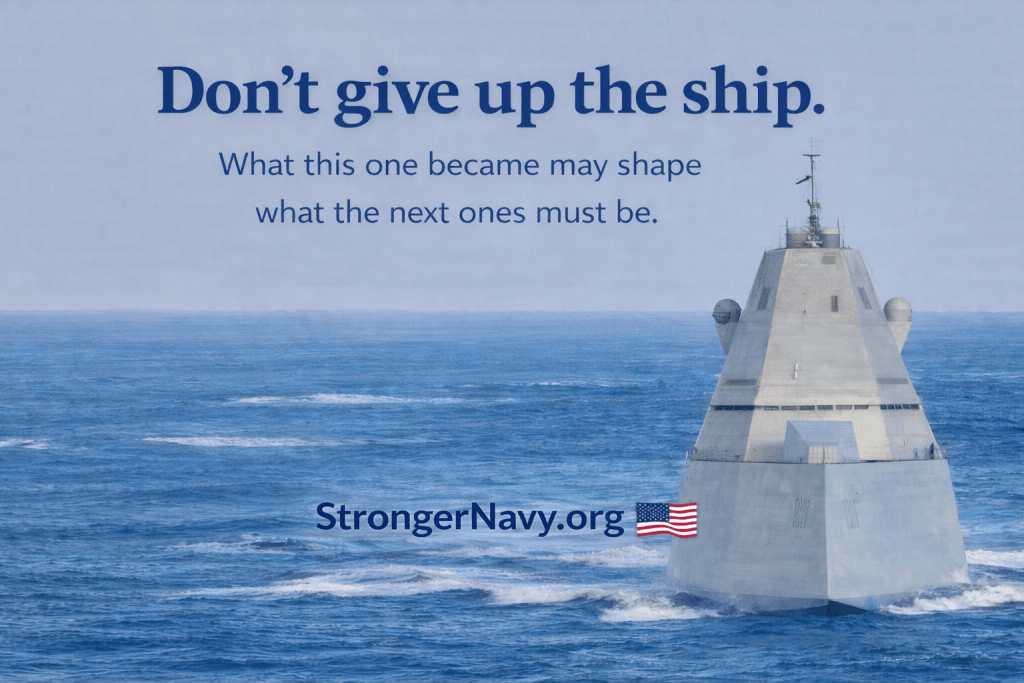
USS Zumwalt has returned to sea after one of the most radical ship conversions in modern naval history. Its guns are gone. In their place: the Conventional Prompt Strike (CPS) hypersonic weapon system. On the surface, this looks like a story about cutting-edge weapons and futuristic warfare. But the deeper story is about something far more important for Americans to understand: how naval power is evolving from platforms to systems—and how design decisions, industrial capacity, and national alignment determine whether innovation becomes usable combat power.
This is not just a story about a destroyer. It is a story about whether the United States can adapt fast enough to a changing era of warfare.
What Actually Happened
After entering the yard in 2023, Zumwalt was taken out of the water, structurally modified on land, stripped of its twin 155mm Advanced Gun Systems, and rebuilt to host large-diameter launch infrastructure for hypersonic missiles. Builder’s sea trials in January 2026 validated propulsion, power generation, hull integrity, and ship systems after this extraordinary redesign.
This was not a maintenance period. This was a repurposing of a warship’s entire combat identity.
The Navy took a class originally built for precision naval gunfire support and turned it into the first surface ship designed to deliver hypersonic strike.
That decision tells us a lot.
Why This Matters Beyond the Headlines
Hypersonic weapons are impressive. Speeds above Mach 5. Maneuverability. Minimal warning time. Ability to penetrate advanced defenses.
But the more important question is this:
What does it take to put a weapon like this to sea?
The answer is uncomfortable.
It required removing the original mission.
It required structural redesign.
It required years in the yard.
It required extraordinary industrial effort.
It required a ship with unusual power capacity and internal space.
In other words:
You can’t just bolt hypersonics onto any ship.
You need design margin.
You need electrical power.
You need internal volume.
You need shipyards capable of radical modification.
You need a Navy and an industrial base that can adapt.
That is the real story.
A Ship as a System, Not a Platform
For years, Americans have been taught to think of naval strength as “how many ships we have.”
Zumwalt shows the flaw in that thinking.
Naval power is not a hull count.
It is whether your ships can evolve when the fight changes.
This ship was able to change because of how it was originally designed:
- Integrated electric propulsion
- Excess power generation
- Internal growth space
- Signature management for survivability
Most of our fleet does not have that kind of design margin.
And that is where this story becomes national.
The Hidden Constraint No One Talks About
Hypersonic missiles are huge.
The launchers are huge.
Magazine depth is limited.
This is not a “volume of fire” weapon. It is a high-impact, precision, strategic signaling weapon.
Which means the value of Zumwalt is not how many missiles it carries.
The value is what it does to an adversary’s planning.
A mobile, hard-to-target, forward-deployed ship that can strike time-sensitive targets with almost no warning from unpredictable sea locations forces an adversary to defend everything.
That is naval maneuver used as a weapon.
And that is a concept most Americans have never been taught.
What Others Will Focus On
Many analysts will talk about:
- The cost of the Zumwalt program
- The failure of the original gun system
- Whether hypersonics belong at sea
- Magazine limitations
- Strategic signaling risks
All valid discussions.
But they miss the bigger lesson.
The question is not whether Zumwalt was worth it.
The question is whether we are designing today’s ships so they can adapt tomorrow.
Because wars between major powers are not decided by what we start with.
They are decided by what we can modify, replace, and evolve after the fighting begins.
Why Americans Should Care
This story is about far more than a destroyer.
It is about:
- Shipyard capacity
- Industrial skill
- Design philosophy
- Electrical power margins in ships
- Flexibility in fleet architecture
- The ability to change missions without building a new class of ship
That is national strength.
That is governance.
That is whether budgets, priorities, and industry are aligned with the realities of modern warfare.
Most Americans think innovation happens in labs.
Zumwalt shows that innovation must be built into the steel of ships years before it is needed.
Implications for the Navy
The Navy now has proof that:
- Large-scale mission conversion is possible
- Integrated electric ships have enormous future value
- Hypersonic strike can be distributed across surface platforms
- Ship design margin is not a luxury—it is a warfighting requirement
The remaining two Zumwalts will follow.
But the real question is whether future ship classes are being designed with this lesson in mind.
Implications for Our Allies
Allies watching this are learning something important:
The U.S. Navy is not just adding new weapons.
It is learning how to adapt existing platforms into new roles.
That flexibility is a form of deterrence.
Because it signals that the fleet they see today is not the fleet they will face tomorrow.
The Governance Lesson Hiding in Plain Sight
This did not happen because of a single weapon.
This happened because:
National will → budgets
Budgets → priorities
Priorities → ship design
Ship design → adaptability
Adaptability → readiness
That chain is what turns technology into combat power.
Break that chain anywhere, and innovation stays on paper.
The Bigger Takeaway
USS Zumwalt is no longer a story about a controversial ship.
It is now a case study in how naval power must be built for change.
And that is a lesson Americans need to understand if we want a Navy that can fight—and adapt—in the decades ahead.
Because the future of naval warfare will not be decided by what ships were built to do.
It will be decided by what they can become.
That’s why we launched Charting the Course: Voices That Matter — a 24-part educational series breaking down how we got here, what went wrong, and what must happen next. Our goal is simple: educate the public, connect the dots, and build the support needed to close the readiness gap before it’s too late.
Let’s roll.