
I want to give a huge shout-out to CDR Salamander for consistently providing the “intel” that helps advocates like us stay informed. We are all part of this maritime endeavor, and the more we learn, the stronger our Navy becomes.
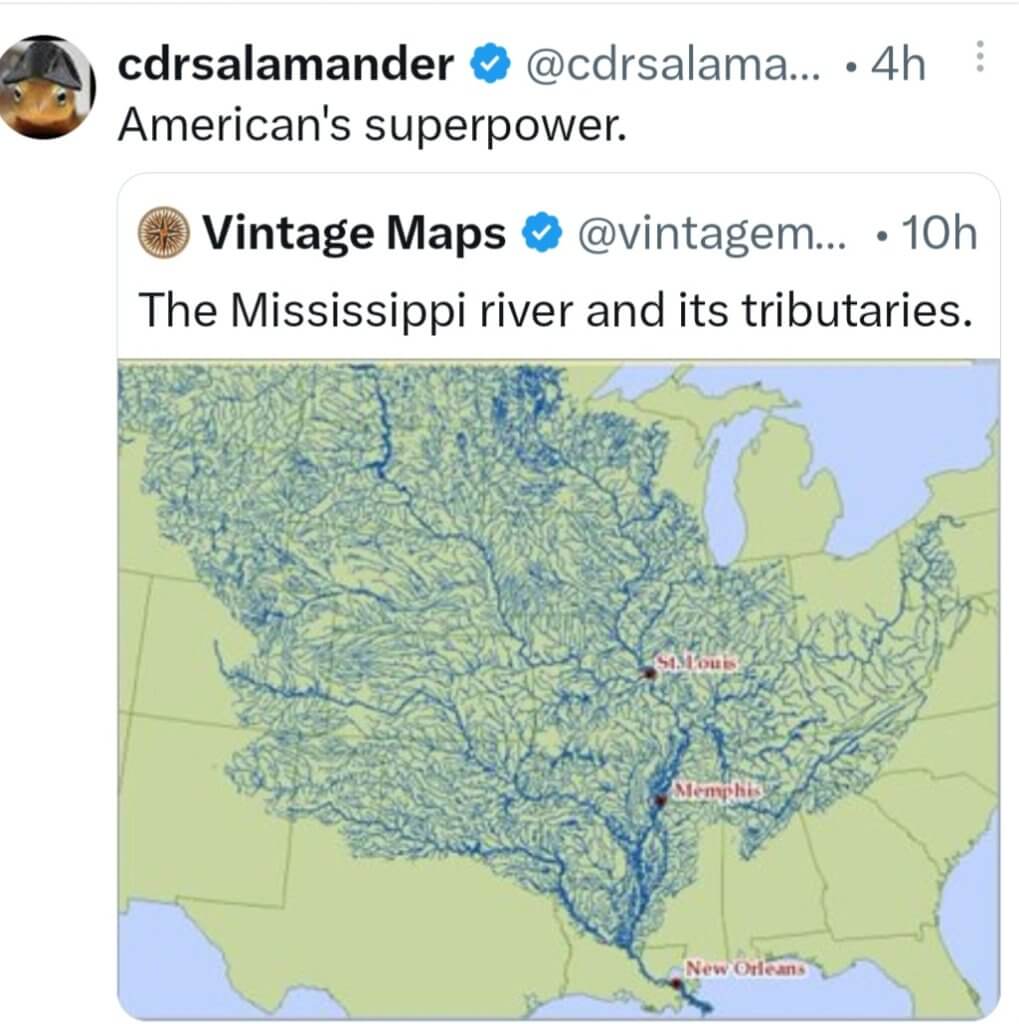
A recent post of his was just a simple image: a map of the Mississippi River and its tributaries. Two words above it: “America’s superpower.”
No explanation. No thread. Just a map.
But for anyone who understands naval logistics, industrial capacity, and how wars are actually sustained, that image says more than a thousand white papers.
This is not a river map. This is a national supply chain diagram.
The Bench That Wins Wars
Wars are not won by the best starting lineup. They are won by the deepest bench.
The Mississippi River system connects:
- Farms to factories
- Mines to mills
- Rail to ports
- The American heartland to the sea
From Minnesota to Louisiana, from Pittsburgh to New Orleans, this inland waterway network moves grain, steel, coal, petroleum, chemicals, machinery, and countless other goods at a scale and efficiency no rail or highway system can match.
Long before most Americans ever think about ships, fleets, or carriers, this river system is quietly doing the work that makes naval power possible.
This is the bench.
Why This Matters to Naval Power
The U.S. Navy does not exist in isolation. It is supported by a vast civilian industrial ecosystem that begins far inland.
Shipyards require steel.
Steel requires ore and energy.
Factories require raw materials and transport.
Ports require cargo to move.
That cargo comes from here.
This river system is why the United States was able to mobilize so rapidly during World War II. It is why American industry could surge production. It is why America became a maritime power before most Americans even realized we were one.
You cannot understand American sea power without understanding this map.
Geography Is Destiny
Other nations build ports.
America inherited a continent designed for logistics.
The Mississippi and its tributaries create a natural internal highway system that feeds directly into the Gulf of Mexico and global sea lanes. It is an unmatched geographic advantage that has quietly powered American prosperity and military capability for over a century.
This is strategic geography in its purest form.
Why Americans Should Care
Most Americans think naval strength begins with ships and sailors.
It doesn’t.
It begins with rivers, rail, roads, ports, trades, factories, and supply chains. It begins with civilian infrastructure that allows the Navy to exist at scale.
If this system weakens, naval power weakens.
If this system thrives, naval power thrives.
Understanding this connection is essential if Americans are to understand what it really means to support a Stronger Navy.
Implications for the Navy
The Navy’s strength is tied directly to the health of:
- Inland logistics networks
- Industrial capacity
- Shipbuilding trades
- Port infrastructure
- Maritime commerce
When we talk about the industrial base, we are talking about this map.
When we talk about sealift, replenishment, and sustainment, we are talking about this map.
When we talk about readiness, we are talking about this map.
Implications for Our Allies
America’s ability to project power and keep sea lanes open for our allies is made possible by this inland capacity. Our partners rely on the stability created by U.S. naval presence, and that presence is supported by the economic engine that flows down these waterways.
This is not just an American advantage. It underwrites global stability.
Seeing the Whole System
CDR Salamander’s simple post is a reminder that naval power is a system, not a platform.
A fleet is the visible tip.
This river system is the foundation beneath it.
The more Americans understand this connection, the more clearly they can see why supporting maritime infrastructure, shipbuilding, and industrial resilience is not optional—it is essential.
That’s why we launched Charting the Course: Voices That Matter — a 24-part educational series breaking down how we got here, what went wrong, and what must happen next. Our goal is simple: educate the public, connect the dots, and build the support needed to close the readiness gap before it’s too late.
Let’s roll.