

There’s a concept every naval planner understands but few Americans realize – one that I’ve come to appreciate over time: the decisions we make today about shipbuilding, maintenance, and industrial capacity don’t affect today’s Navy – they determine what Navy we’ll have seven to ten years from now.
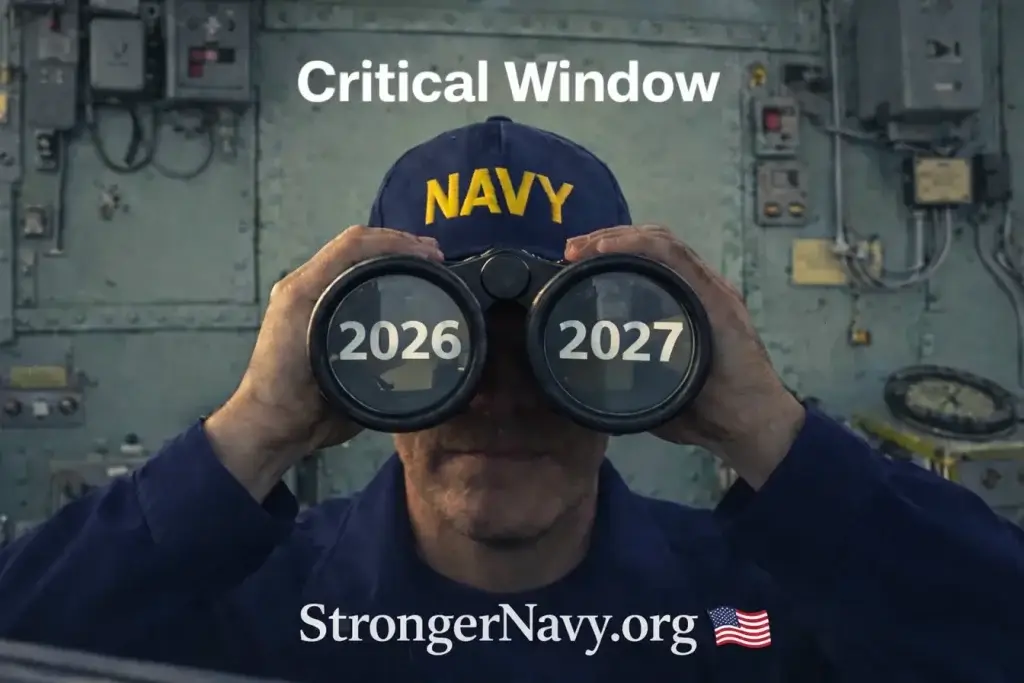
This creates what I call the Critical Window – a concept familiar to anyone who’s managed large-scale projects. It’s that narrow period when decisions made now lock in outcomes years down the line. For shipbuilding, budget decisions, industrial investments, and strategic commitments made in 2026-2027 will directly shape our naval capabilities in the 2030s.
After this window closes, the die is cast. The industrial base will be committed. The budgets will be locked in. The ships – or the absence of ships – will be determined by choices we’re making right now.
Why 2026-2027 Is The Critical Window
The mathematics of naval construction are unforgiving:
Attack submarines take 7-8 years from contract award to delivery. A Virginia-class submarine ordered in FY2027 enters the fleet in 2034-2035.
Surface combatants take 4-5 years to build. An Arleigh Burke-class destroyer funded in FY2027 delivers in 2031-2032.
Shipyard expansions take 3-4 years to become operational. Capacity investments made in FY2027 start producing results in 2030-2031.
Columbia-class ballistic missile submarines require 7+ years and are consuming enormous portions of the shipbuilding budget through the end of this decade.
This isn’t abstract policy planning – it’s industrial reality. You cannot surge naval capability. You cannot speed up physics, metallurgy, or the skilled workforce required to build nuclear-powered warships.
What Makes This Window “Critical”
Several factors converge to make 2026-2027 uniquely consequential:
The Big Beautiful Bill Timeline: The $150 billion defense investment passed in July 2025, including $29 billion for shipbuilding, is one-time funding available through 2029. By 2027, Congress must decide whether to sustain these investments with recurring appropriations or let them lapse.
The 2030s Capability Gap: Multiple studies project the Navy falling below required force structure in the early 2030s as older ships retire faster than new ones are built. Decisions made in the next two years determine whether that gap widens or closes.
The China Pacing Challenge: China’s shipbuilding capacity far exceeds America’s. They’re building ships faster than we are. The gap between their naval growth and ours widens with each passing year we fail to accelerate production.
The Industrial Base Constraint: U.S. shipyards operate near capacity. Expanding that capacity requires multi-year investments in facilities, equipment, and workforce. The window to make those investments for 2030s production is now.
The Commission Opportunity: The National Commission on the Future of the Navy becomes operational in 2026 with public input phase in Q2. This represents a once-in-a-generation chance to reshape naval policy – but only if the recommendations translate to budget action in the 2026-2027 cycle.
Looking Through The Binoculars: What We See In The 2030s
Imagine standing in 2026 with binoculars, looking ahead to the 2030s. What you see depends entirely on decisions being made right now:
If we maintain current trajectory:
2030: Total battle force ships decline as retirements outpace deliveries
2032: Attack submarine fleet reaches minimum viable numbers as Los Angeles-class boats age out
2034: Surface combatant fleet continues shrinking despite occasional new construction
2035: China’s navy substantially larger than projected, exploiting our constrained shipbuilding
If we use the Critical Window wisely:
2030: Shipyard expansions funded in 2026-2027 come online, increasing production capacity
2032: Accelerated submarine production from 2026-2027 decisions begins delivering boats
2034: Sustained surface combatant procurement maintains credible presence in Indo-Pacific
2035: Industrial base investments enable increased production to match strategic requirements
The difference between these futures is being decided in congressional markup sessions happening in the next 18 months.
What The Critical Window Requires
Using this window effectively demands specific actions:
Budget Commitments: Moving beyond one-time supplemental funding to sustained, recurring appropriations that match strategic requirements. The Big Beautiful Bill provided a down payment. The FY2027 and FY2028 budgets must demonstrate commitment to sustaining those investments.
Industrial Base Investment: Funding shipyard expansion, workforce development, and supply chain resilience now so capacity exists in 2030-2032 when we need it. This includes dry dock capacity, skilled labor training, and critical component manufacturing.
Acquisition Reform: Streamlining procurement processes to reduce the time from budget authorization to ship delivery. Every month shaved off construction timelines is a month of capability gained in the 2030s.
Strategic Clarity: Defining force structure requirements based on geography and mission (First Island Chain denial defense, for example) rather than arbitrary ship count targets. This enables informed debate about what capabilities we actually need.
Alternative Funding Mechanisms: Exploring revenue streams beyond traditional appropriations to supplement and sustain naval modernization. The strategic environment requires creative approaches to the recurring funding challenge.
From Experience: The Hollow Navy and The Reagan Response
I served during the 1970s hollow Navy – ships that couldn’t deploy, maintenance deferred, readiness compromised. I witnessed what happens when strategy documents promise capabilities that budgets don’t deliver.
I also witnessed the Reagan administration’s response: a commitment to rebuild the Navy to 600 ships, backed by sustained funding year after year. That wasn’t just rhetoric – it was budget authority, industrial investment, and political will sustained across multiple budget cycles.
The lesson from that era is clear: You can’t sprint to naval power. You build it methodically, year after year, with sustained commitment and adequate resources.
The 1980s rebuild succeeded because leaders recognized their Critical Window and acted decisively within it. They understood that decisions made in 1981-1983 would determine what Navy existed in 1990. They were right.
We face the same choice now. The decisions Congress makes in 2026-2027 will determine what Navy exists in 2034-2036. The question is whether we’ll demonstrate the same foresight and commitment.
The One-Time vs. Recurring Challenge
The Big Beautiful Bill represented important progress – $150 billion in defense investment including significant naval funding. But one-time money, no matter how substantial, doesn’t solve recurring requirements.
Consider the mathematics:
The Big Beautiful Bill funds 16 ships through 2029. That’s important, but it’s one-time construction.
Annual shipbuilding requirements for credible Indo-Pacific presence: significantly higher, sustained indefinitely.
Munitions stockpiles: The Big Beautiful Bill provides $25 billion for initial procurement. Maintaining and replenishing forward-deployed munitions: ongoing annual cost.
Shipyard maintenance and workforce: One-time capacity investments help, but sustaining that capacity requires recurring funding.
The Critical Window challenge is transitioning from one-time surge funding to recurring appropriations that sustain naval power year after year.
What Happens If We Miss This Window
The consequences of inaction during the Critical Window are predictable and severe:
By 2030: Fleet size continues declining as older ships retire. Shipyard capacity remains constrained. Industrial base struggles with irregular funding and uncertain demand.
By 2032: Attack submarine fleet reaches critical shortfall. Surface combatant numbers insufficient for distributed operations across Indo-Pacific. China’s naval advantage widens substantially.
By 2035: The gap between strategic requirements and available capability becomes undeniable. Political pressure to “do something” leads to crash programs, but the physics of shipbuilding mean no quick fixes exist.
By 2037-2040: Ships ordered in response to the crisis begin delivering – but by then, a decade has been lost. China has exploited the window of American naval weakness. Allies have made accommodations. The strategic landscape has shifted against U.S. interests.
This isn’t speculation – it’s the mathematical consequence of ignoring shipbuilding timelines and industrial capacity constraints.
The Commission’s Role in The Critical Window
The National Commission on the Future of the Navy represents a unique opportunity within the Critical Window. The Commission’s public input phase in Q2 2026 allows Americans – veterans, policy experts, industry leaders, and concerned citizens – to shape recommendations that could influence the crucial FY2027 and FY2028 budgets.
But only if those recommendations translate to action. The Commission’s value lies not in producing another study that sits on a shelf, but in generating specific, actionable proposals that Congress can incorporate into budget authority during the Critical Window.
Americans for a Stronger Navy will be engaging actively with the Commission to ensure the naval community’s voice is heard and that recommendations address the urgent timeline challenges we face.
What You Can Do During The Critical Window
The Critical Window isn’t just a timeline for policymakers – it’s a call to action for everyone who cares about American naval power and national security:
For veterans and advocates:
Understand that 2026-2027 budget decisions determine 2030s capabilities – this is when your voice matters most
Engage with congressional representatives now, during budget markup season
Submit testimony to the Commission on the Future of the Navy during public input phase
Use the Critical Window framework in conversations: “The ships we fund this year determine what Navy we have in 2034”
For congressional staff and policymakers:
Recognize that normal budget cycle thinking doesn’t apply to naval construction – today’s choices have 7-10 year consequences
Ask Pentagon witnesses to explain industrial timelines and capacity constraints
Demand analysis of what 2030s fleet looks like based on current budget trajectory
Explore alternative funding mechanisms that create sustainable revenue streams
For defense journalists and analysts:
Connect current budget debates to future capability outcomes
Report on shipyard capacity and industrial base constraints as strategic issues
Hold officials accountable for explaining how current plans achieve stated objectives
Track whether Big Beautiful Bill investments are being sustained or allowed to lapse
For concerned citizens:
Understand that naval power isn’t built overnight – it requires sustained commitment
Ask candidates and elected officials about their plans for sustaining naval investment
Recognize that “peace through strength” requires backing rhetoric with budget authority
Support proposals that create sustainable funding for naval modernization
The Bottom Line
The Critical Window of 2026-2027 is closing. The decisions made in the next 18 months – in congressional budget committees, in Pentagon planning sessions, in Commission hearings, in public debate – will determine what Navy America has in the 2030s.
We cannot change the physics of shipbuilding. We cannot compress the timeline for industrial expansion. We cannot pretend that one-time funding solves recurring requirements.
What we can do is recognize this moment for what it is: a narrow window of opportunity to make choices that will echo through the next decade.
The 1970s hollow Navy taught us what happens when we defer hard decisions. The Reagan 600-ship rebuild taught us what’s possible when we act decisively within our Critical Window.
The question for 2026 is simple: Which lesson will we apply?
Peace through strength isn’t a slogan – it’s a sustained commitment to matching resources with strategic requirements, year after year, beginning right now.
The binoculars are focused on the 2030s. What we see there depends on what we do here, in 2026-2027, during the Critical Window.
Americans for a Stronger Navy advocates for naval transparency, readiness, and strategic policy development. We provide credible, non-partisan analysis connecting naval power to American security and prosperity.
Learn more: StrongerNavy.org
Follow the Commission: National Commission on the Future of the Navy
The Critical Window is now. The time to act is today.

