The Navy’s future gets decided in the next four months. Not in a speech, not in a hearing — in a conference committee most Americans have never heard of, deciding whether $350 billion actually gets spent on American shipyards or gets quietly stripped out before anyone notices.
Here’s what’s happening, and what we’re asking you to do about it.
What’s Actually at Stake
The FY27 NDAA — the annual bill that funds the military — carries the core pieces of the SHIPS for America Act inside it. Right now, the House and Senate versions don’t match, and a small group of lawmakers in a conference committee will decide which pieces survive, get watered down, or disappear entirely. That includes funding that could total up to $350 billion for shipbuilding, and a proposed Select Committee for Maritime Industrial Revival — a dedicated congressional body to keep this problem from falling through the cracks the way it has for decades.
None of that happens automatically. Bills this size get shaped by who shows up — and right now, the loudest voices in Washington on this issue are the lobbyists paid to slow it down.
Three Things You Can Do Right Now
1. Call your rep before the NDAA conference.
Use our Contact Your Representative tool to find your member of Congress and reach their office directly. Tell them you want the shipbuilding provisions kept in the final NDAA — not traded away in conference.
2. Back the Select Committee for Maritime Revival.
Congress created single-purpose committees before when the stakes demanded it. Shipbuilding capacity — the thing that decides whether America can surge sealift in a crisis — deserves the same standing attention, not a rotating cast of committees that each own a slice of the problem and none of the whole picture.
3. Make Congress pass the $350B.
This isn’t a blank check — it’s the difference between shipyards with the capacity to build and shipyards limping along on year-to-year funding fights. Tell your rep this number matters, and that “we’ll get to it next year” isn’t good enough anymore.
Why Now
Conference committees move fast and mostly out of public view. By the time a compromise bill becomes public, it’s usually too late to change it. The next four months are the window — not because we’re saying so, but because that’s how the calendar actually works this year.
Part 1 of 4 in our series, “Six Weeks That Decide the Fleet: September 24 to November 9 — what happens to a fee meant to protect American shipyards.”
What This Series Covers
– How a 2024 labor petition turned into a real trade penalty on Chinese shipping — and why it barely survived a week
– Who’s financially backing the fight to kill that penalty, and what’s separately been reported about that same company
– What to watch for when President Trump hosts Xi in Washington on September 24
– What the people actually building ships and running unions told Congress this month, in their own words
– What happens on November 9 — the day the fee’s one-year suspension runs out
Where Things Stand, Briefly
For readers who want the fuller picture: three years in, there’s real progress and real gaps. On the plus side — an executive order creating a national maritime strategy, a $65.8 billion Navy shipbuilding request for FY2027, and a new submarine-component factory in Alabama already producing parts. On the other side — the U.S.-flagged oceangoing fleet actually shrank to 178 ships last year, the Maritime Security Trust Fund still isn’t law, and the industrial base has lost up to 40% of its waterfront facilities over two decades. Read the full three-year accounting →
A fee designed to protect American shipbuilding jobs lasted six days before someone made it disappear. This is the story of who did it, and why it should bother you even if you’ve never thought about a shipyard in your life.
Three years ago, we started asking a simple question: who pays for American naval readiness? Congress. Taxpayers. Shipyard workers who show up at 5am to weld hulls in the summer heat. That question is the whole reason Americans for a Stronger Navy exists.
This year we learned there’s a second question hiding behind the first one: who pays to make sure we never have to.
Two facts below are worth reading side by side. We’ll let you draw your own conclusion.
Let’s walk through it.
The Fee Nobody Remembers Was Labor’s Idea
This didn’t start in Washington. It started with the people who actually weld the hulls.
In March 2024, five American labor unions — not a think tank, not a senator, not us — petitioned the U.S. Trade Representative to investigate China’s dominance of global shipbuilding.[1] They’d watched it happen up close for years: American shipyards closing, skilled jobs disappearing, an entire industrial base hollowing out while China built ships by the hundreds. Nobody in Congress had acted on it yet. The workers went first anyway.
USTR agreed there was a real problem, opening a Section 301 investigation — a legal process the government uses to investigate unfair foreign trade practices. By early 2025, nearly a year after the unions first raised the alarm, the investigation confirmed what they’d been saying all along: China’s practices were “unreasonable” and burdened U.S. commerce.[2] The remedy: a modest port fee on Chinese-built and Chinese-operated vessels calling at U.S. ports — money that would help fund the rebuilding of America’s own shipbuilding capacity.[3]
The fees took effect October 14, 2025. Six days later, at a summit in South Korea, they became a bargaining chip.[4] By November 10, they were suspended for a full year — paused at $0, with the scheduled 2026 rate increase simply never happening.[5]
Two senators, one from each party, have since asked the obvious question: what exactly did the United States get in exchange for giving that leverage away?[6] As of this writing, nobody in the administration has given them a straight answer.
Who Wanted the Pause
We already knew part of this story. Our 2025 Navy year-in-review documented over $3 million in lobbying spent fighting the SHIPS for America Act and the fees meant to fund it — six times what was spent supporting it.[7] The National Retail Federation alone spent $2.27 million. The American Apparel & Footwear Association, the Consumer Technology Association, the Travel Goods Association, and the U.S. Chamber of Commerce rounded out the list.
What we didn’t know then was how organized that campaign actually was. In March 2025, NRF and the Retail Industry Leaders Association — joined by more than thirty other organizations — jointly commissioned an economic study designed to make the case to USTR that the fees would hurt American consumers.[8] Their own words: “U.S. businesses and consumers will take the brunt of these service charges… many, if not all, of the leading ocean carriers capable of meeting U.S. shipping needs use Chinese-built vessels in their fleets.”
Read that sentence again. Their argument for keeping shipping cheap is that America has become so dependent on Chinese-built ships that we can’t afford to stop being dependent on them.
The Part Nobody’s Said Out Loud
Here’s what we found that nobody else has connected: the same interests fighting these fees include the company the fees were written to counter.
Companies are legally required to disclose who pays them to lobby the government — public paperwork anyone can look up. Those U.S. Senate filings show COSCO — China Ocean Shipping Company — and China Shipping Group are named directly, by address and by percentage of ownership, as the entities behind the World Shipping Council’s American lobbying activity.[9] Not a shell. Not an inference. Their names are on the federal paperwork, filed through two U.S. law and government-relations firms: Cozen O’Connor Public Strategies, and Shamrock Maritime Consultants.
In April 2025, Maritime Executive ran a headline that should have gotten more attention than it did: “Shipping Industry Joins with China Calling for U.S. to Reconsider Port Fees.”[10] The World Shipping Council’s objections and Beijing’s official objections were, functionally, the same argument, published within days of each other.
What Kind of Company Is Paying for This
Separately: just over a week ago, the Foundation for Defense of Democracies reported that COSCO uses concealed equipment aboard its own ships to intercept U.S. military communications near American coastlines.[11] The Pentagon put COSCO on its list of companies linked to the Chinese military back in January 2025.[12] Chinese law requires companies like COSCO to support state intelligence work whether they want to or not.
We’re not going to tell you what to make of those two facts sitting next to each other. Americans can draw their own conclusions.
What Wasn’t Said at Hudson
On September 16, the Hudson Institute hosted senators, industry, and labor to talk through the SHIPS Act’s path forward. Heritage’s Brent Sadler raised Chinese state shipping as an espionage vector, in general terms.[13] Sen. Todd Young described, without naming anyone, an uncomfortable conversation with congressional colleagues who wouldn’t answer whether they were comfortable continuing to route cargo through Chinese-owned shipping companies given what’s now known about tracking and targeting systems aboard some of those vessels.[14]
Nobody drew the line all the way through. Nobody said: the resistance you’re describing has a name, an address, and a line item on a federal disclosure form.
We’re Not Anti-Business. We’re Pro-Paying-Your-Share.
We’ve said from the start that this isn’t about picking a fight with retailers or the shipping industry. Companies are allowed to lobby for their interests — that’s how the system works, and we’re not interested in relitigating that.
What we’re saying is simpler than that: here are the facts, here’s who’s named on the paperwork, and here’s what’s been separately reported about that same company. Judge for yourself what it means that they line up the way they do.
The Clock
The fee suspension expires November 9, 2026. That’s the next real decision point — not a hearing, not a letter, an actual expiration date with a binary outcome: reinstate, extend, or let it lapse further.[5]
There’s an earlier date worth watching first. On September 24 — 46 days before that expiration — President Trump hosts Xi Jinping in Washington for their second summit of the year. The first time these two men met at a summit, the port fees became a bargaining chip within six days.[4] The Heritage Foundation’s own pre-summit brief argues this meeting should be judged by whether China shows “measurable progress on its previous commitments,” not by how many new deliverables get announced.[16] We’d add the obvious corollary: that standard should apply to what the United States gives up, too.
If the port fee comes up again on or around September 24 — as a “goodwill gesture,” a “de-escalation step,” or anything else dressed up as diplomatic progress — that won’t be a new development. It will be the same pattern repeating, with the same question still unanswered: what did the first suspension buy us?
Sen. Mark Kelly put the underlying stakes plainly at Hudson: 400 U.S. oceangoing ships during Desert Storm. Eighty today.[15]
Three years in, we’ve learned who’s supposed to pay for rebuilding the fleet. This year we learned who’s paying, quietly, to make sure that never happens.
Next in “Six Weeks That Decide the Fleet”: what to watch for when Trump hosts Xi in Washington on September 24 — and whether the same trade happens twice.
References
[1] Petition to USTR, five national trade unions, March 12, 2024, cited in Clyde & Co, “USTR Section 301 Fee and Tariff Measures and Their Impact to Charterparties.”
[2] USTR, Section 301 investigation determination, January 16, 2025.
[3] Federal Register, “Notice of Action and Proposed Action in Section 301 Investigation,” April 23, 2025.
[4] White House Fact Sheet, November 1, 2025; Hellenic Shipping News, “US-China Port Fee Truce.”
[5] Federal Register, “Notice of Modification of Section 301 Action,” November 13, 2025.
[6] Sens. Mark Kelly and Elizabeth Warren, letter to USTR Ambassador Jamieson Greer, June 2026.
[7] Americans for a Stronger Navy, “2025 U.S. Navy Year in Review — Follow the Money: Who’s Fighting Against American Shipyards.”
[8] Textile World / National Retail Federation, “Retailers Submit Comments In Opposition To USTR Shipping Remedies Proposal,” March 24, 2025.
[9] U.S. Senate Lobbying Disclosure Act filings, Cozen O’Connor Public Strategies and Shamrock Maritime Consultants, LLC, client World Shipping Council.
[10] Maritime Executive, “Shipping Industry Joins with China Calling for U.S. to Reconsider Port Fees,” April 18, 2025.
[11] Foundation for Defense of Democracies, “Yes, China’s State-Owned Shipping Giant Is Spying on the United States,” September 9, 2026.
[12] U.S. Department of Defense, list of companies linked to the Chinese military, January 2025.
[13] Hudson Institute, “Fixing Shipping and Shipbuilding: Plotting the Course Ahead,” September 16, 2026.
[14] Ibid.
[15] Ibid.
[16] Andrew Harding, “Xi Comes to Washington: Expectations for the Trump-Xi Summit,” The Heritage Foundation, September 9, 2026.
Ask most people following naval policy what’s happening with the Ships for America Act, and you’ll get a confident answer. Ask a second person, and you’ll often get a different one—not because either is wrong, but because “the Ships for America Act” isn’t one bill anymore. It’s four, moving on four different tracks, with four very different odds of becoming law. Even close observers conflate them.
That confusion isn’t a footnote. It’s the story—and it reveals a fundamental truth about how naval policy is won or lost in Congress.
The Reality of Legislative Fragmentation
Complex national security policy rarely moves in a single, neat package. To survive Capitol Hill, broad policy visions get carved up to fit whatever legislative doors are open:
The Core SHIPS for America Act (NDAA Track): By folding key fleet expansion provisions into the must-pass FY27 National Defense Authorization Act (NDAA), lawmakers gave the core vision institutional momentum heading into the Senate conference.
The FLEETS Now Act (Standalone Track): Focused on maritime diplomacy and allied coordination, this standalone effort faces steep legislative odds without a major annual defense vehicle carrying it forward.
The Ready Reserve Force Modernization Accountability Act (Senate Track): A targeted companion bill addressing the nation’s aging military sealift fleet, moving along its own distinct procedural path.
The Shipbuilding Investment and Workforce Act (Ways & Means Track): Because House rules prohibit tax-code modifications inside a defense authorization bill, essential capital investment credits and workforce incentives had to be split into a separate revenue bill.
None of this is scandalous; it’s standard legislative mechanics. But when complex maritime strategies fracture across different committees—Armed Services, Ways & Means, Transportation & Infrastructure—it creates a massive messaging gap for advocates. A citizen calling their representative to “support the Ships for America Act” during NDAA conference is taking the right action for one piece, but leaving tax incentives, workforce programs, and sealift readiness completely unaddressed.
Beyond Four Bills: Tracking the Issues That Matter
This challenge extends far beyond a single legislative package. Rebuilding American maritime power requires sustained focus across four core operational pillars:
Sealift & Reserve Readiness: Tracking the age, operational availability, and crew readiness of the Ready Reserve Force and domestic merchant fleet.
Dedicated Funding Mechanisms: Following structural proposals like Maritime Security Trust Funds and capital tax credits that end damaging boom-and-bust budget cycles.
Allied Maritime Cooperation: Monitoring frameworks that coordinate shipbuilding, repair capabilities, and diplomacy with international partners to counter peer competition.
When policy breaks apart across Capitol Hill, grassroots energy usually breaks with it. Winning requires tracking not just the intent of a bill, but the procedure driving it.
A Job for a Committee, Not a Comment Section
Following this ecosystem across two chambers, five committees, and a shifting calendar rewards patience and consistency over expertise. It is work that single reporters or think tanks cannot easily sustain—but it is precisely the gap an organized network of volunteers can close.
StrongerNavy.org is establishing a Volunteer Legislative & Policy Tracking Committee. We aren’t building a team of lobbyists; we’re mobilizing citizens willing to check Congress.gov, monitor committee markups, and help translate dense legislative movements into plain-language monthly updates.
By assigning volunteers to monitor specific pieces of the maritime puzzle, we turn confusing Capitol Hill mechanics into clear, targeted action—showing supporters exactly when, where, and to whom a phone call or letter matters most.
No single volunteer needs to master the entire defense budget. The power is in numbers, consistency, and plain English. If you want to help ensure great maritime policies become enacted law rather than missed opportunities, join us.
Reach out and sign up at StrongerNavy.org.
Americans for a Stronger Navy advocates for a modern, capable fleet capable of deterring conflict and protecting American interests worldwide. Learn more at StrongerNavy.org.
Today is National Maritime Day — May 22 — and for the first time since Richard Nixon sat in the Oval Office, there is genuine presidential attention on reviving America’s maritime and naval power. A 30-year Navy shipbuilding plan. Executive orders. Legislative proposals. And now, a compelling call from one of Washington’s sharpest naval analysts for the President himself to break the legislative logjam.
The vision is finally taking shape. The ambition is real. But a bold maritime revival still has a critical gap at its center: how do you sustain it?
Sadler’s TRUMP Act: The Right Diagnosis
On May 20 — two days before National Maritime Day — Brent Sadler, Senior Research Fellow at The Heritage Foundation’s Allison Center for National Defense, published a powerful op-ed in The Washington Times calling for President Trump to invoke his constitutional authority under the Recommendation Clause (Article II, Section 3) to personally propose legislation to Congress.[1]
Sadler’s argument is straightforward: the SHIPS for America Act — a bipartisan, bicameral bill first introduced in December 2024 — has stalled in Congress. Again. Presidential sponsorship, he argues, is the only force capable of breaking that logjam before Congress heads into summer recess and political attention fractures.
He proposes calling it the Transformative Revival and Urgent Maritime Program — the TRUMP Act. The branding is deliberate, and Sadler knows exactly what he’s doing.
His three modifications to the existing SHIPS Act framework are sound:
Adjusted incentives for workforce and shipbuilding infrastructure reinvestment
Regulatory relief through Maritime Prosperity Zones to accelerate industrial investment
A new Maritime Department consolidating the Coast Guard, MARAD, FMC, and NOAA into a unified commercial maritime revival body
“More navel-gazing in Washington is unacceptable. With Congress’ summer recess fast approaching, national political attention will shift from bipartisan endeavors, such as a national maritime revival, to vote-seeking.” — Brent Sadler, The Washington Times, May 20, 2026 [1]
He’s right. And the constitutional argument is well-constructed. James Madison’s Federalist No. 47, FDR’s first 100 days, Eisenhower’s Congressional Relations office — Sadler lays the groundwork for a president who likes to move fast.
Notably, Sadler elaborated further on the Lunch Hour Podcast this week, framing the entire challenge as an engineering problem first, a business problem in the middle, and an engineering problem again at the end. On the Jones Act debate consuming Washington, he was direct: the real problem is that “leadership and industry have not had the appropriate focus or incentive structures.”[2] That is a precise diagnosis — and it points directly to the gap this article addresses.
The Navy’s 30-Year Plan: The Ambition Is There
Sadler’s op-ed lands against a significant backdrop. On May 11, the Navy published its 2026 Shipbuilding Plan — a 30-year vision for what it calls the “Golden Fleet.”[3] The fiscal year 2027 request alone is $68.5 billion, a 57 percent increase over the prior year.[4]
The plan explicitly acknowledges what advocates have been saying for years: decades of inconsistent demand and misaligned priorities left the fleet smaller, the shipyards atrophied, and American workers facing unacceptable risk.[3] Executive Order 14269, “Restoring America’s Maritime Dominance,” and the February 2026 Maritime Action Plan are cited as the catalyst for a long-overdue reindustrialization.[3]
That’s the right framing. The harder question is whether the funding architecture can sustain the ambition across political cycles.
The Pier Review: Even Navalists Are Sounding the Alarm
On the same day Sadler published his TRUMP Act proposal, the Center for Maritime Strategy — the Navy League’s policy arm — released a landmark 141-page report titled Pier Review: Leveraging the Allied Maritime Industrial Base for U.S. Shipbuilding.[5] Authored by a team including Steve Wills, Admiral James Foggo, and Nick Weising, with a foreword by 77th Secretary of the Navy Kenneth Braithwaite, the report delivers a sobering conclusion: the United States cannot rebuild its maritime industrial base alone.
The Pier Review examined allied shipbuilding nations — South Korea, Italy, Canada, Sweden, and the United Kingdom — and returned with a frank assessment. The domestic industrial base is so severely hollowed that a bridge strategy involving allied yards, allied supply chains, and allied skilled workers may be necessary while American capacity is rebuilt.
These are not critics of American seapower. These are its most dedicated advocates. That they felt compelled to reach this conclusion is itself a measure of how deep the hollowing runs.
The Pier Review cites Canada’s National Shipbuilding Strategy as the model worth emulating — a multi-decade, consistent demand signal that ended the boom and bust cycle and gave the industrial base something durable to build around. The report calls for the United States to create a similar structure.
What neither the Pier Review nor the TRUMP Act provides is the funding mechanism that makes that structure mandatory and durable across administrations. That is the gap the SEAS Act is designed to close.
The Sustainability Gap No One Is Talking About
Here is what every current maritime proposal — the SHIPS Act, the TRUMP Act, the 30-year plan — has in common: they are all dependent on annual congressional appropriations. Fund it one year, gut it the next. That is precisely the cycle that produced the hollow fleet we are now trying to rebuild.
The last time sustained naval investment actually worked was 1982 to 1992 — a decade of consistent political will, consistent funding, and consistent production signals to the industrial base. Shipyards plan in decades, not fiscal years. They hire and train workforces over years, not budget cycles. The industrial base doesn’t respond to hope or headlines. It responds to durable, multi-year demand signals it can build a business around.
Presidential legislation — even landmark presidential legislation — does not by itself solve that problem. A bill passed in one Congress can be defunded by the next. The SHIPS Act stalled once. The TRUMP Act, if passed, could face the same gravitational pull the moment political attention shifts, a budget fight erupts, or a new administration arrives with different priorities.
That is the sustainability gap. And it is the one gap that no current proposal directly addresses.
The SEAS Act: Closing the Sustainability Gap
The Strategic SEAS Act — Shipbuilding Economic Acceleration and Security Act — is designed to do precisely that.
Rather than competing for annual appropriations against entitlements, healthcare, and every other priority in the federal budget, the SEAS Act proposes a 2 percent Strategic Technology Responsibility Contribution from U.S. companies with significant revenue from China operations, directed into a dedicated Naval Modernization account.[6]
This is a structural funding mechanism, not a budget line item. It creates the kind of durable, mandatory investment signal that the shipbuilding industrial base can actually plan around — the modern equivalent of the sustained commitment that made 1982 to 1992 work, and the American answer to the Canadian model the Pier Review recommends.
The logic behind the contribution is grounded in history. The “Triple Whammy” — the End of History complacency after 1989, the responsible stakeholder framework that opened WTO access in 2001, and the mass migration of American corporate manufacturing to China — created the conditions for naval hollowing.[7] American companies that benefited from that migration helped create the problem. The SEAS Act creates a mechanism for them to contribute to the solution.
Sadler himself named the core problem on the Lunch Hour Podcast: the wrong incentive structures. The SEAS Act corrects that — not through legislation alone, but through a mandatory funding architecture that changes the calculus permanently.
Former House Select Committee on China Chairman Mike Gallagher documented the PRC’s systematic exploitation of U.S. export control gaps and argued that Commerce consistently prioritized industry revenue over national security.[8] Palantir’s “The Technological Republic” — currently a national conversation — makes a parallel argument about Silicon Valley’s moral debt to the hard power that underwrites its commercial freedom.[9]
The SEAS Act turns that argument into a funding architecture.
National Maritime Day 2026: Vision Needs Architecture
Brent Sadler is right that presidential action is needed, and the constitutional case he makes is compelling. The TRUMP Act framework — if it moves — will be the most significant maritime legislation in a generation. The Pier Review is right that the industrial base crisis is deep and requires a generational commitment to fix.
But a generational commitment cannot be built on an annual appropriation. The 30-year shipbuilding plan requires a 30-year funding architecture. Presidential legislation opens the door. The SEAS Act keeps it open regardless of which party controls Congress or who sits in the Oval Office.
National Maritime Day has a theme each year. This year’s should be simple: build the vision, build the architecture to sustain it.
The SEAS Act is not a competitor to Sadler’s proposal or the Pier Review’s recommendations. It is the missing piece that makes them last.
Americans for a Stronger Navy will continue to advocate for all three pillars: the presidential legislative action Sadler rightly calls for, the allied cooperation framework the Pier Review recommends, and the structural funding mechanism that makes both durable. That is the complete architecture a generational maritime revival requires.
References
[1] Brent D. Sadler, “National security demands that White House act on maritime legislation,” The Washington Times, May 20, 2026.
[2] Brent D. Sadler, Lunch Hour Podcast with Andrew Langer, May 2026.
[3] U.S. Navy, 2026 Shipbuilding Plan, May 11, 2026.
[4] “U.S. Navy unveils 30-year plan to rebuild American shipbuilding,” The Washington Times, May 12, 2026.
[5] Matt Reisener, ed., Pier Review: Leveraging the Allied Maritime Industrial Base for U.S. Shipbuilding, Center for Maritime Strategy, Navy League of the United States, May 2026. Foreword by Secretary of the Navy Kenneth J. Braithwaite.
[6] Americans for a Stronger Navy, Strategic SEAS Act framework, StrongerNavy.org.
[7] Americans for a Stronger Navy, “The Triple Whammy,” StrongerNavy.org.
[8] House Select Committee on the Chinese Communist Party, Export Control Enforcement Reports, 2023–2024.
[9] Alex Karp and Nicholas Zamiska, The Technological Republic, 2025.
“We strongly encourage other nations whose economies depend on the strait far more than ours to come and help us.”
Those are President Trump’s words. Not a think tank analyst. Not a naval advocacy group. The President of the United States, standing in the White House, publicly demanding that the nations who benefit most from American naval protection start paying their share.
He’s right. And there’s already a legal framework to make it happen.
The Strongly Worded Letter
On March 19, 2026, twenty nations issued a joint statement condemning Iran’s closure of the Strait of Hormuz. Britain. France. Germany. Japan. South Korea. Canada. Twenty signatures. Strong language. Zero ships.
The statement expressed “readiness to contribute to appropriate efforts to ensure safe passage.” France and Germany were more direct — any coalition would only form after a ceasefire. The German chancellor said he would only join a mission with an international legal mandate, and only after the fighting stopped.
Meanwhile, American sailors — some at sea more than 250 days — are doing it now.
This is not a new pattern. It is the defining pattern of post-Cold War burden-sharing. Allies sign statements. America sends ships. The bill goes to the American taxpayer.
What’s Actually at Stake
The Strait of Hormuz is not a regional waterway. It is the world’s most critical energy chokepoint. Roughly one-fifth of global oil supply passes through it daily. Since Iran’s effective closure began on February 28, tanker traffic has dropped by approximately 70 percent. Over 150 ships anchored outside the strait rather than risk transit. Oil crossed $100 a barrel.
Then Iran struck Qatar’s Ras Laffan LNG facility — the world’s largest. QatarEnergy reported extensive damage. Their CEO said repairs would take three to five years. This is not a temporary disruption. The economic consequences will be measured in years, not weeks.
Who depends on that oil?
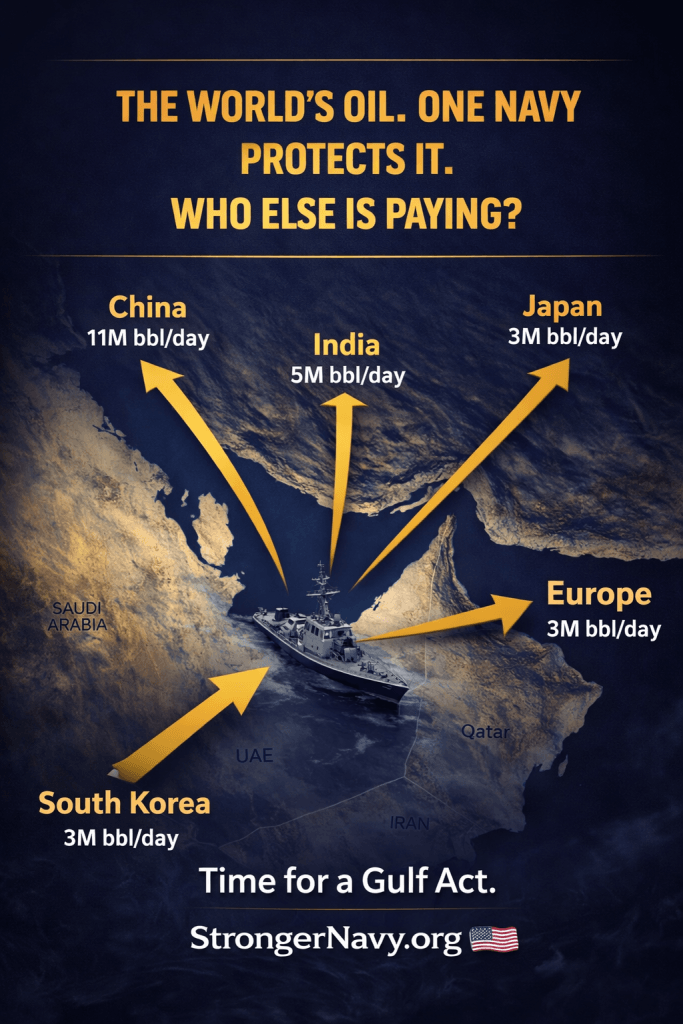
China imports approximately 11 million barrels per day through Gulf sea lanes secured by the U.S. Navy. India imports 5 million. Japan 3 million. South Korea 3 million. Europe 3 million. Japan gets 95 percent of its crude oil from the Gulf. South Korea is similarly dependent.
One navy keeps it flowing. Ours.
The Precedent Already Exists
This is not uncharted territory. The beneficiary-pays principle has been established twice in living memory.
In 1987, Kuwait paid the United States Navy to escort their tankers through the Persian Gulf during the Iran-Iraq tanker war. Operation Earnest Will established a clear precedent: nations that benefit from U.S. naval protection of their commercial interests contribute to the cost of that protection.
In 1991, Japan paid $13 billion toward Operation Desert Storm. Japan did not send combat troops. Japan wrote a check. The Special Measures Agreement made the burden-sharing arrangement formal and documented.
The precedent exists. What is missing is a permanent, mandatory mechanism.
The Gap in the Framework
Every crisis produces a new round of negotiations, statements, and voluntary contributions — or the lack thereof. The 1987 model worked because Kuwait had a direct and immediate interest in the outcome. The 1991 model worked because Japan faced intense diplomatic pressure and the threat of real consequences.
Neither model is durable. Neither model is predictable. Neither model builds the naval industrial base that sustained forward presence requires.
The current Hormuz crisis will eventually resolve. The Iranian threat will recede, or be defeated, or be negotiated away. And when it does, the allied nations who signed that joint statement will declare victory, go home, and resume importing Gulf oil on America’s dime.
Until the next crisis. When the cycle repeats.
The Gulf Act: If You Benefit, You Contribute
Americans for a Stronger Navy has proposed the Gulf Maritime Protection and Burden Sharing Act — the Gulf Act — as a permanent legislative solution to a permanent structural problem.
The Gulf Act establishes a mandatory burden-sharing mechanism requiring nations that benefit from U.S. naval protection of Gulf sea lanes to contribute to the cost of that protection. It is grounded in the 1987 Earnest Will precedent and the 1991 Desert Shield/Desert Storm Special Measures model. It codifies what has previously been left to ad hoc diplomacy and presidential pressure.
The core principle is straightforward: if you benefit, you contribute.
This is not isolationism. It is not a withdrawal from global leadership. It is the application of a basic fairness principle that the American people already understand instinctively. You don’t get to import millions of barrels of oil through a strait secured by American sailors — some of whom haven’t seen their families in eight months — and sign a statement saying you’ll help out after the shooting stops.
The Window Is Now
President Trump has made burden-sharing a front-page issue. The Hormuz crisis has made the stakes visible to every American who has filled a gas tank in the last month. The National Commission on the Future of the Navy is examining the structural questions underlying American naval power.
This is the moment to move from principle to legislation.
The strongly worded letter had twenty signatories. The Gulf Act needs one vote.
Learn more at StrongerNavyDotOrg.
References
[1] Axios, “Seven U.S. allies back potential Strait of Hormuz coalition,” March 19, 2026. https://www.axios.com/2026/03/19/strait-hormuz-coalition-allies-statement-uk
[2] Wikipedia, “2026 Strait of Hormuz crisis,” accessed March 24, 2026. https://en.wikipedia.org/wiki/2026_Strait_of_Hormuz_crisis
[3] Al Jazeera, “European nations, Japan to join ‘appropriate efforts’ to open Hormuz Strait,” March 19, 2026. https://www.aljazeera.com/news/2026/3/19/european-nations-japan-to-join-appropriate-efforts-to-open-hormuz-strait
[4] Naval News, “The challenges of securing Hormuz as 6 nations issue joint statement,” March 2026. https://www.navalnews.com/naval-news/2026/03/the-challenges-of-securing-hormuz-as-6-nations-issue-joint-statement/
[5] GOV.UK, “Joint statement from the leaders of the United Kingdom, France, Germany, Italy, the Netherlands, Japan, Canada and others on the Strait of Hormuz,” March 19, 2026. https://www.gov.uk/government/news/joint-statement-from-the-leaders-of-the-united-kingdom-france-germany-italy-the-netherlands-and-japan-on-the-strait-of-hormuz-19-march-2026
[6] Operation Earnest Will / Special Measures Agreement, 1987. Historical record.
[7] Desert Shield/Desert Storm burden-sharing agreements, Japan Special Measures, 1991. Historical record.
1. The “Five-Day Reprieve”: Trump Postpones Strikes In a major de-escalation move today, President Donald Trump announced a five-day extension on his deadline for Iran to reopen the Strait of Hormuz. Citing “very good and productive” conversations involving intermediaries, the President has instructed the Department of War to postpone planned strikes on Iranian power plants and civilian energy infrastructure.
* The Market Reaction: Global oil prices dropped nearly 10% following the announcement as markets reacted to the potential for a “total resolution” of hostilities. * The Catch: The President noted that the pause is “subject to the success” of ongoing meetings throughout the week.
2. USS Gerald R. Ford (CVN 78) Sabotage Investigation The USS Gerald R. Ford arrived at Souda Bay, Crete, today for emergency repairs. However, the focus has shifted from a simple fire to a formal criminal inquiry. * The Investigation: Investigators are formally examining whether the 30-hour laundry room fire on March 12 was an act of internal sabotage. One theory suggests industrial dryers were intentionally overloaded to trigger the blaze. * Crew Impact: The fire destroyed the ship’s laundry capability and displaced over 600 sailors from their berths. To provide relief, the Navy successfully airlifted 1,000 mattresses from the future USS John F. Kennedy (CVN 79).
3. Long-Range Escalation: Diego Garcia Targeted Over the weekend (March 21), Iran demonstrated a previously unrevealed long-range capability by firing two ballistic missiles at the joint U.S.-U.K. base at Diego Garcia. * The Defense: The strike covered a distance of approximately 2,500 miles (4,000 km), double Iran’s previously claimed 2,000 km limit. One missile failed mid-flight, and the second was successfully intercepted by a U.S. Navy Aegis destroyer. * Significance: This marks Iran’s first operational use of an Intermediate-Range Ballistic Missile (IRBM), confirming they can now reach high-value U.S. logistics hubs far outside the Middle East.
4. “Lightning Carrier” Arrival: USS Tripoli (LHA 7) The amphibious assault ship USS Tripoli and the 31st Marine Expeditionary Unit (MEU) are expected to take up station in the North Arabian Sea within the next 24 hours. * The Mission: Carrying over 2,200 Marines and F-35B stealth fighters, the Tripoli provides a flexible “raid” capability. Despite the diplomatic pause, this force is positioned to forcefully reopen the Strait or conduct maritime interdictions if negotiations fail.
5. Shipbuilding & Fleet Renewal * USS Harvey C. Barnum Jr. (DDG 124): The Navy’s newest Arleigh Burke-class destroyer arrived at its homeport in Norfolk on March 20. It is officially scheduled for commissioning on April 11, 2026. * Budget Boost: Congress has finalized a $27.2 billion shipbuilding budget for FY2026—a $6.5 billion increase over initial requests—to fund 17 new ships, including a Columbia-class ballistic missile sub and two Virginia-class attack subs.
The Navy needs money. Taxpayers are tapped out. So where does the funding come from?
That is not a rhetorical question. It is the defining challenge of American naval policy in 2026. The fleet is shrinking. Shipyards are strained. The gap between what the Navy is asked to do and what it has the resources to do grows wider every year. And the American taxpayer — already carrying an unsustainable fiscal burden — cannot be the answer to every problem.
But there is an answer. It just requires asking who else benefits from American naval power — and whether they are paying their share.
The United States Navy keeps the Persian Gulf open. Every tanker that transits the Strait of Hormuz does so because American sailors, American ships, and American taxpayers back the deterrent that makes it possible.
Japan imports it. South Korea imports it. Germany imports it. The economic engines of our closest allies run on Gulf-sourced petroleum — secured by a Navy they do not fund.
That is not an alliance. That is a subsidy.
We’ve Seen This Before
This is not a new problem. In 1987, Iran began attacking tankers in the Persian Gulf. The Reagan administration launched Operation Earnest Will — the largest naval convoy operation since World War II — reflagging Kuwaiti tankers as American vessels and providing direct Navy escort through waters Japan depended on for survival.
Congress noticed. If the U.S. Navy was protecting Japan’s oil supply, Japan should help pay for it. The pressure produced the first formal Special Measures Agreement in 1987, requiring Japan to contribute to the cost of U.S. forces providing that protection. The principle was established: beneficiaries of U.S. naval protection should contribute to it.
That agreement has been renewed and expanded ever since. The precedent has held for nearly four decades.
The Gap Has Grown
What was true in 1987 is more true today. Gulf oil revenues exceed $350 billion annually. The nations collecting that revenue — and the allies consuming it — benefit from sea lanes the U.S. Navy patrols at a cost of billions per year.
The Navy keeps the sea lanes open. The beneficiaries collect the profits.
Meanwhile, the Navy that provides this service is smaller, older, and more strained than at any point in recent memory. Shipyards are at capacity. The fleet is shrinking. The gap between what the Navy is asked to do and what it has the resources to do grows wider every year.
Allies reliant on Gulf energy are not being asked to share that burden in proportion to their dependence on it.
The Gulf Act: Applying an Established Principle
The Gulf Act is the logical extension of the 1987 burden-sharing framework to the present day. The concept is straightforward: nations that depend on Gulf energy security — and the sea lane access that makes it possible — should contribute meaningfully to the naval forces that provide it.
This is not a radical idea. It is the application of a 35-year-old precedent to a threat environment that has grown more complex, not less.
The mechanisms can take multiple forms — direct contributions to naval operations, minesweeper deployments, escort ship commitments, or financial contributions to a dedicated naval modernization account. The form matters less than the principle: if you benefit, you contribute.
A Note on Why We’re There
Some will argue that the United States has multiple reasons for maintaining a naval presence in the Gulf — and they are right. Security commitments to allies in the region, Iranian nuclear ambitions, freedom of navigation as a global principle, and counterterrorism interests all play a role. The Gulf Act does not dispute any of that.
But those reasons are a separate question from this one: who should pay for the benefit they receive?
The two questions are separable. In 1987, the U.S. had multiple reasons for being in the Gulf too — and Congress still established that Japan, as the primary beneficiary of tanker protection, should contribute to its cost. The Gulf Act asks the same narrow, defensible question: if your economy depends on sea lanes the U.S. Navy keeps open, what is your fair share of that bill?
This is not about relitigating American strategy. It is about making sure the nations that benefit most are not free-riding on the nations that bear the cost.
The SEAS Act Connection
Regular readers will recognize the parallel. The Strategic SEAS Act applies the same beneficiary-pays doctrine to U.S. corporations with significant China operations — companies that helped build the industrial base now threatening American naval superiority should help fund the response.
The Gulf Act and the SEAS Act are two applications of the same governing principle:
Those who extract value from American naval protection should share the cost of providing it.
Whether the beneficiary is an allied nation importing Gulf oil or a Fortune 500 company running supply chains through Chinese ports, the logic does not change.
The Cost of Doing Nothing
If the burden-sharing argument sounds abstract, consider what is happening right now in the Persian Gulf.
According to a Center for Strategic and International Studies estimate cited by Defense One on March 12, 2026, the first 100 hours of Operation Epic Fury cost approximately $3.7 billion — roughly $891 million per day. Air defense munitions costs alone ranged from $1.2 billion to $3.7 billion. [2]
The cost asymmetry is stark. Iran’s Shahed drones cost around $30,000 each. The missiles used to shoot them down — AIM-120s at $1 million, PAC-3 interceptors at $4 million — cost orders of magnitude more. As one defense analyst put it: every cheap drone that forces the U.S. to fire an expensive interceptor is a win for Iran. [2]
Six U.S. soldiers were killed at Port Shuaiba, Kuwait, when an Iranian drone evaded air defenses. Three F-15E Strike Eagles were lost in a friendly fire incident over Kuwait. [2]
Meanwhile, the nations whose energy supplies depend on the Gulf’s sea lanes — Japan, South Korea, Germany — are not bearing these costs. The American taxpayer is.
That is the externality the Gulf Act is designed to correct.
The Question Sadler Asked
Captain Brent Sadler of the Heritage Foundation recently raised this directly in the context of a potential Gulf convoy mission, asking whether it was time for allies dependent on Gulf petroleum to contribute escort ships and minesweepers. [1]
The answer is yes. It has always been yes. The 1987 precedent proved it was politically achievable. The current fiscal and force structure reality — and the live situation unfolding today in the Strait of Hormuz — makes it urgent.
The Navy cannot be the world’s free security service while simultaneously being asked to compete with a Chinese fleet building ships at a rate that dwarfs American production. Something has to give — or someone else has to contribute.
What Comes Next
Americans for a Stronger Navy will be developing the Gulf Act framework in the coming months, including burden-sharing models, historical precedents, and legislative pathways. This post is the opening argument.
If you agree that nations benefiting from American naval protection should help fund it, share this post. The conversation Sadler started on X deserves a longer answer than a tweet.
The sea lanes don’t protect themselves.
— Bill Cullifer, Founder, Americans for a Stronger Navy
References
[1] Brent D. Sadler (@brentdsadler), X (formerly Twitter), March 11, 2026. Captain Sadler serves as a Senior Research Fellow at the Heritage Foundation’s Center for National Defense.
[2] Thomas Novelly, “Fighter jets are downing Iranian drones—a dangerous, expensive mission,” Defense One, March 12, 2026. Cost figures sourced from CSIS estimate and Forecast International report cited therein.
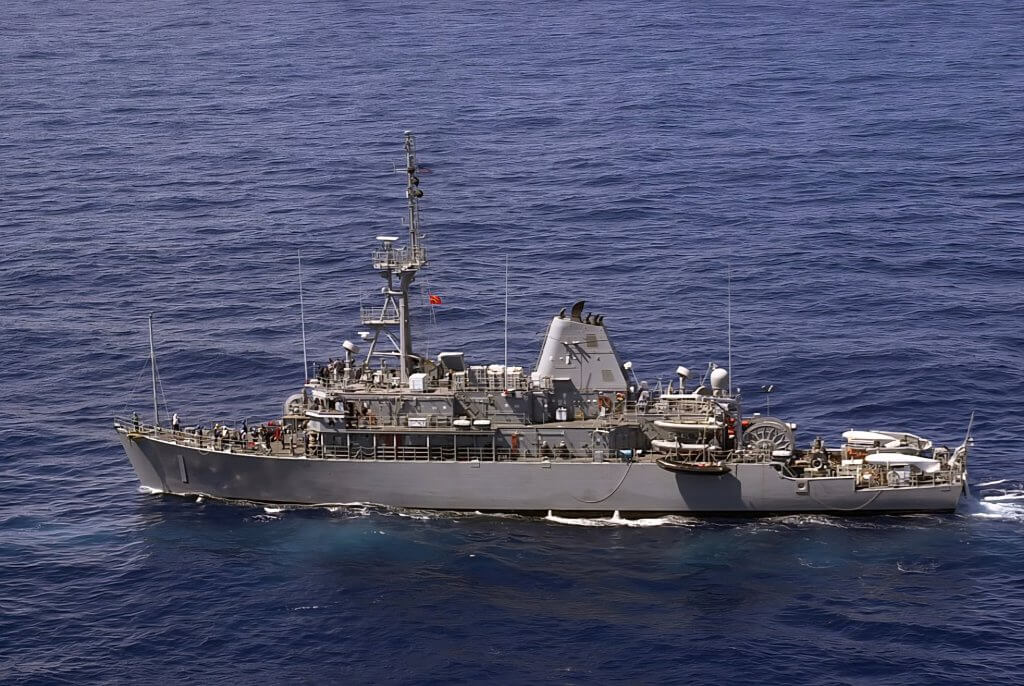
The Mine countermeasure ship USS Avenger (MCM 1) “Old Gaurd” heads out for decommision.
The New Guard: Independence-class LCS as a ‘Mother Ship’
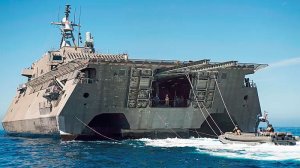
The transition to the Independence-class Littoral Combat Ship (LCS) represents a fundamental shift in naval doctrine. As seen in recent operations, vessels like the USS Canberra (LCS 30) utilize their massive mission bays and stern launch capabilities to act as a command hub for uncrewed systems.
Independence-class LCS deploying surface assets from the mission bay.
Technical Deep Dive: The AN/AQS-20 Sonar
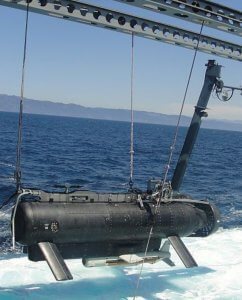
Central to the new MCM Mission Package is the AN/AQS-20 sonar set. Unlike the legacy hull-mounted systems on the Avenger ships, this towed array uses five separate sonar arrays to detect and classify mines in a single pass, providing 3D bottom mapping with high-resolution clarity.
The AN/AQS-20 sonar being prepared for deployment.
A Strategic Evolution
By moving the primary sensors and sweep systems off the manned ship and onto uncrewed platforms, the Navy significantly reduces the risk to sailors. These autonomous systems can operate closer to the threat while the “Mother Ship” remains at a safe standoff distance, ensuring our sea lanes remain open through advanced technology rather than wooden hulls.
Strength at sea now includes protecting the invisible systems that guide global trade.
Electronic warfare is no longer confined to the battlefield. In the days following U.S. and Israeli strikes on Iran, maritime intelligence firms reported that more than 1,100 ships operating in and around the Strait of Hormuz experienced GPS or AIS disruption. Vessels appeared inland on digital maps. Others showed strange circular patterns off the coasts of the United Arab Emirates, Qatar, and Oman. Maritime officials described the risk level in the region as “critical.”
This is what modern conflict looks like.
Not just missiles. Not just drones. Navigation. Commerce. Confidence.
The Strait of Hormuz is one of the most important maritime chokepoints on Earth. Roughly a fifth of the world’s oil moves through that narrow passage. When positioning systems degrade in such a congested, militarized waterway, the risk of collision, grounding, or miscalculation rises sharply. Add aerial threats and naval maneuvering to the equation, and degraded navigation becomes a risk amplifier.
Why Americans Should Care
Most Americans will never sail through the Strait of Hormuz. But they will feel the effects if shipping slows, insurance premiums spike, or energy markets react to instability. Maritime security is economic security. The sea lanes quietly underpin global supply chains, energy flows, and financial stability. When GPS signals flicker in a strategic chokepoint, markets notice.
Electronic interference aimed at navigation systems is not just a military tactic. It directly impacts civilian shipping. Tankers hesitate. Routes change. Traffic patterns compress. The cost of uncertainty ripples outward. In a globally connected economy, those ripples eventually reach American households.
For years, we have warned that maritime chokepoints are soft underbellies in a fragile system. This latest episode underscores that warning. The battlespace now includes the invisible infrastructure of positioning, navigation, and timing.
Implications for the Navy
When commerce comes under electronic pressure, the U.S. Navy becomes the stabilizer. Escort missions, presence operations, surveillance, and deterrence all require ships, crews, logistics depth, and technological resilience. Strength at sea is not abstract. It is measured in hulls, readiness, training, and industrial capacity.
Yet we continue to fund our maritime industrial base through unstable, year-to-year appropriations cycles. We debate ship counts while the underlying architecture remains fragile. Predictable investment is not about expansion for its own sake. It is about reducing systemic risk.
Electronic warfare against commercial shipping highlights the need for redundancy. Redundancy in fleet capacity. Redundancy in basing and logistics. Redundancy in navigation technologies. If GPS can be degraded in one of the world’s most vital trade routes, resilience cannot be optional.
The Case for Predictable Maritime Investment
This moment should not trigger panic. It should prompt clarity.
America’s maritime security underwrites global commerce. Yet the economic beneficiaries of secure sea lanes are not structurally aligned with long-term investment in the maritime industrial base. That mismatch creates vulnerability.
The Strategic Economic Alignment for the Maritime Industrial Base Act, the SEAS Act, is about architecture, not urgency. It seeks to create stability and predictability in funding so that shipyards, suppliers, and maritime infrastructure can plan for the long term. It recognizes that maritime security is foundational economic infrastructure.
If navigation becomes a weapon, then resilience becomes a responsibility.
Strength is built on redundancy. Stability is built on predictability. The events in the Strait of Hormuz are a reminder that modern conflict increasingly targets the connective tissue of commerce. We can either respond episodically, or we can build a durable framework that matches the strategic environment.
At Americans for a Stronger Navy, we believe the American people must understand what is at stake. The Navy belongs to the nation. Its readiness, its resilience, and its industrial foundation require public awareness and engagement.
That’s why we launched Charting the Course: Voices That Matter — an ongoing educational series breaking down how we got here, what went wrong, and what must happen next. Our goal is simple: educate the public, connect the dots, and build the support needed to close the readiness gap before it’s too late.
As a former blue water sailor and founder of Americans for a Stronger Navy, I learned early that naval strength is not defined by speeches or strategies alone. It is defined by readiness—by ships that work, sailors who are trained, and shipyards that can sustain them.
Over the past two years, through Americans for a Stronger Navy and StrongerNavy.org, I have worked to better understand the forces shaping the future of our Navy. What I have discovered is both reassuring and sobering.
Reassuring because the Navy’s leadership clearly understands the changing threat environment. Sobering because serious professionals—inside and outside the Navy—are actively debating how best to prepare for it.
This series is designed to help Americans understand that debate.
A Navy in Transition
The United States Navy is undergoing one of its most significant strategic transitions since the end of the Cold War. For decades, our Navy operated in an environment where it could project power with relative freedom. That era is over.
China now operates the world’s largest navy by ship count and continues expanding its industrial capacity at a pace unmatched in modern times. Russia remains a capable undersea competitor. Meanwhile, unmanned systems, artificial intelligence, and directed-energy weapons are changing how naval warfare may be conducted in the decades ahead.
The Navy’s leadership recognizes this reality. They are adapting strategy, exploring new technologies, and rethinking how naval forces will operate in the future. But within that effort, there are important and healthy debates—and Americans deserve to understand them.
Different Perspectives, Shared Purpose
Some leaders emphasize the continued importance of traditional crewed ships—destroyers, submarines, and aircraft carriers—as the backbone of naval power. Others emphasize the growing role unmanned systems may play in extending reach and enhancing survivability. Still others focus on the industrial foundation that makes both possible: shipyards, maintenance infrastructure, and workforce capacity.
These are not disagreements about the mission. They are discussions about how best to ensure the Navy remains ready, effective, and capable in a changing world. What unites these perspectives is a shared recognition that readiness requires sustained national support.
Ships must be built. Shipyards must be modernized. Sailors must be trained. Infrastructure must be maintained. None of this happens automatically.
Why Industrial Capacity Matters
One of the most important lessons from this work is that naval power is built on industrial strength. Strategy determines what the Navy needs to do. Industrial capacity determines whether it can do it.
Naval Sea Systems Command (NAVSEA), our public and private shipyards, and the skilled workforce that supports them form the foundation of naval readiness. Without their ability to build, maintain, and modernize ships, even the best strategy cannot succeed.
This is not a criticism. It is simply reality—and it is why public understanding matters. Americans deserve to know how their Navy works, what challenges it faces, and what is required to sustain it for future generations.
From Understanding to Sustained Support: The Strategic SEAS Act
Understanding the challenge is the first step. Sustaining readiness over time requires structural solutions.
That is why Americans for a Stronger Navy developed the Strategic SEAS Act—a framework designed to provide predictable, sustained funding for shipbuilding capacity, shipyard modernization, workforce development, and allied maritime infrastructure. Its purpose is straightforward: to help ensure that the Navy and the maritime industrial base have the long-term support necessary to meet national security requirements.
The Strategic SEAS Act complements legislative efforts like the SHIPS Act by addressing a critical question: how to provide sustained, reliable funding to support the Navy’s long-term readiness. Readiness is not built in a year. It is built over decades.
Why This Matters Now
The decisions being made today—about ships, shipyards, technology, workforce, and sustained funding—will define America’s naval strength for the next generation. These decisions are being made now, in budget cycles and legislative sessions that most Americans never see.
Meanwhile, serious questions are being raised by experienced naval professionals, defense analysts, and members of Congress about whether America’s shipbuilding capacity and industrial base can support the strategy at the pace required. Those questions deserve honest, public answers.
This series is intended to provide that clarity—directly, responsibly, and in plain English.
The Questions This Series Will Address
Among them:
• Are traditional ships like destroyers, submarines, and carriers still essential in the age of drones and autonomous systems?
• Can unmanned systems truly enhance naval power—or are they being asked to do too much, too soon?
• Is America’s shipbuilding and repair infrastructure strong enough to sustain the Navy the nation requires?
• What role does Naval Sea Systems Command (NAVSEA) play in ensuring readiness—and what challenges does it face?
• How does America’s shipbuilding capacity compare to China’s—and what does that mean strategically?
• Can the Navy realistically surge its fleet when needed?
• What role do Congress, industry, and the American people play in sustaining naval strength over time?
• And most importantly: what must be done—practically, responsibly, and sustainably—to ensure the United States Navy remains ready to protect American interests for decades to come?
These are not political questions. They are national questions. And Americans deserve clear, honest answers.
Why Americans Should Care
The U.S. Navy protects far more than military interests. It safeguards global commerce, deters conflict, reassures allies, and protects the economic system Americans depend on every day. When the Navy is ready, it helps preserve peace through strength. When industrial capacity declines, readiness becomes harder to sustain.
The decisions being made today will shape America’s naval strength for decades to come. Americans deserve to understand those decisions.
What This 8-Part Series Will Explore
In the weeks ahead, this series will examine why traditional naval ships remain essential, how unmanned systems are changing naval operations, the critical role of NAVSEA and America’s shipyards, the industrial and workforce foundation behind naval readiness, how China and other nations are approaching maritime power, how naval strength is sustained over time, and what must be done to ensure continued readiness.
This is not about choosing sides in a debate. It is about understanding the full picture—because an informed public is essential to sustaining a strong Navy.

 1. The “Five-Day Reprieve”: Trump Postpones Strikes
 Independence-class LCS deploying surface assets from the mission bay.
 The AN/AQS-20 sonar being prepared for deployment.