
Vice Admiral Thomas J. Moore, U.S. Navy (Retired), ran the command that builds and sustains the fleet. As the 44th Commander of Naval Sea Systems Command, he spent more than 20 years in the design, acquisition, and sustainment of the Navy’s CVN fleet — and served as the CNO’s Director of Fleet Readiness for more than three years.
In February 2025, he published one of the most important — and most honest — assessments of American naval power to appear in recent years. The title says it plainly: “A Path to the Navy Force Structure the Nation Needs.”
His thesis is equally plain: “The Navy’s force structure is inadequate because the service has been unable to effectively manage new construction and ship retirements.”
Not China’s fault. Not Congress’s fault. The Navy’s own management failures — documented in detail, with receipts.
What follows is a summary of Moore’s argument, why it matters now more than when he wrote it, and what the Shipbuilding Economic Acceleration and Security (SEAS) Act offers as the funding answer his analysis demands.
Three Self-Inflicted Wounds
Moore identifies three compounding problems — each within the Navy’s control, each making the others worse.
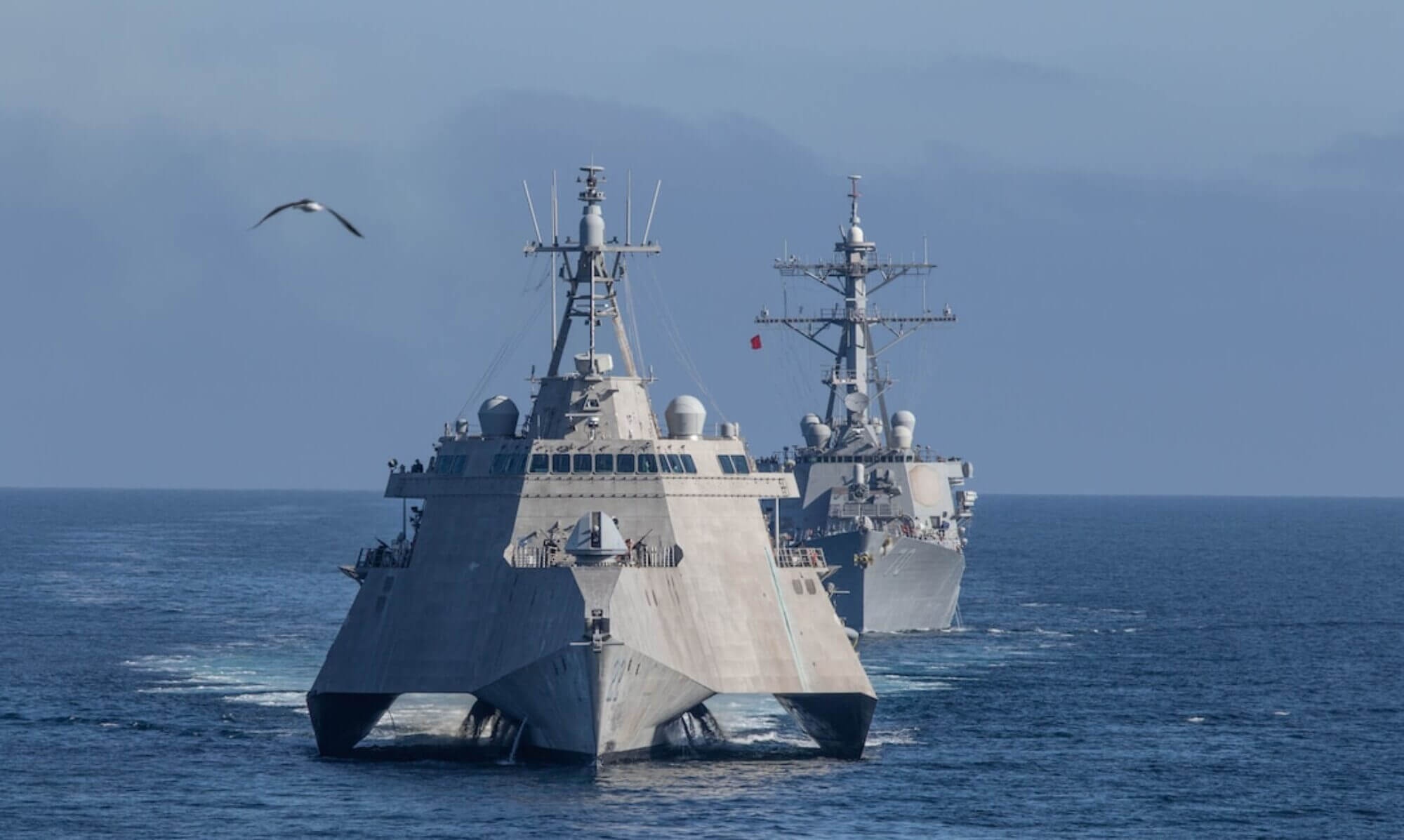
1. An insatiable requirements appetite. The Navy has a persistent pattern of designing ships that are too complex, too expensive, and take too long to build. The Zumwalt-class destroyer is Moore’s primary exhibit — a ship whose cost ballooned so dramatically that the Navy decided to decommission several hulls early, before they had delivered their intended service life. The Gerald R. Ford-class carrier required hundreds of millions in unplanned investment after delivery. The Freedom-class Littoral Combat Ship was decommissioned early. In each case, the Navy’s desire for next-generation capabilities produced platforms that couldn’t be sustained at the numbers the force structure required.
His conclusion: “The fits and starts cannot get to 313, let alone 381 ships.”
2. A workforce the industrial base cannot sustain. This is where Moore’s analysis becomes most specific — and most sobering. From 1993 to 2027, the Navy built an average of just 5.5 ships per year. The industrial base shaped itself around that signal. Growing to the 12 ships per year required to reach 381 ships means growing the skilled shipbuilding workforce by a commensurate amount — and that takes years, not months.
Moore is direct about where the constraint actually lies: the problem is not physical shipyard capacity. It is skilled workers. His highlighted conclusion: the current industrial base does not lack the physical capacity to build the required number of ships annually. What it lacks is a skilled workforce in the numbers needed to meet that increase in demand.
That is a critical distinction. More shipyards don’t solve it. More cranes don’t solve it. Only a stable, predictable, multi-year demand signal — giving industry the confidence to hire, train, and retain the workforce — solves it.
3. Procurement whipsaw. Moore’s Table 1 — Battle Force Ships Procured or Requested, FY1982–FY2028 — is the most damning exhibit in the article. The numbers bounce from 28 ships in a single year down to single digits, back up, down again. Wildly. Decade after decade. His point: a rapid downsizing of shipbuilding creates structural consequences that take 5 to 7 years to reverse. When demand drops, senior workers retire, younger workers leave for other industries, suppliers consolidate or close. The experience and productivity levels needed to support a surge take years to rebuild — far longer than the short-term political signal that caused the drawdown in the first place.
This is the procurement whipsaw. And it has been the dominant feature of American shipbuilding policy for forty years.
The Math Behind 381
Moore’s proposed solution is elegant in its simplicity. Rather than chasing arbitrary ship counts, he proposes building force structure from the bottom up using a “build center” mechanism: divide the required number of ships by service life to determine the steady annual production rate each platform requires. Apply that rate consistently. Give industry a stable and predictable demand 10 to 15 years out.
The resulting force structure requirement — Table 2 in the article — totals 381 ships:
66 fast-attack submarines requiring 2 per year. 87 large surface combatants requiring 2.5 per year. 73 small surface combatants requiring 3 per year. 12 ballistic-missile submarines and 12 aircraft carriers anchoring the deterrent and power projection triad. Amphibious, logistics, and support vessels completing the force.
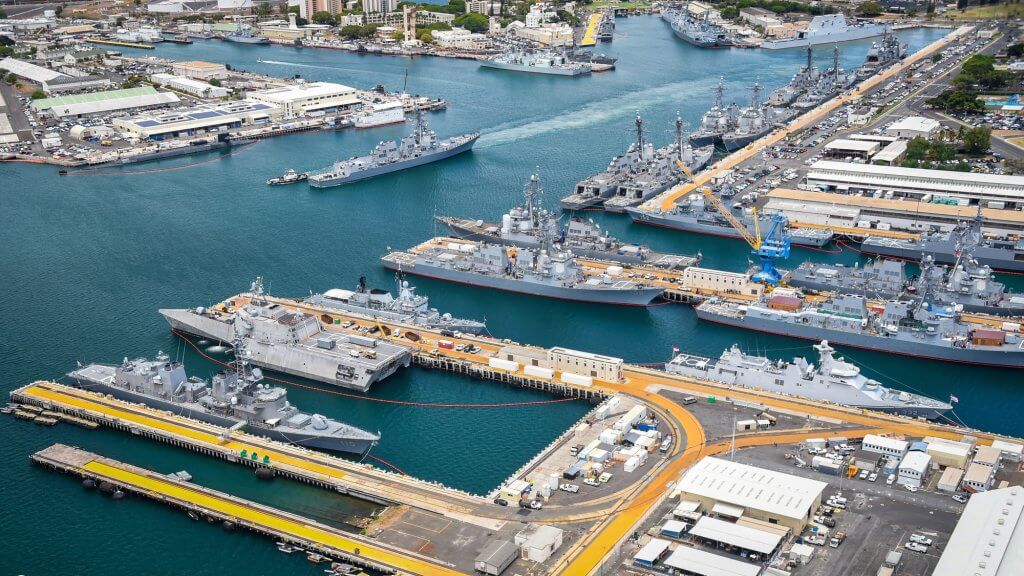
Today’s fleet sits at roughly 291 — below the 325-ship floor identified in the 2016 Force Structure Assessment as the minimum acceptable risk threshold. We are not approaching a gap. We are in one.
The annual shipbuilding budget required: $40 billion. Moore addresses the affordability objection directly and dismisses it:
Some will argue the nation cannot afford $40 billion or more per year for shipbuilding and the attendant costs to operate, maintain, and man the ships. But of course the nation can afford it. It has a multitrillion dollar annual budget and spends far more than $40 billion per year on many things it deems important. The real question is, should the United States do this?
And then the warning that should be on every policymaker’s desk:
The Navy the nation has today is the Navy it will fight with — and it is not big enough. There are parallels to World War II, but unlike in that war, this time the United States will not have the luxury of waiting for industry to catch up in a conflict with China or other adversaries as it did then when labor and large-scale manufacturing facilities were plentiful. The time to start is now.
That is not analysis from a think tank. That is a judgment from the man who ran NAVSEA.
A Lot Has Changed Since He Wrote This. The Gap Hasn’t.
Moore published in February 2025. The policy environment has shifted significantly since then — almost entirely in the direction of validating his urgency while making execution harder.
The FY2027 shipbuilding budget request came in at $68.5 billion — a 57% increase over the prior year. Moore’s $40 billion floor wasn’t an overreach. It was a minimum. The administration confirmed his math and raised it.
The 381-ship goal has since been superseded by the “Golden Fleet” concept — though the full force-level details remain unpublished. Moore’s analysis remains the most precise public accounting of what naval adequacy actually requires.
The Constellation-class frigate — one of the surface combatant programs Moore’s build-rate math depended on — was cancelled in November 2025 after cost overruns made it unsustainable. One more self-inflicted wound, confirming Moore’s requirements appetite diagnosis.
The SHIPS for America Act — the workforce and industrial base legislation Moore’s analysis implicitly requires — has held only one congressional hearing since reintroduction in April 2025. The legislative environment has not caught up to the threat.
And the fleet is still at roughly 291 ships.
Moore Defines the Problem. The SEAS Act Answers It.
Moore’s article diagnoses three problems: requirements creep, workforce collapse, and procurement whipsaw. All three share a common root cause — the absence of a stable, mandatory, multi-year funding signal that industry can plan around.
Annual appropriations cannot solve this. A single large budget request cannot solve this. What Moore’s analysis demands — whether he frames it this way or not — is a funding mechanism that operates outside the political cycle, delivers a consistent signal to the industrial base, and cannot be raided for other priorities when the next fiscal crisis arrives.
That is precisely what the Shipbuilding Economic Acceleration and Security (SEAS) Act proposes.
The SEAS Act establishes a 2% Strategic Technology Responsibility Contribution (STRC) from U.S. companies earning $5 billion or more annually from China operations revenue, directed into a dedicated Naval Modernization account outside the standard appropriations cycle. Estimated annual yield: $4 to $4.4 billion.
The anchor logic: the companies that built billion-dollar China revenue models — enabled by U.S. Navy forward presence, freedom of navigation operations, and Indo-Pacific security architecture — bear a proportional responsibility for sustaining the force that makes that access possible.
The Defense Reinvestment Credit (DRC) allows qualifying companies to offset up to 80% of their STRC obligation through verified domestic defense investment — in shipyard capacity, workforce development, supply chain, or related industrial base priorities. This transforms the mechanism from a contribution into a reinvestment strategy. And critically, it directs capital toward exactly the workforce problem Moore identifies as the binding constraint.
The SHIPS Act asks who builds the ships. The SEAS Act answers who pays for them.
The Reagan Precedent — In Moore’s Own Footnotes
Moore’s Table 1 shows what sustained investment actually produced: the Reagan naval buildup from 1982 to 1992 — the last period of consistent, multi-year shipbuilding commitment — delivered the fleet that won the Cold War. His article cites Jerry Hendrix and Brent Sadler’s October 2024 National Review piece, “Restoring Our Maritime Strength,” as foundational context. Sadler — Senior Research Fellow at the Heritage Foundation — has since published the TRUMP Act proposal calling for presidential sponsorship of the SHIPS for America Act to break the current legislative logjam.
The through-line is clear: Moore establishes the force structure requirement. Sadler maps the legislative path. The SEAS Act provides the funding mechanism that makes either sustainable across administrations.
The Time to Start Is Now
Moore’s closing line is not rhetorical. It is a planning constraint.
The industrial base does not have the skilled workforce to execute a surge today. Building that workforce requires years of stable demand signal. The procurement whipsaw of the last four decades has to stop — and stopping it requires a funding mechanism that outlasts any single budget cycle or administration.
381 ships. $40 billion per year. A force structure derived from service lives and build rates — not politics. Three self-inflicted wounds that a dedicated, mandatory funding stream begins to address structurally.
Admiral Moore has charted the path. The SEAS Act is one serious answer to the funding question that path demands. Washington needs to move from debating whether to rebuild the fleet to deciding how to pay for it — and who has been benefiting most from the security that fleet provides.
The time to start is now.
Americans for a Stronger Navy advocates for a modern, capable fleet capable of deterring conflict and protecting American interests worldwide. Learn more at StrongerNavy.org.
REFERENCES
[1] Vice Admiral Thomas J. Moore, U.S. Navy (Ret.), “A Path to the Navy Force Structure the Nation Needs,” Proceedings, U.S. Naval Institute, February 2025, pp. 22–25.
[2] 2016 Force Structure Assessment — 325-ship minimum acceptable risk threshold; confirmed in multiple subsequent CNO assessments.
[3] SEAS Act STRC mechanism and Naval Modernization account structure — Americans for a Stronger Navy framework documentation, 2025–2026. Published: “Defense Reinvestment as Naval Strategy,” Center for Maritime Strategy, March 16, 2026.
[4] Reagan naval buildup (1982–1992) — Congressional Budget Office historical shipbuilding analysis; Moore Table 1, Battle Force Ships Procured or Requested, FY1982–FY2028.
[5] Jerry Hendrix and Brent Sadler, “Restoring Our Maritime Strength,” The National Review, 24 October 2024. Cited by Admiral Moore as footnote 1 of the Proceedings article.
[6] FY2027 Navy shipbuilding budget request — $68.5 billion, released May 11, 2026.
[7] Constellation-class frigate cancellation — Secretary of the Navy John Phelan, November 2025.
[8] SHIPS for America Act legislative status — one Senate Commerce Committee hearing, October 28, 2025; bill reintroduced April 2025 following EO 14269.