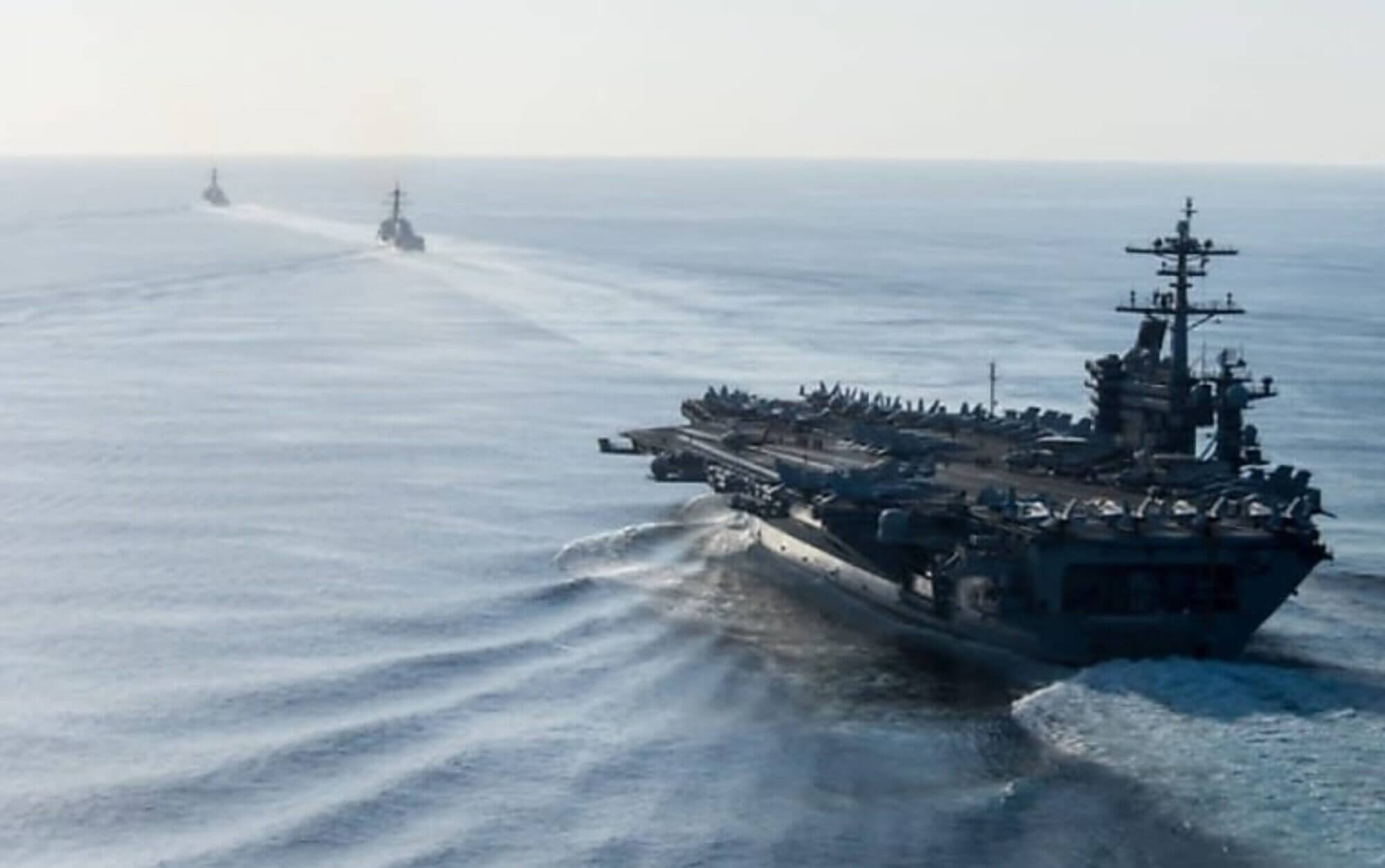

Today is National Maritime Day — May 22 — and for the first time since Richard Nixon sat in the Oval Office, there is genuine presidential attention on reviving America’s maritime and naval power. A 30-year Navy shipbuilding plan. Executive orders. Legislative proposals. And now, a compelling call from one of Washington’s sharpest naval analysts for the President himself to break the legislative logjam.
The vision is finally taking shape. The ambition is real. But a bold maritime revival still has a critical gap at its center: how do you sustain it?
Sadler’s TRUMP Act: The Right Diagnosis
On May 20 — two days before National Maritime Day — Brent Sadler, Senior Research Fellow at The Heritage Foundation’s Allison Center for National Defense, published a powerful op-ed in The Washington Times calling for President Trump to invoke his constitutional authority under the Recommendation Clause (Article II, Section 3) to personally propose legislation to Congress.[1]
Sadler’s argument is straightforward: the SHIPS for America Act — a bipartisan, bicameral bill first introduced in December 2024 — has stalled in Congress. Again. Presidential sponsorship, he argues, is the only force capable of breaking that logjam before Congress heads into summer recess and political attention fractures.
He proposes calling it the Transformative Revival and Urgent Maritime Program — the TRUMP Act. The branding is deliberate, and Sadler knows exactly what he’s doing.
His three modifications to the existing SHIPS Act framework are sound:
- Adjusted incentives for workforce and shipbuilding infrastructure reinvestment
- Regulatory relief through Maritime Prosperity Zones to accelerate industrial investment
- A new Maritime Department consolidating the Coast Guard, MARAD, FMC, and NOAA into a unified commercial maritime revival body
“More navel-gazing in Washington is unacceptable. With Congress’ summer recess fast approaching, national political attention will shift from bipartisan endeavors, such as a national maritime revival, to vote-seeking.” — Brent Sadler, The Washington Times, May 20, 2026 [1]
He’s right. And the constitutional argument is well-constructed. James Madison’s Federalist No. 47, FDR’s first 100 days, Eisenhower’s Congressional Relations office — Sadler lays the groundwork for a president who likes to move fast.
Notably, Sadler elaborated further on the Lunch Hour Podcast this week, framing the entire challenge as an engineering problem first, a business problem in the middle, and an engineering problem again at the end. On the Jones Act debate consuming Washington, he was direct: the real problem is that “leadership and industry have not had the appropriate focus or incentive structures.”[2] That is a precise diagnosis — and it points directly to the gap this article addresses.
The Navy’s 30-Year Plan: The Ambition Is There
Sadler’s op-ed lands against a significant backdrop. On May 11, the Navy published its 2026 Shipbuilding Plan — a 30-year vision for what it calls the “Golden Fleet.”[3] The fiscal year 2027 request alone is $68.5 billion, a 57 percent increase over the prior year.[4]
The plan explicitly acknowledges what advocates have been saying for years: decades of inconsistent demand and misaligned priorities left the fleet smaller, the shipyards atrophied, and American workers facing unacceptable risk.[3] Executive Order 14269, “Restoring America’s Maritime Dominance,” and the February 2026 Maritime Action Plan are cited as the catalyst for a long-overdue reindustrialization.[3]
That’s the right framing. The harder question is whether the funding architecture can sustain the ambition across political cycles.
The Pier Review: Even Navalists Are Sounding the Alarm
On the same day Sadler published his TRUMP Act proposal, the Center for Maritime Strategy — the Navy League’s policy arm — released a landmark 141-page report titled Pier Review: Leveraging the Allied Maritime Industrial Base for U.S. Shipbuilding.[5] Authored by a team including Steve Wills, Admiral James Foggo, and Nick Weising, with a foreword by 77th Secretary of the Navy Kenneth Braithwaite, the report delivers a sobering conclusion: the United States cannot rebuild its maritime industrial base alone.
The Pier Review examined allied shipbuilding nations — South Korea, Italy, Canada, Sweden, and the United Kingdom — and returned with a frank assessment. The domestic industrial base is so severely hollowed that a bridge strategy involving allied yards, allied supply chains, and allied skilled workers may be necessary while American capacity is rebuilt.
These are not critics of American seapower. These are its most dedicated advocates. That they felt compelled to reach this conclusion is itself a measure of how deep the hollowing runs.
The Pier Review cites Canada’s National Shipbuilding Strategy as the model worth emulating — a multi-decade, consistent demand signal that ended the boom and bust cycle and gave the industrial base something durable to build around. The report calls for the United States to create a similar structure.
What neither the Pier Review nor the TRUMP Act provides is the funding mechanism that makes that structure mandatory and durable across administrations. That is the gap the SEAS Act is designed to close.
The Sustainability Gap No One Is Talking About
Here is what every current maritime proposal — the SHIPS Act, the TRUMP Act, the 30-year plan — has in common: they are all dependent on annual congressional appropriations. Fund it one year, gut it the next. That is precisely the cycle that produced the hollow fleet we are now trying to rebuild.
The last time sustained naval investment actually worked was 1982 to 1992 — a decade of consistent political will, consistent funding, and consistent production signals to the industrial base. Shipyards plan in decades, not fiscal years. They hire and train workforces over years, not budget cycles. The industrial base doesn’t respond to hope or headlines. It responds to durable, multi-year demand signals it can build a business around.
Presidential legislation — even landmark presidential legislation — does not by itself solve that problem. A bill passed in one Congress can be defunded by the next. The SHIPS Act stalled once. The TRUMP Act, if passed, could face the same gravitational pull the moment political attention shifts, a budget fight erupts, or a new administration arrives with different priorities.
That is the sustainability gap. And it is the one gap that no current proposal directly addresses.
The SEAS Act: Closing the Sustainability Gap
The Strategic SEAS Act — Shipbuilding Economic Acceleration and Security Act — is designed to do precisely that.
Rather than competing for annual appropriations against entitlements, healthcare, and every other priority in the federal budget, the SEAS Act proposes a 2 percent Strategic Technology Responsibility Contribution from U.S. companies with significant revenue from China operations, directed into a dedicated Naval Modernization account.[6]
This is a structural funding mechanism, not a budget line item. It creates the kind of durable, mandatory investment signal that the shipbuilding industrial base can actually plan around — the modern equivalent of the sustained commitment that made 1982 to 1992 work, and the American answer to the Canadian model the Pier Review recommends.
The logic behind the contribution is grounded in history. The “Triple Whammy” — the End of History complacency after 1989, the responsible stakeholder framework that opened WTO access in 2001, and the mass migration of American corporate manufacturing to China — created the conditions for naval hollowing.[7] American companies that benefited from that migration helped create the problem. The SEAS Act creates a mechanism for them to contribute to the solution.
Sadler himself named the core problem on the Lunch Hour Podcast: the wrong incentive structures. The SEAS Act corrects that — not through legislation alone, but through a mandatory funding architecture that changes the calculus permanently.
Former House Select Committee on China Chairman Mike Gallagher documented the PRC’s systematic exploitation of U.S. export control gaps and argued that Commerce consistently prioritized industry revenue over national security.[8] Palantir’s “The Technological Republic” — currently a national conversation — makes a parallel argument about Silicon Valley’s moral debt to the hard power that underwrites its commercial freedom.[9]
The SEAS Act turns that argument into a funding architecture.
National Maritime Day 2026: Vision Needs Architecture
Brent Sadler is right that presidential action is needed, and the constitutional case he makes is compelling. The TRUMP Act framework — if it moves — will be the most significant maritime legislation in a generation. The Pier Review is right that the industrial base crisis is deep and requires a generational commitment to fix.
But a generational commitment cannot be built on an annual appropriation. The 30-year shipbuilding plan requires a 30-year funding architecture. Presidential legislation opens the door. The SEAS Act keeps it open regardless of which party controls Congress or who sits in the Oval Office.
National Maritime Day has a theme each year. This year’s should be simple: build the vision, build the architecture to sustain it.
The SEAS Act is not a competitor to Sadler’s proposal or the Pier Review’s recommendations. It is the missing piece that makes them last.
Americans for a Stronger Navy will continue to advocate for all three pillars: the presidential legislative action Sadler rightly calls for, the allied cooperation framework the Pier Review recommends, and the structural funding mechanism that makes both durable. That is the complete architecture a generational maritime revival requires.
References
[1] Brent D. Sadler, “National security demands that White House act on maritime legislation,” The Washington Times, May 20, 2026.
[2] Brent D. Sadler, Lunch Hour Podcast with Andrew Langer, May 2026.
[3] U.S. Navy, 2026 Shipbuilding Plan, May 11, 2026.
[4] “U.S. Navy unveils 30-year plan to rebuild American shipbuilding,” The Washington Times, May 12, 2026.
[5] Matt Reisener, ed., Pier Review: Leveraging the Allied Maritime Industrial Base for U.S. Shipbuilding, Center for Maritime Strategy, Navy League of the United States, May 2026. Foreword by Secretary of the Navy Kenneth J. Braithwaite.
[6] Americans for a Stronger Navy, Strategic SEAS Act framework, StrongerNavy.org.
[7] Americans for a Stronger Navy, “The Triple Whammy,” StrongerNavy.org.
[8] House Select Committee on the Chinese Communist Party, Export Control Enforcement Reports, 2023–2024.
[9] Alex Karp and Nicholas Zamiska, The Technological Republic, 2025.