
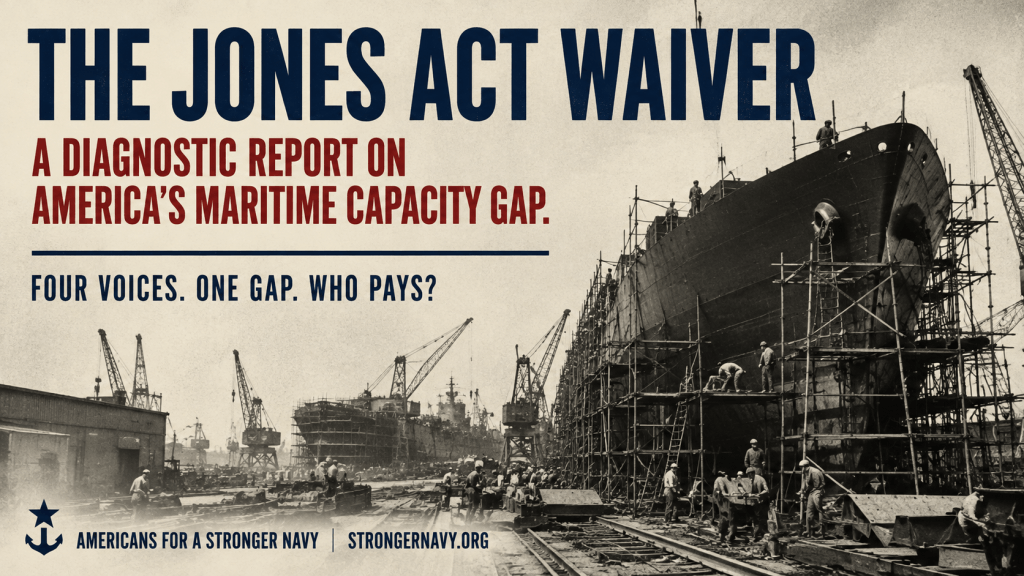

The Jones Act Waiver: What It Actually Revealed
I am not a maritime economist. I am not a Jones Act scholar. I am a former blue-water destroyer sailor who stood watches aboard USS Henry B. Wilson (DDG-7) in the 1970s, and a former telecommunications and web engineering executive who spent three decades watching American industry move offshore — including firsthand business travel to China during the early 2000s tech transfer era. I come to this the way I come to most naval policy questions: as a student, not an expert.
I have a bias, and I want to name it up front. I watched American manufacturing hollow out in real time. So when someone argues the fix for a hollowed-out merchant marine is removing one of the last laws requiring any of it to be American-built, -owned, -flagged, or -crewed, my instinct is skepticism.
That instinct is what sent me digging. Over the past several weeks I’ve read the primary MARAD compliance filings behind the 2026 Jones Act waiver, followed the public arguments of four people who know this issue far better than I do, and engaged two of them directly. What I found didn’t confirm my bias. It refined it.
What the Waiver Actually Is
On March 17, 2026, during the Strait of Hormuz crisis, the federal government waived the Jones Act’s cabotage rules, allowing foreign-flagged vessels to move fuel, fertilizer, and related cargo between U.S. ports. That waiver has been extended twice, is now the longest suspension of Jones Act rules in the program’s history, and by August was being driven substantially by gasoline prices ahead of the midterms rather than the original national-security rationale.
I went to the primary source: MARAD’s own compliance filings, which every operator is legally required to submit within 10 days of each waiver voyage, including a specific field — an “Explanation of National Defense Interest.” What I found in those filings surprised me. A meaningful share of operators listed that required field simply as “Not Applicable.” Most of the rest reused identical boilerplate language, word for word, across unrelated shippers and vessels. That’s not proof the waiver is bad policy. It is proof that its stated legal basis — a case-by-case national defense necessity — isn’t being documented as case-by-case in practice, for a real share of its use.
Four Voices, One Diagnosis
Public debate over the Jones Act has been framed as a binary choice: repeal the century-old law, or defend it as written. I went looking for the strongest version of every position I could find, and heard from four people who do not agree with each other, or always with me:
Colin Grabow of the Cato Institute has built the most detailed public data tracking waiver voyages, and reads it as proof the law suppresses legitimate demand.
Dr. Steven Wills of the Center for Maritime Strategy argues reform, not repeal — that the law is connective tissue between America’s commercial shipyards and naval surge capacity, and removing it without building a replacement trades a flawed foundation for no foundation at all.
Dr. Sal Mercogliano, historian and host of “What’s Going On With Shipping,” rejects both camps. As he put it directly:
“It’s not the Jones Act that’s the issue. It’s our maritime policy. We’ve been asleep at the wheel while China woke up and has seized the reins.”
William P. Doyle, a former U.S. Federal Maritime Commissioner, adds a sharper security dimension — documenting a Chinese state-owned vessel operating in U.S. coastwise trade under the waiver while qualified American tonnage sat idle.
Four different prescriptions. But underneath the disagreement, a shared diagnosis: a shipyard base too thin to survive between crises, a mariner workforce that shrinks every drought cycle, and a country that let China take over 70 percent of global shipbuilding orders while looking the other way.
The Question Nobody’s Asking
None of these four voices, in their public positions, centers a funding mechanism as the answer. That’s the gap I wrote this report to address. Not repeal or defend — who actually pays to rebuild the capacity everyone agrees we’ve lost.
Read the Full Report
I’ve written up the complete research — the MARAD filings analysis, all four positions in full, and where I’ve landed — as a diagnostic report rather than a single post, because the material deserved more room than a blog format allows.
I’ll be tagging Colin, Sal, Steven, and William when this goes live. Their work is half of what’s in it, and I’d value their read.
Stronger together. Break the silos.
— Bill Cullifer
Americans for a Stronger Navy | StrongerNavy.org