
A few days ago, we published a piece about rust on Navy ships. Not because rust is the problem, but because rust is the symptom of something deeper: a governance system that doesn’t fund the unglamorous, essential work of maintaining a ready fleet.
Now Captain John Konrad has walked through the 2025 Military Sealift Command handbook page by page in a detailed podcast, and he’s telling the exact same story—from the other side of the hull.
What Konrad Found
Captain Konrad, founder of gCaptain and a licensed Master Mariner with decades at sea, attended the Surface Navy Association’s National Symposium and picked up what he calls “the most important book the Navy publishes every year”—the MSC handbook.
His conclusion after reviewing it: “We are completely unprepared for a war in the Pacific.”
Here’s what the handbook reveals:
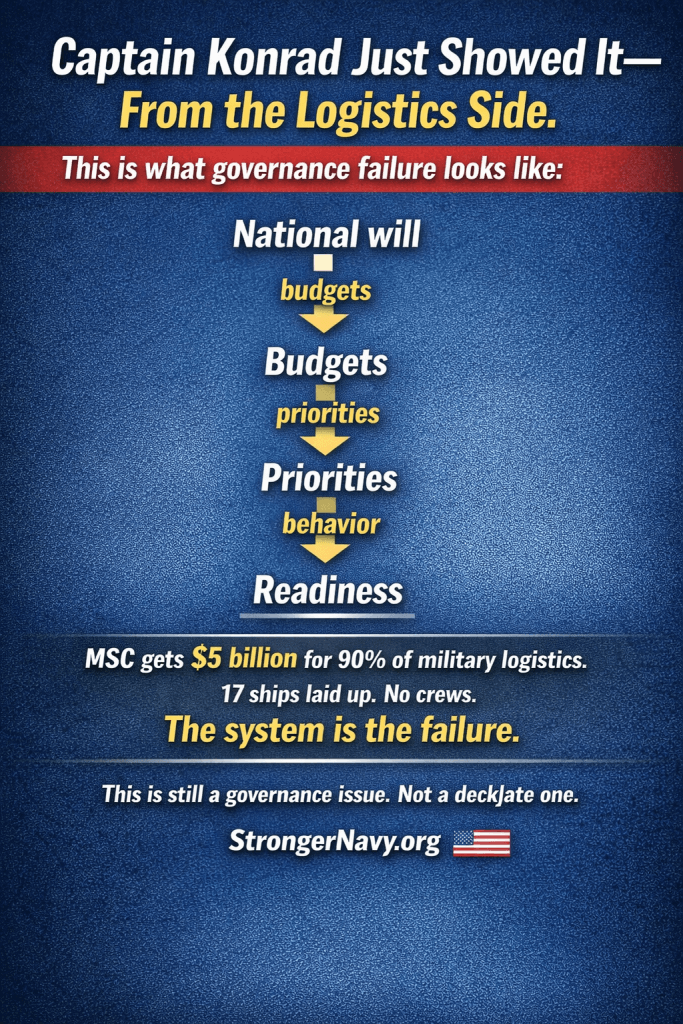
$5 billion annual budget for Military Sealift Command—the organization responsible for 90% of everything the military moves overseas, including fuel, ammunition, food, and equipment for all services across all theaters worldwide.
As Konrad puts it bluntly: “Ships are expensive, people. Crewing ships are expensive. Maintaining ships are expensive. And you just can’t do it with a $5 billion budget.” That’s less than 0.5% of the $1.1 trillion defense budget to sustain the logistics backbone that enables everything else.
17 ships laid up—not because they’re broken, but because there aren’t enough licensed merchant mariners to crew them. The workforce crisis isn’t theoretical. It’s operational right now.
A command authority mismatch: MSC is a one or two-star command trying to support operations across all numbered fleets, which are three and four-star commands. When they compete for resources in Congress, they get outranked by everyone.
The Single Point of Failure Inventory
Konrad methodically documents what “running on fumes” actually looks like:
- 1 Missile Range Instrumentation Ship (to track adversary weapons development)
- 1 Advanced towed array surveillance ship
- 1 Cable repair ship (for undersea cables carrying secure communications)
- 1 Ballistic missile tracking ship
- 1 Navigation test support ship
- 4 Ocean surveillance ships (we had dozens during the Cold War to track Soviet submarines)
- 4 Submarine support ships (submarines can’t safely enter or leave port without them)
- 4 New John Lewis-class replenishment oilers—with only one or two actually deployed due to environmental scrubber requirements making them too tall to fit under 70% of bridges
The oiler situation is particularly critical. As Konrad notes, a former Commandant of the Merchant Marine wrote that we’re 100 tankers short of minimum requirements to fuel the fleet in a Pacific campaign.
This Is the Same Story We’ve Been Telling
In our earlier post on rust, we made a simple point: rust isn’t a Navy problem. It’s an American one.
We showed this governance chain:
National will → budgets → priorities → behavior → readiness
When that chain breaks down, you get rust on deckplates. But as Konrad’s breakdown proves, you also get:
- Ships that can’t deploy because bureaucracy matters more than mission
- Mariners overworked to the point of tragedy (he references the officer who died by suicide aboard the USNS Amelia Earhart from stress and overwork)
- Single ships doing missions that require dozens
- A logistics fleet averaging 40 years old with no replacement plan adequate to requirements
The Governance Failure at Every LevelKonrad’s evidence maps directly to our framework:
National will: Americans support the Navy—surveys prove it. But they picture aircraft carriers and destroyers, not oilers and cable repair ships. They don’t know Military Sealift Command exists. They don’t understand that 90% of military logistics moves by ship, or that the Air Force’s entire airlift capacity is less than what China can fit on one modern container ship.
Budgets: When the public doesn’t understand what naval power requires, Congress doesn’t fund it. MSC gets 0.5% of the defense budget to do what Konrad calls “the most important mission” because logistics wins wars.
Priorities: MSC is outranked by every other command. When it’s time to fight for resources, they lose. The result is predictable: deferred maintenance, aging ships, no replacement pipeline, and a workforce crisis.
Behavior: With inadequate funding and low command priority, you get exactly what Konrad documents—ships laid up, mariners burned out, critical capabilities down to single digits, and new ships stuck pier-side because nobody fixed the bureaucratic tangles.
Readiness: We can move the fleet to the Pacific. But we can’t sustain them there. We can win the first battle, but we can’t win the campaign.
What “Lack of Support” Actually Means
This isn’t about public indifference. It’s about invisibility.
The American public sees:
- Carriers launching jets (thrilling)
- Destroyers shooting missiles (dramatic)
- Submarines running silent (mysterious)
They don’t see:
- The oiler keeping the carrier’s air wing flying
- The dry cargo ship bringing ammunition to the destroyers
- The cable repair ship maintaining secure communications
- The ocean surveillance ship tracking enemy submarines before they become threats
- The submarine tender ensuring boats can safely enter and leave port
What’s invisible doesn’t get funded.
This is why the governance failure at the top of the chain matters so much. If national will doesn’t include understanding what naval power actually requires, budgets will never prioritize the systems that make it work.
Naval Power Is Systems, Not Platforms
We’ve been making this point for months: naval power isn’t platforms. It’s systems.
You can have the most advanced destroyers and carriers in the world, but if you can’t fuel them at sea, resupply them with ammunition, track enemy submarines approaching your bases, repair undersea cables when they’re cut, or crew the ships you already have—then you don’t have naval power. You have expensive hulls that can’t sustain operations.
Konrad’s handbook walkthrough proves this from the logistics side. The platforms get the attention and the funding. The systems that enable them get $5 billion and a two-star admiral.
A Call to Action: DOD and Congress Must Act
We know from surveys that Americans support a strong Navy. They want us to be ready. But readiness isn’t just about how many ships we have—it’s about whether those ships can operate, sustain, and prevail in extended campaigns.
The Department of Defense must:
- Elevate MSC to a three-star command so it has the authority to compete for resources
- Fix bureaucratic tangles keeping new capabilities pier-side
- Properly recognize civilian mariners to improve recruitment and retention
- Stop treating logistics as an afterthought in force structure decisions
Congress must:
- Fund MSC and the maritime industrial base at levels that match strategic requirements, not political convenience
- Expand the Maritime Security Program, especially tankers
- Invest in the mariner training pipeline and Strategic Sealift Officer program
- Demand readiness reporting that focuses on systems and sustainability, not just platform counts
Acknowledging Captain Konrad’s Work
Captain Konrad has been a persistent, credible voice highlighting America’s maritime readiness crisis. Through gCaptain, his podcasts, and media appearances on NPR, BBC, the New York Times, and Wall Street Journal, he’s documented the decline of our merchant marine, the shipbuilding crisis, and strategic sealift challenges.
His latest breakdown of the MSC handbook is a public service. He’s showing Americans what their Navy actually depends on—and how fragile that foundation has become.
At Americans for a Stronger Navy, we’ve been making the case that rust is a symptom and the system is the cause. Konrad just proved it from the logistics side. His work validates our concerns and strengthens the case for urgent action.
The Bottom Line
Rust isn’t a deckplate problem. It’s a governance one.
Ships laid up for lack of crews isn’t a manning problem. It’s a governance one.
Oilers stuck pier-side because nobody fixed the bureaucracy isn’t a maintenance problem. It’s a governance one.
And a $5 billion budget for the logistics backbone that enables 90% of military power projection isn’t a budget problem—it’s a national priority failure.
Captain Konrad is right: we’re not ready for a sustained fight in the Pacific.
But the solution isn’t just to build more ships. It’s to fix the governance chain that determines whether we fund, crew, maintain, and deploy the capabilities we already need.
The American people support a strong Navy. Now we need DOD and Congress to match that support with the resources, priorities, and leadership that readiness actually requires.
Let’s roll.