
The Conversation Is Shifting on Sea Power — Now Americans Must Engage

Bill Cullifer, Founder

Something important is happening.

For years, maritime decline has been treated as a niche issue — something for defense insiders, shipyard executives, or Navy circles to debate quietly. That is beginning to change.

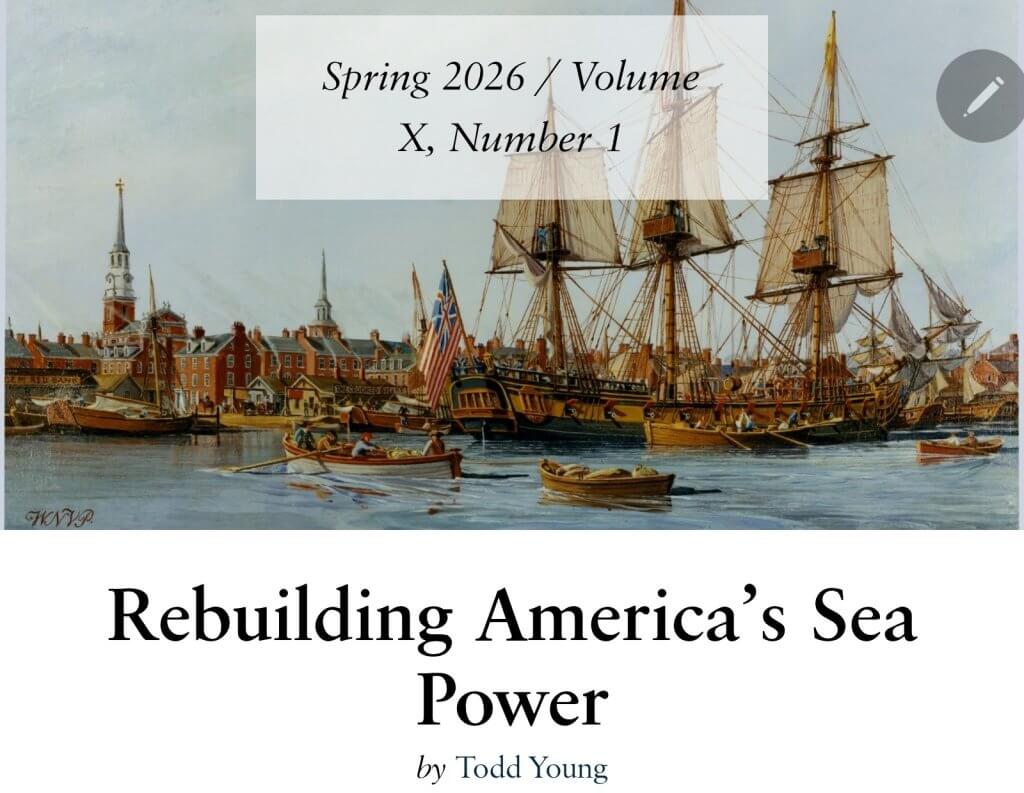
Recently, Senator Todd Young published, in American Affairs Journal a thoughtful piece arguing that rebuilding America’s maritime industrial base is essential to both economic strength and national security. He traced the issue back to the Revolution, through Mahan, and into the present-day competition with China.

That matters.

Not because of who wrote it. But because of what it signals.

Maritime Power Is Back in the Conversation

For decades, America has allowed its commercial fleet to shrink. Shipyards have closed. Skilled labor has aged out. Foreign-flagged vessels now move the overwhelming majority of our trade.

Meanwhile, China designated shipbuilding a strategic industry and built accordingly.

This is not about panic. It is about arithmetic.

Eighty percent of global trade moves by sea. Most of America’s trade does too. If we cannot build, repair, and crew ships at scale, we are strategically exposed — economically and militarily.

The encouraging sign is that leaders are once again speaking openly about maritime strength.

That is progress.

Policy Is Necessary — But Not Sufficient

Legislation like the proposed SHIPS Act is an important step. Tax incentives, regulatory reform, maritime academy modernization — these are serious proposals.

But here is the harder truth:

Industrial revival cannot be sustained by legislation alone.

Shipbuilding capacity requires:

Workforce development
Steel production
Port modernization
Cybersecurity resilience
Long-term capital investment
And, above all, public understanding

Without public buy-in, even well-crafted policy fades with political cycles.

This Is Not a Coastal Issue

One of the most overlooked truths in this debate is that maritime strength touches every American.

Indiana steel feeds shipyards.
Midwestern grain moves to global markets by sea.
Energy exports rely on tankers.
Supply chains run through ports.

Sea power is not about nostalgia. It is about jobs, commerce, resilience, and deterrence.

When ships deploy longer because the fleet is too small…
When maintenance backlogs grow…
When sealift capacity shrinks…

Those are not abstract statistics. They are signs of strain in a system Americans depend on every day.

Civic Engagement Is the Missing Ingredient

We can debate fleet numbers. We can debate funding mechanisms. We can debate industrial policy.

But unless Americans understand why this matters — and choose to participate in the conversation — nothing lasting will change.

Rebuilding sea power is not simply a government project. It is a civic project.

It requires voters who ask informed questions.
Taxpayers who demand accountability.
Educators who teach maritime history and strategy.
Industry leaders willing to invest long-term.

America’s maritime strength has always rested on the character and engagement of its people.

That spirit has not disappeared.

The conversation is shifting. That is a good sign.

Now the responsibility shifts to us.

That’s why we launched Charting the Course: Voices That Matter — a 24-part educational series breaking down how we got here, what went wrong, and what must happen next. Our goal is simple: educate the public, connect the dots, and build the support needed to close the readiness gap before it’s too late.

Let’s roll.
Read the full article here.

Six Frigates: Why America Chose Sea Power — and Why That Choice Still Matters

Six Frigates: Why America Chose Sea Power — and Why That Choice Still Matters

Ian W. Toll’s Six Frigates: The Epic History of the Founding of the U.S. Navy should be required reading for anyone who believes America’s naval strength simply “happened” or that today’s debates about shipbuilding, cost, and purpose are somehow new.

They aren’t.

This book tells the story of how a young, divided, cash-strapped republic made a deliberate decision to build a Navy — not for glory, not for empire, but for survival, commerce, and credibility in a dangerous world.

Reading it today, the parallels are impossible to miss.

What the Book Is Really About

On the surface, Six Frigates recounts the creation of the first six capital ships authorized by the Naval Act of 1794. But at its core, the book is about civic will.

Toll shows that the U.S. Navy was born amid fierce political resistance, public skepticism, regional rivalries, and intense arguments over cost and necessity. Many Americans feared a standing Navy would drag the nation into foreign wars or empower a central government at the expense of liberty.

Nothing about this debate feels distant.

“The debate was never just about ships — it was about what kind of nation America would become.”
— Ian W. Toll

From the beginning, sea power was a choice — not a given.

Notable Quotes That Still Matter Today

Toll repeatedly underscores a truth early Americans learned the hard way:

“A nation that depended on commerce could not afford to remain defenseless at sea.”

American sailors were seized, trade was disrupted, and diplomacy without strength proved ineffective.

Another passage feels especially relevant now:

“Naval power was expensive, controversial — and delay was more dangerous still.”

That sentence could be written today about shipbuilding delays, fragile supply chains, and readiness gaps without changing a word.

And perhaps the most important civic reminder in the book:

“The frigates represented an investment not just in ships, but in skills, infrastructure, and national confidence.”

The founders weren’t just building hulls. They were building a maritime nation.

Why Americans Should Care

This book makes one thing unmistakably clear: the founders did not stumble into sea power. They argued their way into it.

They debated cost, foreign entanglements, corruption, and waste. And then they acted — because they understood that refusing to decide was itself a decision.

Today, Americans benefit daily from secure sea lanes, global trade, and deterrence at sea. Yet public understanding of how fragile that system is has faded.

Six Frigates reminds us that civic engagement is not optional when it comes to national security. The Navy exists because Americans once paid attention.

Implications for the Navy

One of the book’s strongest lessons is that shipbuilding takes time — and delay carries strategic risk.

The original frigates faced cost overruns, workforce shortages, material constraints, and political interference. None of that stopped the effort, because leaders understood that maritime strength could not be created on demand.

“Ships could not be conjured by urgency alone. They required patience, discipline, and sustained public support.”

That lesson applies directly to today’s challenges: a smaller fleet, stressed shipyards, and a public often disconnected from the maritime foundations of American power.

What Has Changed — and What Hasn’t

Technology has changed. The scale of global competition has changed. The oceans have not.

America remains a maritime nation, dependent on trade, energy flows, undersea cables, and allied sea lanes. Adversaries understand this and are building accordingly.

What has not changed is the central truth Six Frigates makes clear: sea power depends on informed citizens willing to support long-term decisions — even when they are politically uncomfortable.

Final Reflection

Six Frigates is not a call for militarism. It is a warning against complacency.

It shows that the U.S. Navy was born not from inevitability, but from hard choices made by leaders who understood the world as it was — not as they wished it to be.

As America approaches its 250th anniversary, this book offers a timely reminder: the Navy belongs to the American people, and its strength ultimately reflects public understanding, engagement, and resolve.

That responsibility didn’t end in 1794.

That’s why we launched Charting the Course: Voices That Matter — a 24-part educational series breaking down how we got here, what went wrong, and what must happen next. Our goal is simple: educate the public, connect the dots, and build the support needed to close the readiness gap before it’s too late.

Let’s roll.