


This wasn’t a military drill. It was lawfare, logistics warfare, and supply-chain coercion in plain sight.
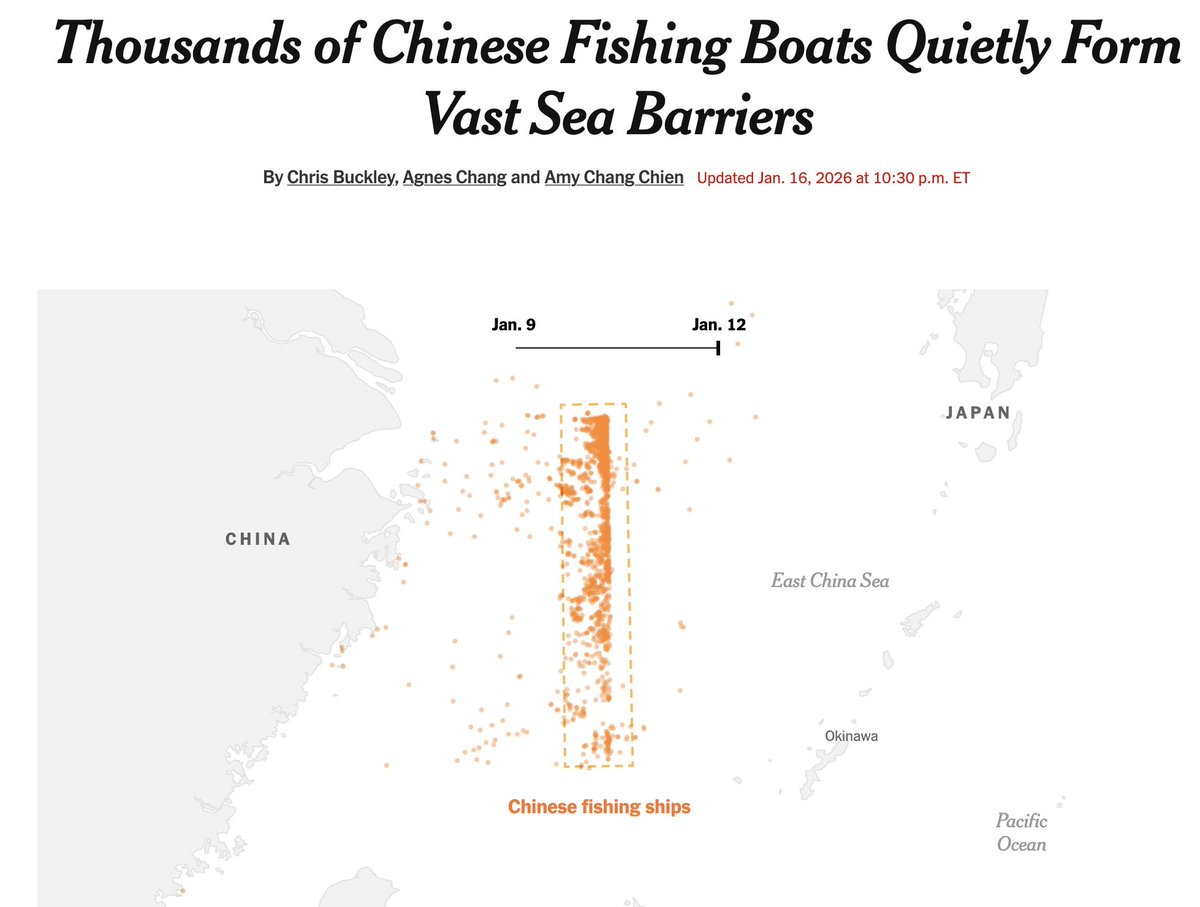
In late December and again in January, thousands of Chinese “fishing vessels” formed long, coordinated lines and rectangles across major shipping lanes in the East China Sea near Taiwan. Cargo ships were forced to zigzag through the formation. AIS signals were active. The message was visible to the world.
These were not fishing expeditions.
They were rehearsals.
And they revealed something most Americans never think about: control of sea lanes doesn’t require missiles or warships. It can be done with civilian hulls, legal ambiguity, and scale.
China’s maritime militia — civilian fishing vessels operating under military direction — just demonstrated how to create a floating wall across global commerce.
What Happened — And Why It Matters
China assembled formations of up to 2,000 vessels stretching for hundreds of miles. Analysts noted the precision, coordination, and positioning near critical routes. Many of these boats are part of a maritime militia that operates alongside the People’s Liberation Army and the People’s Liberation Army Navy, often blurring the line between civilian and military activity.
Under international maritime law, warships must “give way” to vessels engaged in fishing. That legal protection becomes a weapon when the “fishing fleet” is massed, directed, and used for coercion.
This is lawfare at sea.
No shots fired. No war declared. But commercial traffic disrupted, insurance risk raised, and a Navy forced into hesitation by the rules it respects.
Why Americans Should Care
More than one-third of global trade transits the waters around Taiwan and the East and South China Seas. The goods on American shelves, the energy markets we depend on, the components in our technology supply chains all pass through sea lanes like these.
China just practiced how to slow shipping without firing a shot, raise costs for global commerce, create economic pressure on rivals, complicate lawful naval responses, and establish coercive control over maritime arteries.
This is not about Taiwan alone.
This is about the arteries of the global economy.
Implications for the Navy
The United States Navy is built to deter fleets, submarines, missiles, and aircraft. But this tactic targets something different: the legal and operational space between peace and war.
A destroyer captain facing 2,000 “fishing boats” cannot treat them like warships. A collision becomes an international incident. Determining which vessels are legitimate military targets becomes nearly impossible in real time.
China understands this.
And they are practicing it in daylight.
Implications for Our Allies
This tactic has already been used against the Philippines, Vietnam, and others in the South China Sea. It pressures smaller nations to back down without Beijing ever crossing the threshold into open conflict.
For allies who rely on these sea lanes such as Japan, South Korea, Australia, the Philippines, and NATO partners, this is a preview of how maritime coercion can be applied gradually, persistently, and legally ambiguously.
The Industrial Reality Behind the Strategy
China can do this because it possesses the world’s largest distant-water fishing fleet, tens of thousands of industrial vessels that can be mobilized at scale.
The United States cannot.
This is not simply a Navy gap. It is an American maritime industrial gap.
Civilian maritime capacity, shipbuilding, port infrastructure, and merchant marine strength are not side issues. They are central to national security in an era where civilian hulls can be weaponized for state power.
The Real Headline
China just demonstrated it can interfere with the sea lanes that feed the American economy using fishing boats.
That should get our attention.
Because naval strength is not just about ships with guns. It is about protecting the lawful flow of commerce across oceans that most Americans never see but depend on every day.
That’s why we launched Charting the Course: Voices That Matter — a 24-part educational series breaking down how we got here, what went wrong, and what must happen next. Our goal is simple: educate the public, connect the dots, and build the support needed to close the readiness gap before it’s too late.
Let’s roll.