Why a narrow stretch of ocean between three landmasses has shaped 80 years of naval strategy — and why Americans need to understand it now
Introduction
A recent debate centered on whether China or Russia pose an imminent military threat to Greenland. The answer from intelligence sources appears to be no. But that answer, while technically correct, misses the deeper strategic point that has guided U.S. thinking for over two centuries.
The real issue is not invasion.
The real issue is strategic positioning in geography that matters to naval power.
Greenland sits in one of the most important pieces of maritime real estate on the planet. And the United States has understood that for a very long time.
The GIUK Gap: A Naval Choke Point Since World War II
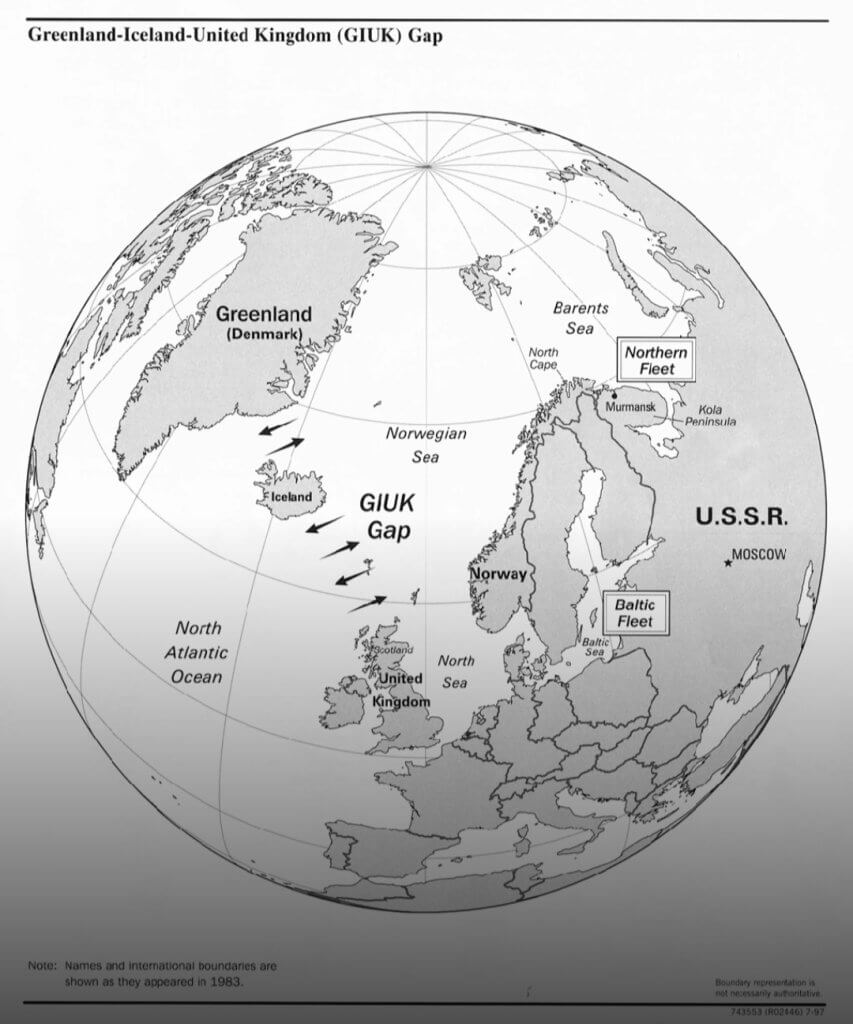
Greenland forms the western anchor of what naval strategists call the GIUK Gap — the sea space between Greenland, Iceland, and the United Kingdom.
This is not a modern concept. During World War II and throughout the Cold War, this gap was the primary maritime passage between the Russian Northern Fleet and the Atlantic Ocean. Soviet submarines had to pass through this space to threaten U.S. and NATO shipping lanes.
The U.S. and NATO built an entire system of surveillance, patrols, air bases, and anti-submarine warfare doctrine around this geography. This was one of the most heavily monitored naval regions on earth for decades.
That geography has not changed.
What has changed is public memory of why it mattered.
Greenland and the U.S. Military Presence
The United States has maintained a military presence in Greenland since World War II. Today, Pituffik Space Base (formerly Thule Air Base) remains a critical U.S. installation for:
- Missile warning
- Space surveillance
- Arctic operations
- Early warning radar coverage of the North Atlantic and polar approaches
This is not symbolic. It is operationally significant to U.S. homeland defense and NATO maritime awareness.
The Monroe Doctrine and Western Hemisphere Strategy
In 1823, the Monroe Doctrine established a foundational principle of U.S. strategy:
Foreign powers establishing strategic footholds in the Western Hemisphere is a U.S. security concern — even if that presence appears commercial or political rather than military.
This was never about invasion. It was about presence.
Because presence becomes leverage.
That thinking has guided U.S. behavior for 200 years across the Caribbean, South America, Central America, and the Arctic.
Greenland fits squarely into that tradition.
China’s Pattern of Strategic Positioning
There is no evidence China plans to invade Greenland. But there is extensive documentation of China’s interest in:
- Arctic shipping routes as ice recedes
- Rare earth and mineral projects in Greenland
- Financing infrastructure projects, including attempted airport construction
- Expanding its presence in Arctic research and commercial ventures
This pattern is not unique to Greenland. Similar approaches have been seen in Africa, the Pacific Islands, South America, and Australia.
The pattern is not military. It is long-term positioning.
That is what concerns strategists, not headlines.
Why This Matters to Naval Strategy
Naval strategy is built around geography, choke points, and access.
Greenland is not important because of its population or economy. It is important because of where it sits on the map.
Control and awareness of the GIUK Gap means control and awareness of submarine movement between the Arctic and the Atlantic. That has been true for 80 years.
It is still true today.
Why This Is Urgent Now
Three developments make Greenland’s strategic position more critical today than at any point since the Cold War:
1. Arctic ice recession is opening new shipping routes and resource access, increasing activity in waters the U.S. has monitored for decades.
2. Russian submarine activity in the North Atlantic has returned to Cold War levels, but U.S. anti-submarine warfare capabilities have atrophied.
3. China’s systematic positioning in Arctic governance, research, and commercial ventures is establishing presence before the U.S. fully recognizes the competition.
Meanwhile, the U.S. Navy faces its smallest fleet since 1916 and readiness challenges that limit sustained presence in multiple regions simultaneously.
The stake is not hypothetical: If the U.S. cannot maintain awareness and presence in the GIUK Gap, it cannot guarantee:
- Protection of transatlantic commerce that underpins the American economy
- Early warning of submarine-launched threats to the homeland
- Credible deterrence that prevents crises from starting
Why Americans Should Care
Most Americans think of naval strength as ships and aircraft carriers. Few think about the map.
But naval power is first and foremost about geography.
The sea lanes that carry global trade, energy supplies, and military movement pass through predictable choke points. Greenland anchors one of them.
Understanding this is key to understanding why the United States watches foreign interest in Greenland closely — not because of paranoia, but because of history.
Implications for the Navy
For the U.S. Navy and NATO maritime forces, Greenland and the GIUK Gap remain central to:
- Monitoring Russian submarine activity
- Securing North Atlantic shipping lanes
- Maintaining Arctic awareness as access increases
- Supporting homeland and allied defense from the maritime domain
This is classic naval statecraft.
Implications for Our Allies
Denmark, the United Kingdom, Iceland, Canada, and NATO partners all share an interest in maintaining control and awareness of this region.
Greenland is not just a U.S. concern. It is a NATO maritime concern.
The Real Debate
The debate is not about whether China or Russia plan to invade Greenland.
It is about whether we recognize the long pattern of strategic positioning that great powers use long before conflict.
Geography doesn’t change. Neither does its importance to naval strategy.
Understanding Geography Is Just The Beginning
Greenland matters because of where it sits on the map. But knowing why geography matters doesn’t answer the harder questions:
How did the U.S. Navy — which once dominated these waters without question — reach a point where we’re debating our ability to maintain presence in strategically vital regions?
What decisions, what budget choices, what policy shifts brought us here?
And most importantly: what must happen next?
That’s why we launched Charting the Course: Voices That Matter — a 24-part educational series breaking down how we got here, what went wrong, and what must happen next. We connect the dots between geography, strategy, budgets, readiness, and national will. Our goal is simple: educate the public on the fundamentals of naval power so Americans understand what’s at stake — and what it will take to close the readiness gap before it’s too late.
Let’s roll.