
Six Frigates: Why America Chose Sea Power — and Why That Choice Still Matters
Ian W. Toll’s Six Frigates: The Epic History of the Founding of the U.S. Navy should be required reading for anyone who believes America’s naval strength simply “happened” or that today’s debates about shipbuilding, cost, and purpose are somehow new.
They aren’t.
This book tells the story of how a young, divided, cash-strapped republic made a deliberate decision to build a Navy — not for glory, not for empire, but for survival, commerce, and credibility in a dangerous world.
Reading it today, the parallels are impossible to miss.
What the Book Is Really About
On the surface, Six Frigates recounts the creation of the first six capital ships authorized by the Naval Act of 1794. But at its core, the book is about civic will.
Toll shows that the U.S. Navy was born amid fierce political resistance, public skepticism, regional rivalries, and intense arguments over cost and necessity. Many Americans feared a standing Navy would drag the nation into foreign wars or empower a central government at the expense of liberty.
Nothing about this debate feels distant.
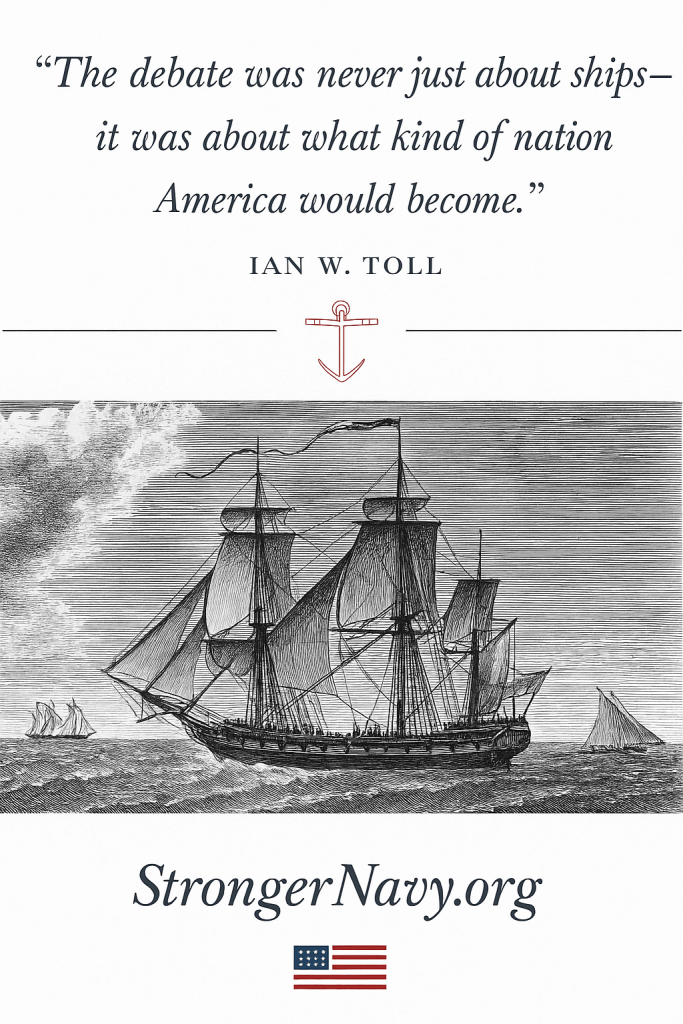
“The debate was never just about ships — it was about what kind of nation America would become.”
— Ian W. Toll
From the beginning, sea power was a choice — not a given.
Notable Quotes That Still Matter Today
Toll repeatedly underscores a truth early Americans learned the hard way:
“A nation that depended on commerce could not afford to remain defenseless at sea.”
American sailors were seized, trade was disrupted, and diplomacy without strength proved ineffective.
Another passage feels especially relevant now:
“Naval power was expensive, controversial — and delay was more dangerous still.”
That sentence could be written today about shipbuilding delays, fragile supply chains, and readiness gaps without changing a word.
And perhaps the most important civic reminder in the book:
“The frigates represented an investment not just in ships, but in skills, infrastructure, and national confidence.”
The founders weren’t just building hulls. They were building a maritime nation.
Why Americans Should Care
This book makes one thing unmistakably clear: the founders did not stumble into sea power. They argued their way into it.
They debated cost, foreign entanglements, corruption, and waste. And then they acted — because they understood that refusing to decide was itself a decision.
Today, Americans benefit daily from secure sea lanes, global trade, and deterrence at sea. Yet public understanding of how fragile that system is has faded.
Six Frigates reminds us that civic engagement is not optional when it comes to national security. The Navy exists because Americans once paid attention.
Implications for the Navy
One of the book’s strongest lessons is that shipbuilding takes time — and delay carries strategic risk.
The original frigates faced cost overruns, workforce shortages, material constraints, and political interference. None of that stopped the effort, because leaders understood that maritime strength could not be created on demand.
“Ships could not be conjured by urgency alone. They required patience, discipline, and sustained public support.”
That lesson applies directly to today’s challenges: a smaller fleet, stressed shipyards, and a public often disconnected from the maritime foundations of American power.
What Has Changed — and What Hasn’t
Technology has changed. The scale of global competition has changed. The oceans have not.
America remains a maritime nation, dependent on trade, energy flows, undersea cables, and allied sea lanes. Adversaries understand this and are building accordingly.
What has not changed is the central truth Six Frigates makes clear: sea power depends on informed citizens willing to support long-term decisions — even when they are politically uncomfortable.
Final Reflection
Six Frigates is not a call for militarism. It is a warning against complacency.
It shows that the U.S. Navy was born not from inevitability, but from hard choices made by leaders who understood the world as it was — not as they wished it to be.
As America approaches its 250th anniversary, this book offers a timely reminder: the Navy belongs to the American people, and its strength ultimately reflects public understanding, engagement, and resolve.
That responsibility didn’t end in 1794.
That’s why we launched Charting the Course: Voices That Matter — a 24-part educational series breaking down how we got here, what went wrong, and what must happen next. Our goal is simple: educate the public, connect the dots, and build the support needed to close the readiness gap before it’s too late.
Let’s roll.