Americans for a Stronger Navy: Advocating for a Robust Naval Force to Protect U.S. Interests

Global Leadership and Peace through Strength

Our mission is to educate policymakers and the public about the crucial role of a strong Navy and advocate for investments in shipbuilding, modernization, and maintenance. Today, we’ll be discussing China’s recent patrols and inspections in the Taiwan Strait and why a strong Navy is essential to preserving peace through strength, deterring aggression, and maintaining freedom of navigation.

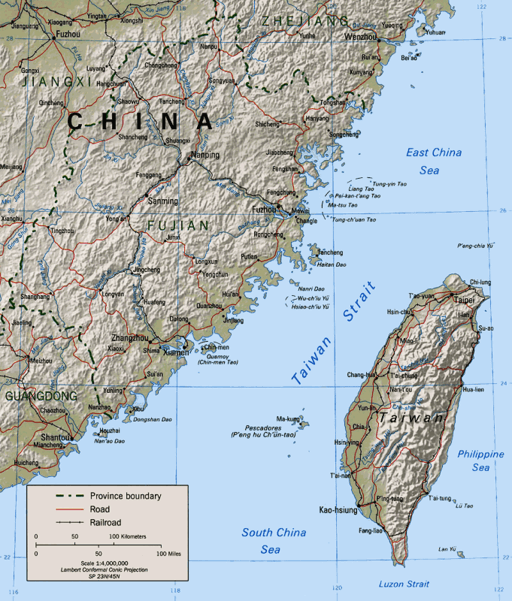
China Increases Patrols and Inspections in Taiwan Strait Following High-Level Meeting with U.S. Officials

Courtesy of the CIA

China Increases Patrols and Inspections in Taiwan Strait Following High-Level Meeting with U.S. Officials

China has launched a series of patrols in the Taiwan Strait and ordered inspections of ships, which Taiwan has rejected and urged its shipping companies to ignore. The inspections could impact passenger and fishing vessels as well as commercial and shipping vessels.

The Chinese move comes after Taiwanese President Tsai Ing-wen met with House Speaker Kevin McCarthy in California, prompting China to vow to take “strong” measures if the two leaders went through with the meeting.

The U.S. has pledged unwavering bipartisan support for Taiwan, while China has said it will resolutely safeguard its country’s sovereignty and territorial integrity. Taiwan split from mainland China in 1949 after pro-democratic forces based there lost a civil war to the Chinese Communist Party.

Key takeaways:

  • China has launched patrols in the Taiwan Strait and ordered inspections of ships, but Taiwan has rejected these measures and urged its shipping companies to ignore them.
  • The Chinese inspections could impact a range of vessels, including passenger and fishing vessels as well as commercial and shipping vessels.
  • China’s actions came after Taiwanese President Tsai Ing-wen met with House Speaker Kevin McCarthy in California, which prompted China to vow to take “strong” measures.
  • The U.S. has pledged its unwavering bipartisan support for Taiwan, while China has said it will resolutely safeguard its country’s sovereignty and territorial integrity.
  • Taiwan split from mainland China in 1949 after pro-democratic forces based there lost a civil war to the Chinese Communist Party.

US Navy won’t be “bullied” says Rear Adm. Christopher Sweeney

The commander of a US Navy aircraft carrier in Northeast Asia, Rear Adm. Christopher Sweeney, has said that American forces will not be deterred by China’s warnings of conflict.

On Board the USS Nimitz courtesy of Sky News

“We’re resolute in that we’re not going to be bullied, we’re not going to be coerced, and we are going to stay here and fly and operate in international norms,” said Rear Adm. Christopher Sweeney, who heads up Carrier Strike Group 11, a flotilla of warships led by the “supercarrier” USS Nimitz.The USS Nimitz and its escorts have arrived in South Korea after back-to-back war games with Japan and South Korea.

China is challenging America’s right to operate in the region, but Sweeney stated that the Navy will sail, operate and fly wherever international law allows, and they do not seek conflict with China.

About Rear Admiral Christopher Sweeney

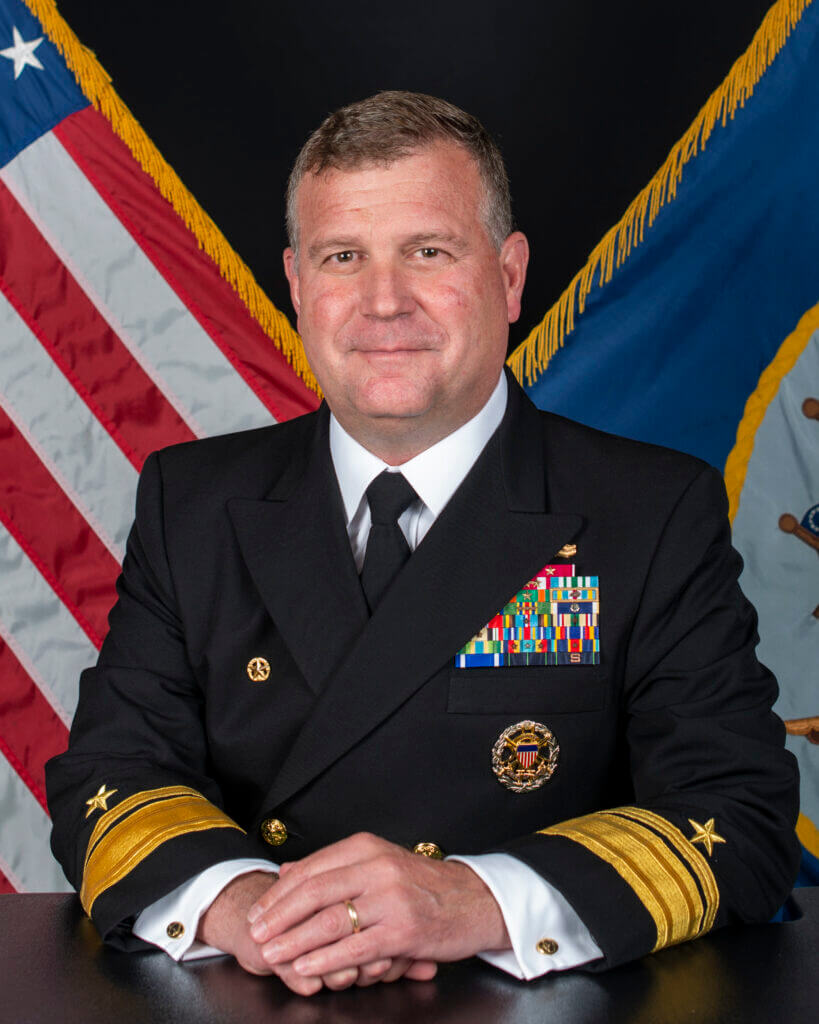
Rear Admiral Christopher Sweeney
Commander, Carrier Strike Group ELEVEN

Rear Adm. Christopher Sweeney is a native of the Eastern Shore of Maryland, a 1991 graduate of the U.S. Naval Academy and also a graduate of the Elliott School of International Affairs, George Washington University, with a master’s degree in International Policy and Practice.

Sweeney has served in a diverse range of sea and shore assignments. As a surface warfare officer, he commanded Destroyer Squadron 15 (CDS 15) from 2015 to 2016 in the Western Pacific and the Destroyer USS Decatur (DDG 73) from 2009 to 2010, deploying twice to the Arabian Gulf in support of U.S. and Coalition Forces in Iraq and Afghanistan.

His service at sea since 1992 includes assignments aboard USS Russell (DDG 59), USS Port Royal (CG 73), USS Paul Hamilton (DDG 60), USS Cyclone (PC 1) and USS San Jacinto (CG 56) deployed to the Middle East, Western Pacific, Mediterranean and South America.

His shore tours included deputy for Combat Systems and Warfighting Integration, responsible for future surface combatant force requirements and integration of warfighting investments for the Director of Surface Warfare (N-96). He has also served as the branch head for Integrated Air & Missile Defense for the Director of Surface Warfare (N-96) and as a strategic and political-military planner on the staffs of the Joint Chiefs of Staff (J-5) and the Chief of Naval Operations.

His first flag tour was as the deputy director for Policy, Plans, Strategy, Capabilities and Resources (J-5/8), U.S. European Command in Stuttgart, Germany. He is currently serving as commander, Carrier Strike Group Eleven.

His awards include the Defense Superior Service Medal, Legion of Merit, Joint Meritorious Service Medal, Navy Meritorious Service Medal and various personal, unit, service and campaign awards.

US Navy challenges China’s maritime claims in South China Sea with freedom of navigation operation

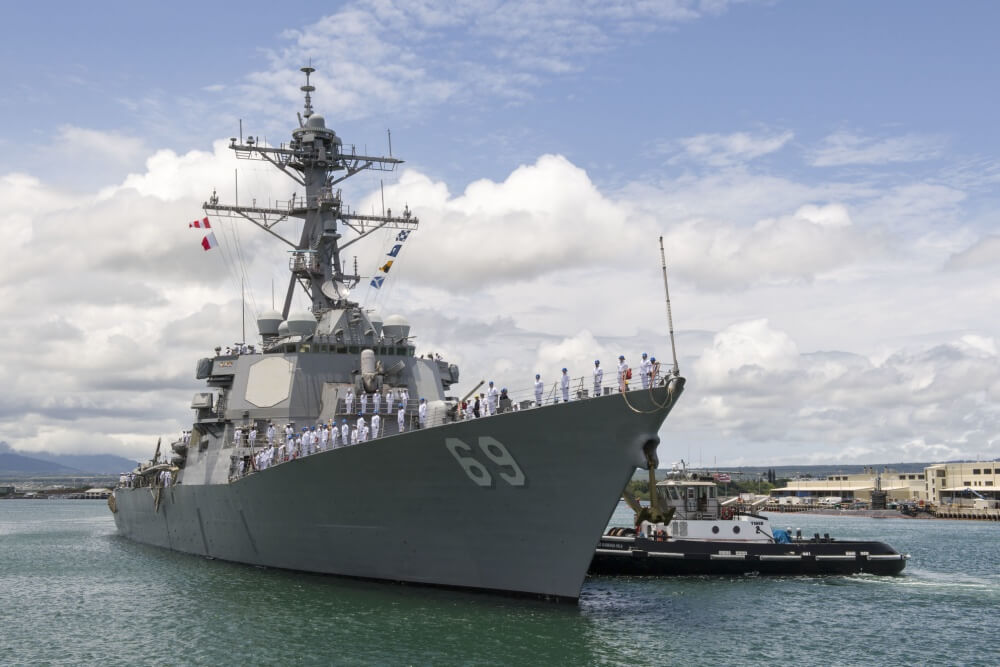
USS Milius (DDG-69). Navy photo

The US Navy conducted a freedom of navigation operation in the disputed waters around the Paracel Islands, which are claimed by both China and Vietnam. The operation was carried out by the guided-missile destroyer USS Milius, which sailed within 12 nautical miles of the islands to challenge China’s maritime claims in the region according to press reports.

AP reported that China threatened “serious consequences” Friday after the United States Navy sailed a destroyer around the disputed Paracel Islands in the South China Sea for the second day in a row, in a move Beijing claimed was a violation of its sovereignty and security.

In response to the operation, US Navy spokesperson Lt. j.g. Luka Bakic stated, “The United States conducts routine and regular freedom of navigation operations, as we have done in the past and will continue to do so in the future. These operations are designed to uphold the rights, freedoms, and lawful uses of the sea and airspace guaranteed to all nations under international law.”

China has claimed almost the entire South China Sea as its own, a claim that is disputed by other countries, including the Philippines, Vietnam, Malaysia, Brunei, and Taiwan. The US has been conducting freedom of navigation operations in the region to challenge China’s excessive claims and assert its right to sail through what it sees as international waters.

The operation comes amid tensions between the US and China over a range of issues, including trade, human rights, and the origins of the Covid-19 pandemic. China has accused the US of “provocation” and “interference” in the region, while the US has said it will continue to challenge what it sees as China’s excessive claims in the South China Sea.

In a report from PBS, the U.S. has no South China Sea claims itself, but has deployed Naval and Air Force assets for decades to patrol the strategic waterway, through which around $5 trillion in global trade transits each year and which holds highly valuable fish stocks and undersea mineral resources.

A United Nations-backed arbitration tribunal ruled in 2016 that the historical claim from China on the waters had no legal basis under the 1982 United Nations Convention on the Law of the Seas, and Washington maintains that freedom of navigation and overflight of the waterway are in the American national interest.

U.S. forces currently operate daily in the South China Sea, and have been present for more than a century. China regularly responds angrily, accusing the U.S. of meddling in Asian affairs and impinging upon its sovereignty.

China’s claims have frequently brought it into conflict with other nations in the region as well. Filipino diplomats unleashed a slew of protests Friday over China’s recent targeting of a Philippine coast guard ship with a powerful military laser and other aggressive behavior.

.In 2018, CNN also reported on the Paracel Islands, a group of islands in the South China Sea that are claimed by both China and Vietnam. The islands have long been a source of tension between the two countries, with China asserting its sovereignty over the region and Vietnam claiming that the islands are part of its territory. This conflict has escalated in recent years, with China building military facilities on some of the islands and Vietnam protesting these actions.

The Paracel Islands are a group of around 130 small islands, reefs, and atolls that are located in the South China Sea, approximately equidistant from the coasts of Vietnam and China. The islands are located in an area that is rich in natural resources, including oil, gas, and fish, which has made them a source of contention between the two countries. Both China and Vietnam claim historical rights to the islands, with China pointing to records dating back to the Han Dynasty and Vietnam citing evidence of its control of the islands during the 18th and 19th centuries.

Despite the competing claims, China has taken steps to assert its sovereignty over the Paracel Islands in recent years. China has built military installations on several of the islands, including airstrips, radar systems, and naval bases. This has led to concerns among Vietnam and other countries in the region that China is seeking to establish de facto control over the South China Sea.

Vietnam has responded to China’s actions by protesting its sovereignty over the islands and conducting its own military exercises in the region. In 2016, Vietnam’s prime minister called for a peaceful resolution to the dispute, stating that “Vietnam will resolutely and persistently protect its sovereignty and legitimate rights and interests in the East Sea [South China Sea].”

The Paracel Islands dispute is just one of several territorial disputes in the South China Sea, which has become a key flashpoint in the region. China’s claims to the islands are part of a larger effort to assert its dominance over the region, which has led to tensions with other countries in the region, including the Philippines, Malaysia, and Brunei.

The dispute over the Paracel Islands is likely to continue in the coming years, as both China and Vietnam remain committed to their competing claims to the region. The United States and other countries in the region have called for a peaceful resolution to the dispute, but it remains to be seen whether this will be possible given the complex geopolitical factors at play.

In conclusion, the Paracel Islands dispute is a complex and contentious issue that has significant implications for the region. While China has taken steps to assert its sovereignty over the islands, Vietnam and other countries in the region have expressed concern over China’s actions. The dispute is likely to continue for the foreseeable future, as both China and Vietnam remain committed to their claims to the region

US and Philippines Condemn China’s “Gray Zone” Activities in the South China Sea

The United States and the Philippines have issued a joint statement condemning China’s “gray zone” activities in the South China Sea. These activities include the deployment of maritime militia and the harassment of Philippine vessels and fishermen. The two countries also reaffirmed their commitment to upholding international law and called for a peaceful resolution to the disputes in the region. The statement was issued after the conclusion of the annual joint military exercises between the US and the Philippines.

Key takeaways:

The US and the Philippines have condemned China’s “gray zone” activities in the South China Sea.

China’s activities include the deployment of maritime militia and the harassment of Philippine vessels and fishermen.

The two countries reaffirmed their commitment to upholding international law and called for a peaceful resolution to the disputes in the region.

The statement was issued after the conclusion of the annual joint military exercises between the US and the Philippines.

Source: The Manila Times

What are the Gray Zones?

U.S. Position on Maritime Claims in the South China Sea:

In a 2020 U.S. Secretary of Defense the statement, the PRC has no lawful territorial or maritime claim to (or derived from) James Shoal, an entirely submerged feature only 50 nautical miles from Malaysia and some 1,000 nautical miles from China’s coast. James Shoal is often cited in PRC propaganda as the “southernmost territory of China.” International law is clear: An underwater feature like James Shoal cannot be claimed by any state and is incapable of generating maritime zones. James Shoal (roughly 20 meters below the surface) is not and never was PRC territory, nor can Beijing assert any lawful maritime rights from it.

The world will not allow Beijing to treat the South China Sea as its maritime empire. America stands with our Southeast Asian allies and partners in protecting their sovereign rights to offshore resources, consistent with their rights and obligations under international law. We stand with the international community in defense of freedom of the seas and respect for sovereignty and reject any push to impose “might makes right” in the South China Sea or the wider region.


U.S. Navy’s Readiness Questioned – Admiral Samuel Paparo Provides Key Insights

The U.S. Navy’s readiness is being tested as China continues to build up its naval forces and threatens Taiwan. These concerns were highlighted in a recent 60 Minutes story featuring Admiral Samuel Paparo, onboard the USS Nimitz, deployed near the U.S. territory of Guam, southeast of Taiwan and the People’s Republic of China, or PRC.

Admiral Samuel Paparo commands the U.S. Pacific Fleet, whose 200 ships and 150,000 sailors and civilians make up 60% of the entire U.S. Navy.

“The Navy’s always on alert. One third of the Navy is always deployed and operating at all times. The Navy’s mustering right now about 300 ships, and there are about 100 ships at sea right now all around the globe.” – Admiral Samuel Paparo.

The story emphasized the challenge posed by China’s rapidly growing navy, which now boasts the world’s largest fleet of ships.

CBS 60 minutes with Admiral Samuel Paparo

“The Chinese have made a great effort over the last decade-plus to modernize their navy, and in many cases to achieve parity with us.” – Admiral Samuel Paparo.

The 60 Minutes story also emphasized the need for the U.S. to maintain a strong and capable navy in the face of China’s rise, while also working with its allies in the region to counter China’s ambitions. The story also discussed the situation in Taiwan, where tensions have been rising as China increases its military activities in the region.

“I’ll tell you this: we are here to stay, right, in the South China Sea, and in this part of the world. And I think that’s the message that we really want to convey to not only China, but the entire world. We will sail wherever international law allows.” – Lt. Cmdr. David Ash.

Key takeaways from the story include:

  • The need to increase the Navy’s readiness through more training and better equipment, as well as concerns about a shortage of ships and the impact of budget cuts on the Navy’s ability to maintain its readiness.
  • The saying, which is, “Si Pacem, Para Bellum,” which is, “If you want peace, prepare for war.” Admiral Samuel Paparo.

About Si vis pacem, para bellum

This ancient Latin adage means “If you want peace, prepare for war.” For additional information on this topic click here for earlier post from the Americans for a Stronger Navy blog.

Amidst these challenges, organizations such as the Americans for a Stronger Navy will advocate for a stronger and better-equipped Navy.

The mission of the Americans for a Stronger Navy is to educate the public and policymakers about the importance of a strong Navy to national security and economic prosperity.

On behalf of the members of the Americans for Stronger Navy, we would like to salute both Admiral Samuel Paparo, Lt. Cmdr. David Ash, the entire crew for their service and CBS 60 Minutes for covering this important story.

“It is crucial to raise awareness about the threats facing the U.S. Navy and the need to maintain a strong and capable naval presence in the Indo-Pacific region.” – Americans for a Stronger Navy.

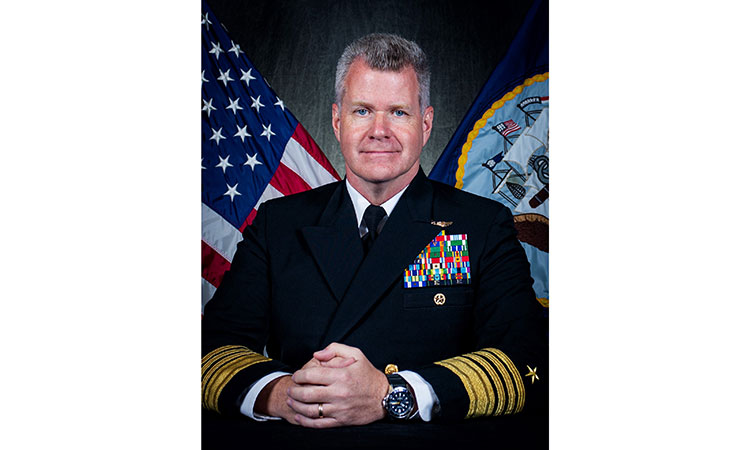
Admiral Samuel Paparo

More about Adm. Samuel Paparo

Adm. Samuel Paparo, a native of Morton, Pennsylvania graduated from Villanova University and was commissioned in 1987. He is the son of a former enlisted Marine and the grandson of a World War II enlisted Sailor. He has earned a Master of Arts in International Studies from Old Dominion University and a Master of Science in Systems Analysis from the Naval Postgraduate School.

A U.S. Naval Aviator, he is a TOPGUN graduate and has flown over 6,000 hours in the F-14, F-15 and F/A-18 and 1,100 carrier landings.

Operational command tours at sea include Strike Fighter Squadron (VFA) 195 in the Forward Deployed Naval Forces, Yokosuka, Japan, deploying in Kitty Hawk Strike Group; VFA 106, NAS Oceana, Va; Commander, Carrier Air Wing 7, embarked in Dwight D. Eisenhower Strike Group and Commander, Carrier Strike Group 10.

Other operational assignments at sea include Fighter Squadron (VF) 14, flying the F-14 Tomcat with USS John F. Kennedy and USS Dwight D. Eisenhower Strike Groups and VFA-15, flying the F/A-18 Hornet with USS Theodore Roosevelt and USS Enterprise Strike Groups.

In joint operational service, he was Director of Operations (J3) at U.S. Central Command, Tampa, Florida; Battle Director at the Combined Air and Space Operations Center, Al Udeid, Qatar; and Commanding Officer of Provincial Reconstruction Team, Nuristan Province, Afghanistan with the 3rd Brigade, 10th Mountain Division and the 173rd Airborne Brigade. He served also on exchange duty with the U.S. Air Force flying the F-15C Eagle with the 71st Fighter Squadron, deploying multiple times to Saudi Arabia and Keflavik, Iceland.

Shore assignments include the staff of Commander, Naval Air Forces, as F/A-18 training, readiness and requirements officer. He was Programming Division (OPNAV N80), Strategy and Resource and Requirements Review Board branch head.

Executive staff tours include service as executive assistant to Commander, U.S. Fleet Forces Command, and executive assistant to the 31st Chief of Naval Operations.

His most recent assignment was commander, U.S. Naval Forces Central Command, U.S. 5th Fleet and Combined Maritime Forces, Manama, Bahrain.

Source: US Navy

Fast Warship Building

Dry Dock Charleston

The article “How Fast Can We Build Warships Today?” discusses the challenges of rapidly building warships in times of crisis, specifically in response to China’s increasing naval power. The author notes that the US Navy’s shipbuilding process is currently slow and inefficient, with complex procurement procedures and limited shipyards.

Key takeaways from the article include:

  • The US Navy needs to be able to rapidly increase its shipbuilding capabilities to counter China’s growing naval power.
  • Current shipbuilding processes are slow and inefficient, and the Navy needs to streamline its procurement procedures and expand its shipyard capacity.
  • Private shipyards could play a larger role in building warships for the Navy.
  • Building a large number of smaller, simpler warships may be a more effective strategy than building a few large, complex ones.

Credit: The National Review, a conservative media outlet that covers politics, policy, and culture. The article was written by Jerry Hendrix, a retired Navy captain and former director of the Naval History and Heritage Command.

Increased Cyber-attacks and other Forms of Aggression to U.S.

Republican lawmakers have sounded the alarm on the growing threats to the US from China, Russia, and Iran according to news reports today. The lawmakers released a report highlighting the challenges faced by the US military, including increased cyber-attacks and other forms of aggression.

Some of the key takeaways from the report include the need to increase funding for the military to counter these threats, the need for a comprehensive strategy to address the challenges posed by China and Russia, and the need to prioritize cybersecurity to prevent future attacks.

This report is of interest to Americans for a Stronger Navy because it underscores the importance of a strong and well-funded military, particularly in the face of growing foreign threats. As one of the primary advocates for a stronger Navy, this report reinforces the need for continued investment in naval power to protect American interests both at home and abroad.

The Unsung Heroes of World War II: The Collaborative Effort of the U.S., the U.K., and Australia in Defeating the Axis Powers

Press reports from Politico reflect that a plan by the United States, Australia, and the U.K are to share submarine technology as part of a strategic effort to counter Chinese naval power in the Pacific. The three countries have agreed to deepen their defense cooperation and share information on the development of new submarines, including advanced propulsion systems and stealth technology. The plan is aimed at strengthening the allies’ ability to detect and deter Chinese submarines, which have become increasingly active in the region. The article also notes that the plan is likely to further strain the already tense relationship between the three allies and China.

Takeaways:

  • The US, Australia, and the UK plan to share submarine technology as a strategic effort to counter Chinese naval power in the Pacific.
  • The plan includes deepening defense cooperation and sharing information on the development of new submarines with advanced propulsion systems and stealth technology.
  • The aim is to strengthen the allies’ ability to detect and deter Chinese submarines that have become increasingly active in the region.
  • The plan is likely to further strain the already tense relationship between the three allies and China.

The Power of Collaboration: The Story of the U.S., the U.K., and Australia in World War

Historical Context

  • The U.S., the U.K., and Australia collaborated in World War II to defeat the Axis powers.
  • The allies faced significant challenges, including the threat posed by German U-boats in the Atlantic.
  • The U.S. and the U.K. developed a plan to build aircraft carriers capable of tracking and destroying enemy subs
  • Australia provided the necessary shipbuilding expertise to build two carriers, which played a key role in the final months of the war.
  • The collaboration between the three nations continued after the war and remains strong today, reflecting the enduring power of collaboration and shared values.
  • In the early days of World War II, the United States, the United Kingdom, and Australia came together in a collaborative effort to defeat the Axis powers. The three nations formed an alliance that would prove to be instrumental in turning the tide of the war.

As the war raged on, the Allies faced numerous challenges and setbacks. One of the most significant was the threat posed by German U-boats, which were wreaking havoc on Allied shipping in the Atlantic. To combat this threat, the U.S. and the U.K. came up with a plan to build a new type of vessel – an aircraft carrier that could launch planes capable of tracking and destroying enemy subs.

The U.S. and the U.K. quickly realized that they didn’t have the resources to build these carriers on their own. They needed help from a nation with a strong naval tradition and the necessary shipbuilding expertise. That nation was Australia.

Australia eagerly joined the project and quickly set to work building two of these new carriers – the HMAS Melbourne and the HMAS Sydney. The carriers were launched in 1945 and played a key role in the final months of the war, helping to track down and destroy numerous German U-boats.

The collaboration between the U.S., the U.K., and Australia didn’t end with the war, however. In the years that followed, the three nations continued to work closely together on a wide range of issues, from defense to trade and beyond.

Today, the bond between the U.S., the U.K., and Australia remains strong, a testament to the enduring power of collaboration and the shared values that unite us all.

Chinese Ships Suspected as Cutting Internet to Taiwan’s Outlying Islands

Several news sources including a report from ABC News, report that Chinese ships have cut the internet access to Taiwan’s outlying islands, which are located close to China. The disruption has affected around 6,000 people, who are now unable to access the internet or make phone calls. The Taiwanese government has condemned the move and said that it is a violation of international law. The incident comes amid rising tensions between China and Taiwan, which Beijing considers a renegade province.

  • Chinese ships have cut off internet access to Taiwan’s outlying islands, affecting about 6,000 people according press report
  • The move has been condemned by the Taiwanese government as a violation of international law.
  • This incident occurs amidst growing tensions between China and Taiwan.

Secretary of the Navy warns China’s warship production outpacing US, emphasizes need for acceleration

Secretary of the Navy, Carlos Del Toro

The Secretary of the Navy, Carlos Del Toro, has expressed concerns over China’s faster production of warships, which could impact the future of the US Navy. Del Toro has called for an acceleration of efforts to keep up with China’s naval modernization by building more warships and expanding its fleet. The report emphasizes the significance of the US Navy’s industrial base in supporting the production of advanced naval technologies. Del Toro made these remarks during a speech at the National Press Club in Washington, D.C.

Takeaways

The Secretary of the Navy has warned that China is outpacing the US in warship production, posing a threat to American naval supremacy.

The US needs to accelerate its efforts to keep up with China’s naval modernization, including building more warships and expanding its fleet.

The US Navy’s industrial base is crucial in supporting the production of advanced naval technologies.

These remarks were made by the Secretary of the Navy during a speech at the National Press Club in Washington, D.C.