Abstract
As I continue to learn from naval professionals, analysts, and thoughtful voices like CDR Salamander, Brent Sadler, and Steven Wills, one reality keeps coming into sharper focus: wars between major powers are not decided by what we start with, but by what we can replace after the fighting begins. Many of our most advanced systems today are designed in ways that make rapid replacement, repair, and adaptation extremely difficult. This is not simply a funding or acquisition issue — it is a design, industrial, and national alignment issue. Understanding this is essential if Americans are to understand what true naval power requires in the 21st century.

Introduction
As I continue this journey with Americans for a Stronger Navy, I find myself learning as much as I am advocating.
One of the most valuable parts of this work has been listening to and reading professionals like CDR Salamander, retired U.S. Navy Commander and widely read naval commentator; Brent Sadler, Senior Research Fellow for Naval Warfare and Advanced Technology at The Heritage Foundation and former U.S. Navy submariner; and Dr. Steven Wills, naval historian and former U.S. Navy officer, who are describing a reality that should concern every American — not just those in uniform or working in the defense industry.
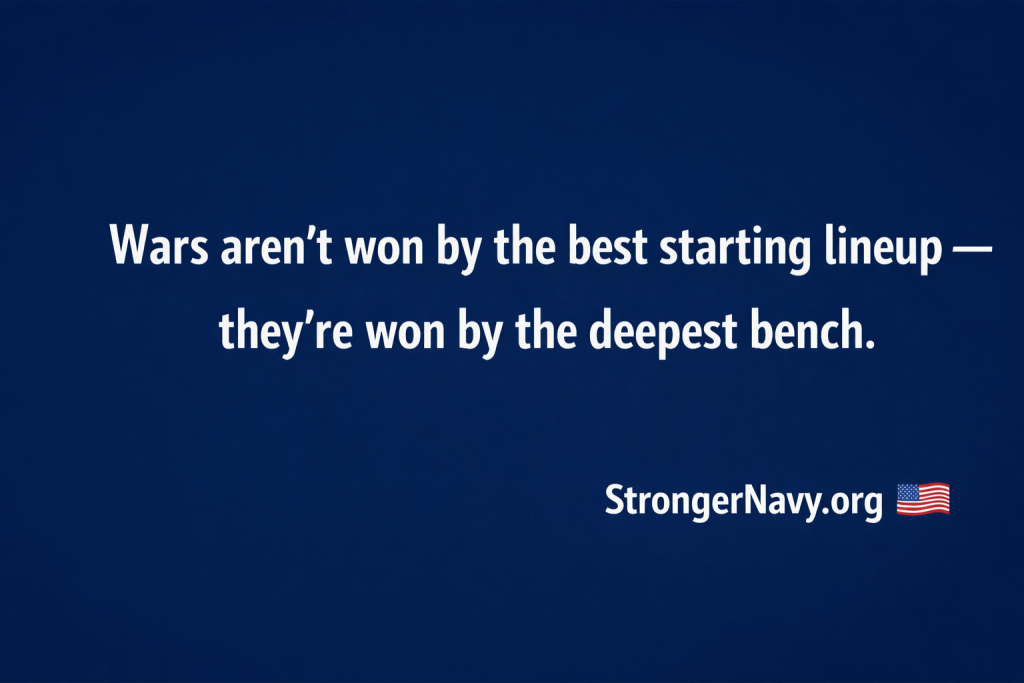
Here’s the light-bulb moment. Imagine two football teams. One starts the game with the best players in the league — faster, stronger, more skilled. The other starts with good players, but has a deep bench. When players get hurt, they substitute quickly. When equipment breaks, they replace it. When fatigue sets in, they rotate fresh players onto the field. By the fourth quarter, the first team is exhausted, short-handed, and can’t keep up. The second team wins.
Wars between major powers work the same way. It’s not the starting lineup that decides the outcome. It’s the depth of the bench.
Today, we have an impressive starting lineup. What professionals like Salamander, Sadler, and Wills are warning us about is the size of our bench.
That was true in World War II. It is proving true in Ukraine today. And it will be true in any future conflict in the Pacific.
Here’s the uncomfortable part: many of the systems we build today are extraordinarily capable — but they are not designed to be built, repaired, or replenished at wartime scale.
The Lesson We Forgot from World War II
In World War II, America did not win because our tanks, ships, and aircraft were perfect. We won because they were designed to be built in massive numbers by the factories we already had. Design matched industrial strength. Throughput, not elegance, won the war.
What CDR Salamander Is Warning Us About
“In a fight defined by attrition, adaptation, and industrial endurance, the winning systems will not be the perfect ones on paper but the ones that can be produced, replaced, and improved the fastest.”
Brent Sadler and Maritime Statecraft
Sadler calls this maritime statecraft — naval power tied directly to shipyards, logistics, trade, workforce, and industry.
Steven Wills and the Structural Slide
Wills shows this is a structural capacity problem, not a readiness statistic.
What This Means for Middle America
Factories, trades, ports, shipyards — naval power begins in American towns long before a ship leaves port.
How We Got Here — The Quiet Erosion of Industrial Depth
This didn’t happen overnight. Industrial redundancy gave way to efficiency. What was once economic change is now understood as national security fragility.
Maritime Commerce — The Part Most Americans Never See
Over 90 percent of global trade moves by sea. Naval strength protects American prosperity.
How the Country Benefits
Stable supply chains, energy security, jobs, reliable trade, and deterrence.
The Good News
The good news is this: America has solved this problem before. In the 1930s, we did not yet have the industrial capacity that would later win World War II. What we had first was understanding. Once Americans understood what was required, industry, workforce, and national focus followed. We are at a similar moment now.
Why Americans Should Care
If war comes in the Pacific, it will not be decided in the first month. It will be decided in month six by who can replace losses fastest.
That’s why we launched Charting the Course: Voices That Matter — a 24-part educational series breaking down how we got here, what went wrong, and what must happen next. Our goal is simple: educate the public, connect the dots, and build the support needed to close the readiness gap before it’s too late.
Let’s roll.