The Questions Americans Deserve Answered (Part 1 of 8)

I served as a blue-water destroyer sailor in the 1970s, and like many veterans, I’ve spent the years since trying to understand how America maintains the naval strength that protects our country, our allies, and the global sea lanes we all depend on.
The charts and analysis below help tell part of that story.
This article is part of Charting the Course: Voices That Matter, our ongoing educational series exploring the future of American sea power and the policies, people, and industrial strength that sustain the U.S. Navy.
If you’re new to the series, you can start with the introduction here:
Inside the Navy’s Future: The Questions Americans Deserve Answered.
This article also launches a focused 8-part series within Charting the Course examining some of the most important questions facing the Navy today — from shipbuilding capacity and fleet readiness to workforce challenges and the future of maritime deterrence.
We’re calling it The Questions Americans Deserve Answered.
For most Americans, the Navy is something we think about only in moments of crisis. A conflict erupts, a carrier group deploys, or a headline mentions tensions in the Pacific or the Middle East.
But the strength of the U.S. Navy is not decided during those moments. It is determined years — sometimes decades — earlier in shipyards, classrooms, industrial plants, research labs, and congressional hearings.
Today the United States faces serious questions about shipbuilding capacity, industrial readiness, and long-term naval strategy. China is building ships at a pace the world has not seen in generations. Russia continues to challenge Western stability at sea. Critical maritime infrastructure and supply chains are increasingly vulnerable to disruption.
And yet many Americans remain understandably disconnected from the decisions shaping the future of our fleet.
The strength of the U.S. Navy is determined long before ships sail into crisis—it is built in shipyards, sustained by skilled workers, and shaped by decisions made years earlier in industry, technology, and national policy.
Why Americans Should Care
America is, and has always been, a maritime nation.
Nearly 90 percent of global trade moves by sea. The global economy depends on secure shipping lanes. Energy markets, supply chains, and the stability of democratic alliances all rely on freedom of navigation.
The U.S. Navy has quietly safeguarded those sea lanes for generations.
But maintaining that advantage requires more than ships — it requires people, industry, technology, and public understanding.
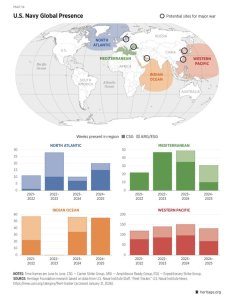
Chart: Global Operational Demand on the U.S. Navy
This Heritage Foundation chart illustrates the geographic reach of U.S. naval operations across multiple regions. Carrier Strike Groups and Amphibious Ready Groups are routinely deployed worldwide, highlighting the constant global demand placed on the fleet.
The Questions Americans Deserve Answered
Over the coming weeks, this series will explore several critical questions about the future of U.S. sea power.
Can America rebuild the shipbuilding capacity required to compete in a new era of great power competition?
Do we have enough skilled workers — engineers, welders, and naval architects — to sustain fleet growth?
How serious is the maintenance backlog affecting submarines and surface ships?
Are current procurement processes helping or hurting the Navy’s ability to modernize?
How should the United States balance aircraft carriers, submarines, uncrewed systems, and logistics platforms?
What role do civilian shipyards and maritime infrastructure play in national security?
Can the United States scale submarine production fast enough to match emerging threats?
And perhaps most importantly: how do we ensure the American public remains engaged in decisions that affect the future of the fleet?
These are not partisan questions. They are national questions.
Understanding the Industrial Challenge
Much of the discussion about naval power focuses on ships already at sea. But the true story begins on land — in America’s shipyards and industrial base.
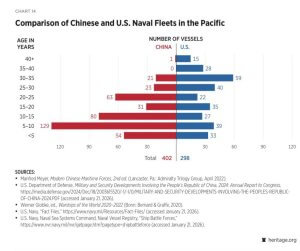
Chart: Age Distribution of Chinese and U.S. Naval Fleets
This chart compares the age distribution of Chinese and U.S. naval fleets. China’s fleet contains a larger number of relatively new ships, reflecting rapid shipbuilding expansion in recent years.
China now possesses the world’s largest shipbuilding industry by a wide margin.
Meanwhile, American shipyards face workforce shortages, supply chain constraints, and unpredictable funding cycles.
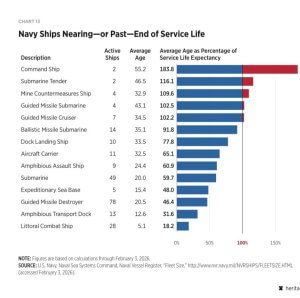
Chart: U.S. Navy Ships Nearing or Exceeding Service Life
This chart shows the growing number of U.S. Navy ships approaching — or exceeding — their expected service life, placing additional strain on fleet readiness and modernization timelines.
The Human Factor
Ships and technology matter — but ultimately the Navy is built on people.
From sailors standing watch at sea tonight to the skilled workers building submarines and carriers at home, the strength of the fleet depends on the dedication and expertise of thousands of Americans.
Implications for Our Allies
America does not operate alone at sea.
Alliances with countries such as Japan, Australia, the Philippines, and NATO partners form a critical part of global maritime stability.
These partnerships reinforce an important truth: deterrence is strongest when democracies stand together.
Public Engagement Matters
The U.S. Navy ultimately belongs to the American people.
Yet the complexity of defense planning can make it difficult for citizens to understand how decisions about shipbuilding, budgets, and strategy affect national security.
That is one of the reasons we created StrongerNavy.org.
Our goal is simple: help Americans better understand the challenges facing the fleet, the industrial base that supports it, and the people who serve at sea and in shipyards across the country.
The Questions Americans Deserve Answered — Series Guide
Part 1 – Understanding the Industrial Challenge (this article)
Part 2 – Can America Rebuild Shipbuilding Capacity?
Part 3 – The Submarine Production Challenge
Part 4 – Maintenance and Fleet Readiness
Part 5 – Workforce and the Maritime Industrial Base
Part 6 – The Role of Allies in Sea Power
Part 7 – Procurement, Policy, and the Future Fleet
Part 8 – Why Public Engagement Matters
That’s why we launched Charting the Course: Voices That Matter — an ongoing
educational series breaking down how we got here, what went wrong, and what must happen next.
Our goal is simple: educate the public, connect the dots, and build the support needed to close the readiness gap before it’s too late.
Let’s roll.