

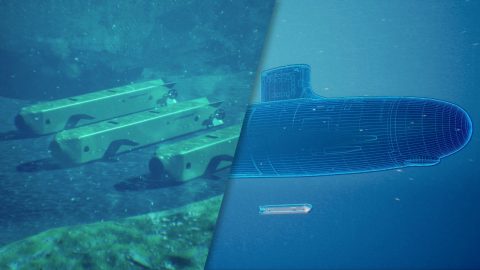
Lockheed Martin has officially pulled back the curtain on a revolutionary piece of naval technology: the Lamprey Multi-Mission Autonomous Undersea Vehicle (AUV).
While the world focuses on high-speed drones, Lockheed is looking at persistence and endurance. Inspired by the natural world, the Lamprey isn’t just a drone; it’s a parasite—in the best way possible.
The Remora Strategy: Hitching a Ride
Named after the fish known for latching onto larger marine animals, the Lamprey drone solves the “energy gap” in undersea warfare. Typically, a small drone wastes most of its battery life just traveling to its mission area.
The Lamprey changes the game
- Passive Transit: It attaches to the hull of a friendly ship or submarine using suction or a mechanical docking system.
- Energy Harvesting: Instead of draining its batteries, it uses small onboard turbines (hydrogenerators) to harvest energy from the water flowing past the host vessel.
- Arrive Fully Charged: By the time the host ship reaches the objective, the Lamprey detaches with 100% battery, ready for combat.
Modular Lethality: A 24-Cubic-Foot Payload
The Lamprey isn’t just a sensor; it’s a modular “Swiss Army knife” for the Navy. Built with an open architecture and a 24-cubic-foot internal payload bay, it can be swapped for various missions without a major redesign: - Anti-Submarine Warfare: Carrying lightweight torpedoes.
- Electronic Warfare: Deploying acoustic decoys and intercepting signals.
- Intelligence Gathering: Using deployable sensor arrays.
- Aerial Dominance: It can be fitted with up to three retractable twin-tube launchers to deploy aerial drones from beneath the waves.
Distributed Warfare: The “Quiet” Threat - In a conflict, these drones are built for persistence. Multiple units can deploy at once, settle quietly on the seabed, and wait. They can sit silently for days or weeks, gathering data and relaying intelligence. When commanded, they shift from passive observers to active disruptors or strike platforms.
- Status Check: Is Lamprey Mission-Ready?
While the technology is groundbreaking, it is important to distinguish between “unveiled” and “fully operational.” Based on recent developments in February 2026, here is the ground truth: - Advanced Prototyping: Lockheed Martin developed the Lamprey using internal research and development (IRAD) funds. This means they built it on their own initiative to prove the concept before seeking a formal government contract.
- Proven at Sea: The drone has already undergone successful sea trials, validating its autonomous maneuvering and “hitchhiking” energy-harvesting capabilities in real-world conditions.
- The “Product on the Shelf”: Lockheed has effectively “handed the keys” to the U.S. Navy. It is a mature system ready for immediate adoption, though it has not yet been designated as an official “Program of Record” for mass production.
The Lamprey addresses the biggest challenge in autonomous undersea systems: endurance. By turning friendly vessels into mobile charging stations, it trades raw speed for staying power.
In a battle space where hiding matters more than sprinting, the Lamprey is the future—quiet, modular, and already in position before the fight begins.