Special Report | March 5, 2026

Cutting through the noise on the world’s most critical waterway — and why this moment calls for resolve, not panic.
There is a lot of noise right now about the Strait of Hormuz. Some of it is accurate. Some of it is not. All of it is loud. Before you form an opinion about what this crisis means — and what America should do about it — you deserve the facts, stated plainly, without an agenda.
That is what we do at StrongerNavy.org. Plain language. Verified facts. No spin.
What Is Actually Happening
The Strait of Hormuz — a 21-mile-wide waterway on Iran’s southern border — is the single maritime exit for the Persian Gulf. Every barrel of oil produced in Saudi Arabia, Iraq, Kuwait, Qatar, the UAE, and Iran that leaves by sea passes through this one gap. It carries 20% of the world’s oil and a substantial share of global liquefied natural gas. There is no alternative route. Ships that cannot use the strait must sail around the southern tip of Africa — adding two to three weeks to every voyage.
Since February 28, that strait has been effectively closed to nearly all commercial shipping. Let’s be precise about what that means.
It is legally open. The U.S. Central Command has confirmed the strait “remains open to international navigation.” Iran has not formally closed an international waterway — it cannot under maritime law.
It is operationally closed. Ship traffic is down 94%, according to the Joint Maritime Information Center. The world’s largest shipping companies — Maersk, Hapag-Lloyd, MSC, CMA CGM — have all suspended transits. Approximately 750 ships are caught in or around the strait, unable to move.
The reason ships stopped is not Iran’s navy. It is marine insurance. A European regulatory framework called Solvency 2 requires insurers to hold capital sufficient for a once-in-200-year loss event at all times. When conflict escalated, insurers recalculated their exposure overnight. Cancelling war risk coverage takes seven days. Raising new capital takes months. The math was simple — and 90% of the world’s commercial fleet lost its coverage. As maritime historian Sal Mercogliano put it plainly on March 4: “It’s not the Iranians closing the strait. The decision was made by the shipping companies.”
Iran’s weapon is not its fleet. It is economic fear. And it has worked — for now.
What It Tells Us
None of this should be a surprise. The vulnerability of the Strait of Hormuz has been documented for decades. Naval planners have war-gamed this scenario repeatedly. The question was never whether it could happen. The question was whether America would be ready when it did.
On March 3, President Trump ordered the U.S. Development Finance Corporation to provide government war risk insurance for all maritime trade in the Gulf — effective immediately, at what he described as “a very reasonable price.” It was the right instinct. Private insurers had fled the market overnight, and the insurance gap — not Iranian guns — was what stopped the ships.
Whether it moves the needle remains to be seen. The shipping industry has signaled the offer may not be sufficient to restore confidence on its own. And if vessels are damaged, American taxpayers could face a bill in the hundreds of millions — potentially billions. The commitment is real. The details are still emerging.
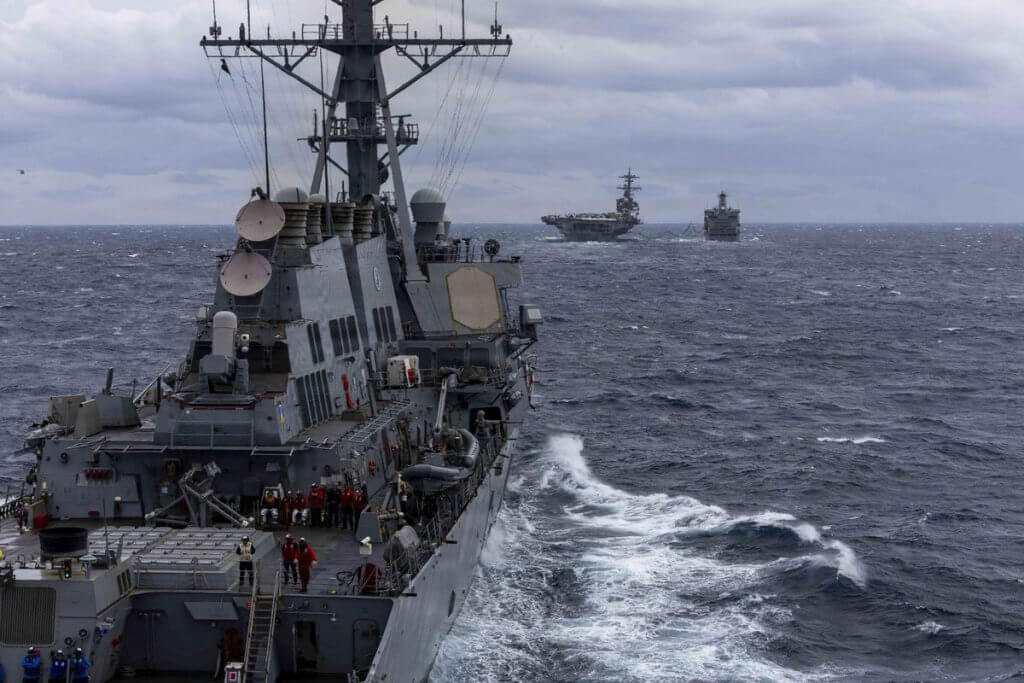
On March 4, President Trump pledged the U.S. Navy would escort commercial tankers through the strait. Within hours, Lloyd’s List reported the Navy had privately told shipping industry leaders it does not currently have sufficient assets to fulfill that commitment. Approximately 125 ships transit the strait daily under normal conditions. The U.S. has roughly eight guided-missile destroyers and three Littoral Combat Ships in the region. As Mercogliano noted: “This is nowhere near enough assets. They just do not have the assets to do it.”
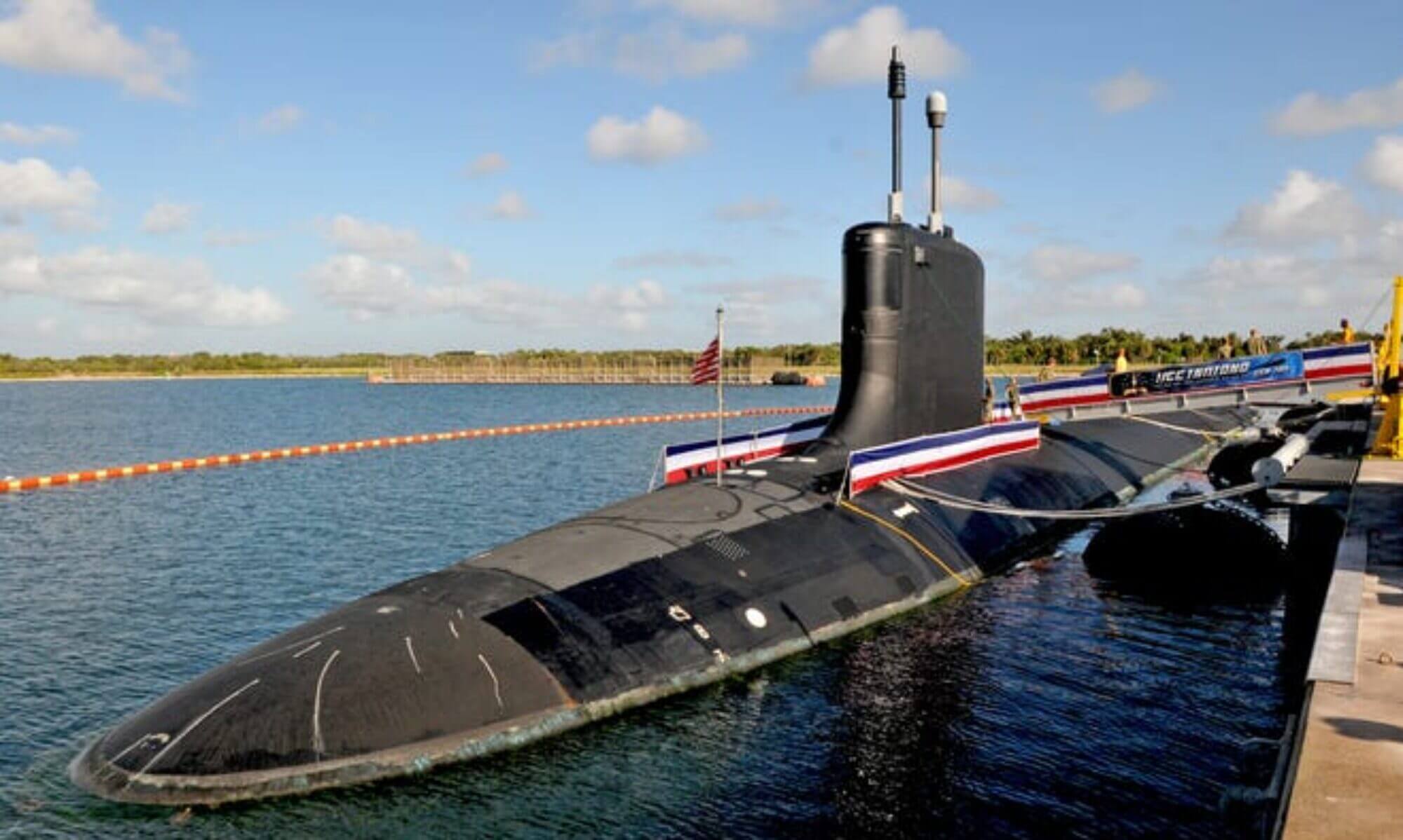
There are no frigates available — because the U.S. has not yet built a replacement frigate. The Littoral Combat Ships present cannot reliably provide air defense against drones and missiles, as the Red Sea campaign demonstrated. And even as U.S. forces degrade Iran’s conventional navy — including the March 4 torpedo sinking of the Iranian corvette IRS Dena, the first U.S. submarine sinking of a warship since World War II — the asymmetric threat remains. Drones, mines, and fast boats do not require a functioning navy. The Houthis proved that. The Ukrainians proved that in the Black Sea.
We also do not know the full readiness picture of the ships operating in the Gulf tonight — because the Navy’s Board of Inspection and Survey readiness reports have been classified since 2008. The American public cannot independently verify whether those vessels are fully mission-capable. That is unacceptable. #FreeTheData
The gap between the President’s public commitment and the Navy’s private assessment is not a failure of this administration alone. It is the accumulated result of a generation of deferred shipbuilding, underfunded shipyards, and what we have long called seablindness — America’s institutional tendency to underinvest in naval power during periods of relative peace, then scramble when a crisis arrives.
You cannot build a destroyer in a crisis. The fleet available tonight was determined by decisions made — and deferred — over the past decade.
We Have Been Here Before
I want to say something that tends to get lost in the noise: America has fixed this before.
I served aboard USS Henry B. Wilson in the 1970s. That was the hollow Navy — undermanned, underfunded, demoralized after Vietnam, outpaced by a Soviet fleet that was growing faster than ours. The readiness gap then was real. The threat was real. The concern among those of us who served was real.
And then America came together and fixed it.
The Reagan-era naval buildup — driven by bipartisan recognition that sea power was not optional for a global superpower — took a Navy that could barely sustain itself and rebuilt it into the 600-ship force that helped end the Cold War without firing a single shot at its primary adversary. It did not happen because of panic. It happened because enough Americans, in and out of uniform, looked at the problem clearly and decided the answer was investment, not retreat.
That is the moment we are in again. The Strait of Hormuz crisis is not the end of the story. It is the alarm clock.
What America Does Now
The framework for action already exists. The President signed Executive Order 14269 restoring America’s maritime dominance. The Maritime Action Plan, released in February 2026, identified exactly the investments needed — shipbuilding capacity, workforce development, industrial base expansion, a Maritime Security Trust Fund with dedicated funding. The National Commission on the Future of the Navy is preparing public hearings in Q2 2026. The SHIPS for America Act has bipartisan support in Congress.
The architecture is there. What has been missing is national will — the public demand that elected representatives treat naval power as the non-negotiable strategic necessity it is.
That is what StrongerNavy.org exists to build. Not alarm. Not partisanship. Not finger-pointing. A clear-eyed, evidence-based, nonpartisan case that a strong Navy is not a Republican issue or a Democratic issue. It is an American issue — as fundamental to our security and prosperity as any question before the country today.
The Strait of Hormuz will reopen. Insurance markets will recalibrate. Ships will move again. But the underlying readiness gap — the shipyard capacity shortfall, the escort deficit, the classified readiness reports, the two-theater question that nobody in Washington wants to answer plainly — will still be there the morning after.
The question is whether this crisis produces the national conversation that leads to real investment, or whether we absorb the shock, breathe a sigh of relief, and go back to sleep.
America does not have to choose seablindness. We chose our way into this. We can choose our way out.
“The time to repair the roof is when the sun is shining.” — John F. Kennedy
The sun is not shining right now. But when it does — and it will — let’s make sure we remember what this week felt like. And build accordingly.
Stay Informed. Stay Engaged.
StrongerNavy.org has been covering the naval readiness gap for over two years — plain language, verified facts, no spin. If this post was useful, share it with someone who needs to understand what is at stake. And follow our ongoing coverage as this crisis develops.
This is America’s wake-up call. What we do with it is up to us.
Sources: USNI News | Lloyd’s List | Bloomberg | CNBC | Axios | Breaking Defense | Navy Times | Seatrade Maritime | AAA | Kpler | S&P Global | Joint Maritime Information Center | U.S. Central Command | Rapidan Energy Group | U.S. Energy Information Administration | Sal Mercogliano, What’s Going On with Shipping (March 4, 2026)