

A recent C-SPAN clip of President Trump discussing South Korea has been circulating, and it’s worth pausing on — not for the politics, but for the arithmetic. Trump described renegotiating South Korea’s cost-sharing agreement for U.S. troop protection, contrasting the roughly $3 billion Seoul agreed to pay against an initial ask of $10 billion, and questioning why the U.S. maintains 39,000 troops defending a wealthy ally that declined to assist with a related Middle East operation [1]. He extended the same complaint to NATO, noting the hundreds of billions the U.S. spends defending Europe from Russia [1].
Set aside whether you think that negotiation was handled well. The underlying question — who pays for the protection America provides? — is one we’ve been asking about naval power for three years, and it’s one the country can no longer afford to leave unanswered.
The Number That Changes the Conversation
As of this month, the U.S. gross national debt stands at roughly $40 trillion — up more than $2.8 trillion in the past year alone, or about $7.9 billion in new borrowing every single day [2]. Net interest now consumes nearly 14 percent of federal outlays, a share the Congressional Budget Office expects to keep climbing [2]. Debt held by the public is already above 100 percent of GDP, and CBO’s own long-term outlook shows that ratio climbing toward 120 percent by the mid-2030s absent reform [3].
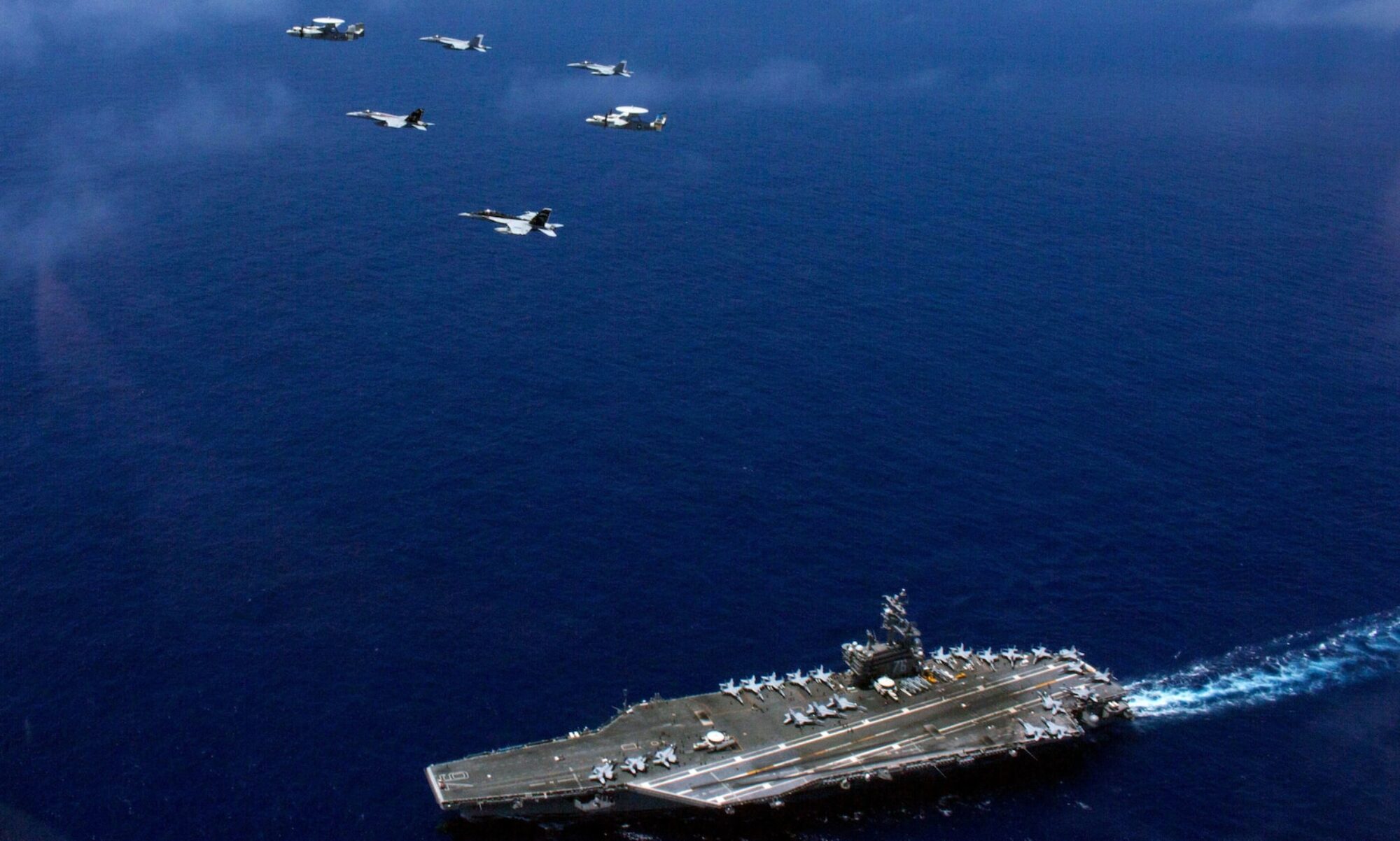
That’s the fiscal backdrop against which every naval modernization request, every shipbuilding appropriation, and every forward-deployed carrier strike group now has to be justified. Taxpayers are not wrong to push back on open-ended commitments funded by more borrowing. As Washington debates spending, the Navy’s own leadership has been blunt that this is fundamentally a resource issue, with the Chief of Naval Operations citing a Congressional Budget Office estimate that an adequate fleet requires something on the order of $38 billion a year in shipbuilding funding alone [4] — funding that has to come from somewhere.
The Gulf Act: Burden-Sharing Where It Belongs
This is exactly the gap the Gulf Maritime Protection and Burden-Sharing Act is built to close. The Strait of Hormuz example is almost too on-the-nose: the U.S. Navy underwrites the security of a chokepoint that carries roughly a fifth of the world’s oil, much of it bound for nations that are not proportionally sharing the cost of keeping that lane open. China alone receives well over a third of the crude that transits the Strait, with India, Japan, and South Korea rounding out the bulk of the remainder — while the United States itself, thanks to domestic shale production and a supply chain built on Canada and Mexico, takes in only a small fraction of that flow [5].
The Iran war earlier this year gave us a live test of what happens when that lane actually closes, and the results make the case for burden-sharing sharper, not weaker. China and Japan largely rode out the closure on strategic reserves and pipeline diversification; India surprisingly weathered it too, on the strength of a decade of stockpile-building [6]. But none of that resilience came free. It meant months of elevated prices, emergency reserve drawdowns, and — for economies like Vietnam with thin buffers — real shortages and rationing [6]. Self-insuring against a closed strait is expensive and imperfect. A functioning U.S. Navy presence that keeps the strait open in the first place is the far cheaper alternative — which is precisely why it’s in these nations’ own economic interest to help fund it, not simply a matter of fairness to the American taxpayer. Trump’s complaint about allies who “don’t want to get involved” in guarding their own energy lifeline is, functionally, the same diagnosis the Gulf Act was written to fix. The Act doesn’t ask American taxpayers to absorb more debt to police a chokepoint for other nations’ benefit — it asks the beneficiaries to pay a proportional share for a service that is, by their own recent experience, worth far more to them than its cost.
The SEAS Act: A Demand Signal That Doesn’t Touch the Debt
The Strategic SEAS Act applies the identical logic domestically. Rather than asking Congress to appropriate still more borrowed dollars into shipbuilding, the Act’s Strategic Technology Responsibility Contribution draws a modest, offset-eligible assessment from U.S. companies with the deepest revenue dependence on China’s economy — the same offshoring era that hollowed out American shipyard capacity in the first place. It creates a dedicated, predictable demand signal for shipbuilders, which is the single thing industry has said it needs most to justify capital investment, without adding a dollar to the $40 trillion balance sheet [7].
That “no new debt” framing matters more today than it did when we first proposed it. Fiscal conservatives, China hawks, and taxpayers who are simply tired of watching the debt clock spin are, for once, aligned on the same conclusion: national defense funding mechanisms that don’t require more borrowing are worth building.
Builders, Not Critics
We’re not in the business of scoring political points off a South Korea negotiation. We’re in the business of pointing out that the underlying math — protection without proportional payment — shows up everywhere, from allied burden-sharing to Wall Street’s China exposure to a shipbuilding budget the Navy itself says is underfunded by billions a year. The Gulf Act and the SEAS Act are the constructive answer: mechanisms that ask the actual beneficiaries of American sea power, foreign and domestic, to help sustain it — instead of asking an already over-leveraged taxpayer to do it alone.
References
[1] C-SPAN, “Trump says Kim Jong Un has responded to overtures,” transcript, 2026.
[2] Joint Economic Committee (Republicans), Monthly Debt Update, August 2026.
[3] Congressional Budget Office, The Budget and Economic Outlook: 2026 to 2036, February 2026.
[4] Remarks by Adm. Daryl Caudle, CNO, West 2026 conference, San Diego, February 12, 2026, as reported by Janes.
[5] International Energy Agency, “Strait of Hormuz Factsheet,” February 2026; U.S. Energy Information Administration, Q1 2025 destination data.
[6] Gulf International Forum, “Hormuz Disruptions and Asia’s Energy Resilience,” March 2026; The National Interest, “How China Turned the Strait of Hormuz Crisis into an Advantage,” June 2026; India Narrative, “The Strait That Didn’t Break India,” July 2026.
[7] Americans for a Stronger Navy / Center for Maritime Strategy, “Defense Reinvestment as Naval Strategy,” March 2026.