Underwritten by Americans for a Stronger Navy, supported by U.S. Maritime Action and moderated by Capt. Brent Sadler, USN (Ret.), the series asks shipbuilders, mariners, veterans, industry and Navy leaders the same three questions, and will publish a common-ground report at the end of November.
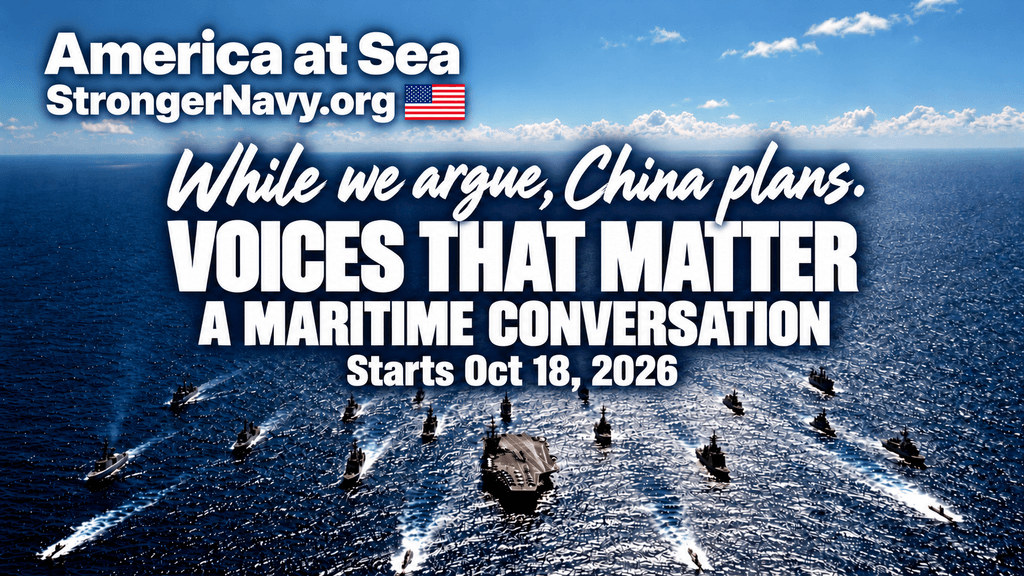
October 21, 2026 — Americans for a Stronger Navy, a nonpartisan not-for-profit organization, has launched America at Sea: Voices That Matter, a 45-day national conversation about how the United States rebuilds its strength at sea. The series runs from October 18 through the end of November 2026, as Congress works to finish this year’s defense bill.
The series is underwritten by Americans for a Stronger Navy, supported by U.S. Maritime Action, founded by former shipyard engineer Clay Wirsing, and moderated by Capt. Brent Sadler, USN (Ret.), a former nuclear submarine officer and longtime maritime strategist.
The stakes are clear. Last year China built more than half of the world’s new commercial ships, while the United States built about one-tenth of one percent. China’s navy has more than 370 ships and is headed to 435 by 2030; the U.S. Navy has about 290. Almost everyone agrees America needs more ships. The arguments are over which ships, who builds them and who pays. America at Sea starts instead with what people already agree on.
“The people who know this best rarely get heard outside Washington,” said Bill Cullifer, founder and executive director of Americans for a Stronger Navy and a former destroyer sailor. “While we argue, China plans. We’re starting with what shipbuilders, mariners, labor and the Navy community already agree on, because arguments stall and common ground moves.”
“It’s not just something for a few technocrats here in Washington, D.C., because that’s not going to work. It’s never worked in the past,” said Capt. Sadler in the series’ opening conversation.
Clay Wirsing, who began his career as a welding engineer at Newport News Shipbuilding, said: “Not a lot has changed since then in terms of actual shipbuilding capacity, but we do now see a ton of momentum.”
Retired Navy commander and naval writer CDR Salamander put it simply: “People are policy. People run programs. People work budgets.”
How it works. The series covers the whole fleet America depends on at sea: the Navy’s combat ships, the support and auxiliary ships that keep them supplied, and the civilian merchant fleet that carries our cargo. It also covers the shipyards that build and repair them, the mariners and skilled workers behind them, and the industrial base and funding that keep it all going. Each voice gets about ten minutes and the same three questions:
- What’s working right now that we should do more of?
- What’s the biggest barrier to rebuilding America at sea?
- If you could fix one thing first, what would it be?
Episodes post at StrongerNavy.org/blog and on X (@StrongerNavy), where the public is invited to weigh in. Guests include shipbuilders, merchant mariners, labor, ports, industry, veterans, the Navy and Coast Guard community, and policy experts. The series has also explained the SHIPS for America Act, the bipartisan maritime bill whose provisions passed the House this summer as part of the defense bill.
What’s next. At the end of November, Americans for a Stronger Navy will publish a common-ground report: where these voices agree, in their own words, and where they differ. Organized by theme and noting the sector and state of each voice, the report is written for policymakers, their staffs and the public, and will note where shared views relate to maritime provisions now under consideration. Maritime professionals interested in taking part can record by Zoom or on their own time.
About Americans for a Stronger Navy
Americans for a Stronger Navy works to help Americans better understand the importance of maritime strength, naval readiness, and the industrial base that sustains the fleet. It connects experts, veterans, historians and policy voices through two initiatives: Charting the Course, an ongoing series of more than 800 articles and analyses, and America at Sea: Voices That Matter. The organization is a nonpartisan 501(c)(3) based in Folsom, California. America at Sea is educational and does not urge support for or opposition to any legislation. StrongerNavy.org
About U.S. Maritime Action
U.S. Maritime Action, founded by Clay Wirsing, works to build public support for a strong American maritime industry.