Fighter Pilot’s Three Answers —Matthew “Whiz” Buckley

America at Sea: Matthew “Whiz” Buckley

America at Sea: Voices That Matter is a 45-day maritime conversation hosted by Americans for a Stronger Navy with U.S. Maritime Action and moderated by Capt. Brent Sadler, USN (Ret.). Each voice answers the same three questions: What’s working? What’s the biggest barrier? What would you fix first?

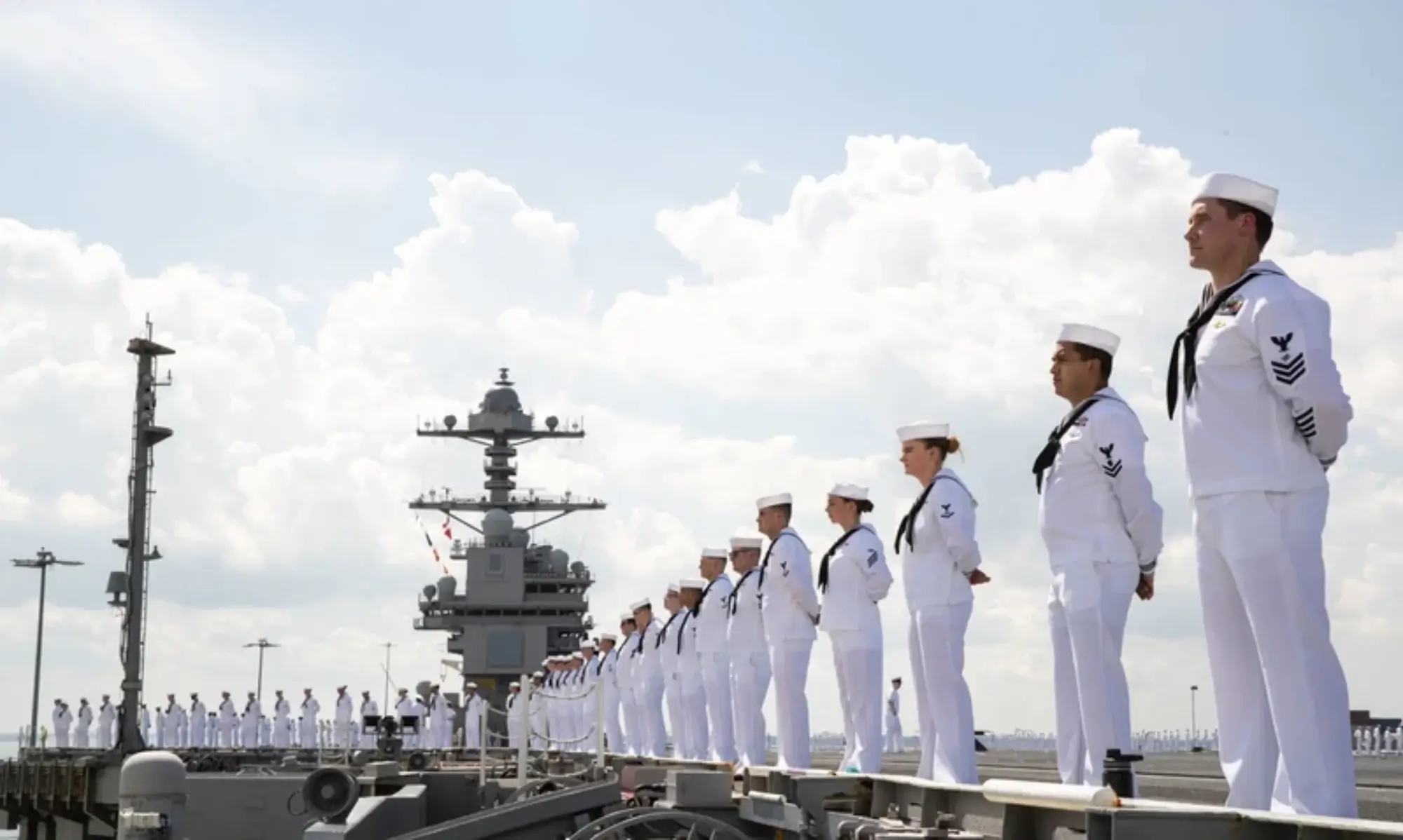
Matthew “Whiz” Buckley flew the F/A-18 Hornet for the U.S. Navy for about 15 years. He graduated from the Navy Fighter Weapons School adversary program, flew combat sorties over southern Iraq in support of Operation Southern Watch, deployed aboard USS Abraham Lincoln and USS Kitty Hawk, and was mobilized for Operations Noble Eagle and Enduring Freedom. After a stint on Wall Street, he founded the No Fallen Heroes Foundation, a nonprofit dedicated to ending veteran suicide [1].

He answers like a fighter pilot: direct, fast, and with no wasted motion.

What’s Working: Forward Presence

For Buckley, the answer starts with the oldest question in American crisis management: when something goes wrong in the world, the first thing a president asks is where’s the nearest carrier?

He tells the story on a friend, Gen. Dan “Razin” Caine, an F-16 pilot Buckley has known for decades. Whenever something happens, Buckley says, even an Air Force fighter pilot has to ask where the boats are: the carriers, the subs, the nearest strike group, the nearest Marine Expeditionary Unit.

“What’s working with the Navy is being forward deployed, projecting our power on 75% of this planet, which obviously is water. When we can put four and a half acres of sovereign U.S. territory off somebody’s coast, it allows us to project power and get the job done.”

The Biggest Barrier: Deployments That Wear Out Ships, Aircraft, and People

The same forward presence that works is also the barrier. Deployments are getting longer, and they are combat deployments. Carriers have been dodging missiles, and an F/A-18 went over the side of a carrier during hard maneuvering to evade hostile fire [2].

“Literally every landing I had in the F-18 Hornet was a car crash. It’s the equivalent force. So we’re beating up the airplanes, we’re beating up the boats, and we’re beating up the people, and you can only do that for so long.”

His prescription is plain: more carriers, more air wings, more ships. And he takes the threat at its word. He points to the 2027 date for the People’s Liberation Army to be ready to take Taiwan, a timeline U.S. intelligence officials have said Xi Jinping set for his military [3].

“The threat ain’t getting less, it’s getting more. We’re really putting our Navy and Marine Corps team to a lot of stress right now. And I think our leaders need to address that.”

Fix One Thing: Peace First, Then Overwhelming Force

Asked what he would fix first if he were king for a day, Buckley starts somewhere unexpected: there wouldn’t be any wars. He says he never served with anyone who wanted to go kill people, and he paraphrases General Douglas MacArthur’s observation that the soldier, above all others, prays for peace because he must bear the deepest wounds of war.

But the world has people who wish America harm. If the nation has to fight, he says, it should fight to end the war quickly. He contrasts the grinding war in Ukraine and 20 years in Afghanistan and Iraq with the Powell and Schwarzkopf doctrine of overwhelming force.

“If I were king for a day, I’d want peace. But if we get pushed to the point of having to use force, overwhelming massive firepower. And that’s where a strong Navy is going to come in.”

Where to Learn More

Buckley’s passion today is the No Fallen Heroes Foundation. More than five years ago, he traveled to Mexico with Marcus Luttrell, the Navy SEAL and author of Lone Survivor, for psychedelic-assisted therapy that he says saved and changed his life. In April 2026, he and Luttrell were in the Oval Office when President Trump signed an executive order directing federal agencies to accelerate research and review of psychedelic treatments for PTSD and other conditions affecting veterans [4].

The foundation gives grants to veterans and their families. And Buckley closes with a personal offer:

“If you’re a veteran and you’re not in a good place, man, I’m available 24/7. I’m here for you. Healing is possible. There is a way out.”

Learn more at NoFallenHeroes.com and WhizBuckley.com [1][5].

If you are a veteran in crisis, or worried about one, call or text the Veterans Crisis Line: dial 988, then press 1 [6].

The Takeaway

Buckley’s three answers make one argument. Forward presence is what America’s Navy does best, and it is wearing out the ships, aircraft, and sailors who provide it. The fix is a Navy big enough to stay forward without breaking, strong enough that adversaries never test it, and decisive enough to end a fight quickly if they do.

He also brings something no other guest has: a reminder that the people who serve carry the cost long after they come home. A stronger Navy means taking care of them too.

—

About America at Sea

America at Sea: Voices That Matter is a 45-day maritime conversation launched October 18, 2026, by Americans for a Stronger Navy with U.S. Maritime Action. Moderated by Capt. Brent Sadler, USN (Ret.), the series asks shipbuilders, mariners, industry leaders, the Navy community, and policy experts the same three questions. A common-ground report will be delivered to policymakers, their staffs, and the public at the end of November.

Learn more: StrongerNavy.org

—

About the Guest

Matthew “Whiz” Buckley flew the F/A-18 Hornet for the U.S. Navy for about 15 years. A graduate of the Navy Fighter Weapons School adversary program, he flew combat sorties over southern Iraq in support of Operation Southern Watch, deployed aboard USS Abraham Lincoln and USS Kitty Hawk, and was mobilized for Operations Noble Eagle and Enduring Freedom. He is the founder of the No Fallen Heroes Foundation, a nonprofit dedicated to ending veteran suicide.

—

References

[1] No Fallen Heroes Foundation: https://nofallenheroes.com
[2] In April 2025, an F/A-18E Super Hornet and its tow tractor were lost overboard from USS Harry S. Truman in the Red Sea when the carrier turned hard to evade Houthi fire. Both crew members survived.
[3] In February 2023, CIA Director William Burns said U.S. intelligence indicated Xi Jinping had instructed the People’s Liberation Army to be ready to invade Taiwan by 2027, while noting that this did not mean Xi had decided to do so.
[4] The White House, “President Trump’s Landmark Order Advances Breakthrough Mental Health Treatments — Delivering New Hope to Veterans,” April 20, 2026. The executive order was signed April 18, 2026.
[5] Matthew “Whiz” Buckley: https://whizbuckley.com
[6] Veterans Crisis Line: https://www.veteranscrisisline.net

Strategy First — Dr. Steven Wills

America at Sea: Voices That Matter is a conversation hosted by Americans for a Stronger Navy, supported by U.S. Maritime Action and moderated by Capt. Brent Sadler, USN (Ret.). Shipbuilders, mariners, industry, the Navy community and policy experts answer the same three questions about rebuilding America at sea: What’s working? What’s in the way? What would you fix first?

Our guest is Dr. Steven Wills, Navalist at the Navy League’s Center for Maritime Strategy and a senior advisor to Americans for a Stronger Navy [1][2]. Steve served 20 years as a Navy surface warfare officer, including as executive officer of a mine countermeasures ship, before earning a PhD in military history. He is the author of Strategy Shelved: The Collapse of Cold War Naval Strategic Planning and, with former Navy Secretary John Lehman, Where Are the Carriers? [1]

Question 1: What’s working now?

Steve sees more interest in shipbuilding than at any time in the last 25 years. There is bipartisan, bicameral interest in the SHIPS for America Act and in the President’s Maritime Action Plan, and voices across Washington and the country are saying the same thing: we don’t build enough ships.

He thinks COVID was the wake-up call. People found out their toilet paper and frozen fish came from somewhere else, on a ship, and that very few ships fly the American flag. Meanwhile the Navy went from close to 600 ships at the end of the Cold War to fewer than 300 today, despite a 355-ship goal on the books for a decade.

“There is really a significant interest in fixing the maritime industrial base in this country. And I’m very heartened by that. Good time for all of us to throw in and try and make that work better.”

Question 2: What are the barriers?

Steve sorts them into three kinds: structural, cultural and economic.

Structural. Warships are funded one year at a time. A program might get full funding one year and less the next, and Congress has run on continuing resolutions “forever,” which means last year’s funding for this year’s problems. For 35 to 40 years after the Cold War, there was also no threat at sea to rally around. The Navy became a supporting force for wars in Southwest Asia. The rise of China’s navy has changed that, and he sees the Navy reworking its acquisition processes in response.

Cultural. “We told people to go away from the trades. We said everybody should go to college.” Now the country needs those tradespeople more than ever if it wants to bring basic industries home.

Economic. The industry has shrunk, so ships cost more to build. They are also far more complex than the ships of the 1990s, which calls for new technology, new workers and new ways of building.

Question 3: What would you fix first?

Steve’s answer is a maritime strategy, like the one the Navy had in the 1980s under President Reagan, led by Navy Secretary John Lehman and the admirals of that era.

“It really said, this is what the Navy is gonna do in peace and war. And here’s exactly the fleet that you need to accomplish these missions. We had that very well defined. We don’t have that as much now.”

For anyone who wants to dig deeper, he points to two Center for Maritime Strategy publications, both free online:

Returning from Ebb Tide: Renewing the United States Commercial Maritime Enterprise [3], which Steve edited, covers how America used to build ships and how it got away from that. It includes ideas from contributors including Capt. Brent Sadler, a section on Military Sealift Command as the backstop for a country that “always plays an away game,” and a section on recruiting, training and keeping mariners, written by California maritime academy instructors.

Pier Review: Leveraging the Allied Maritime Industrial Base for U.S. Shipbuilding [4] comes from visits to shipyards in South Korea, Italy, Sweden, the United Kingdom and Canada. The point, he says, is not to build American ships overseas. It is to learn what allies do well and apply it at home.

The takeaway

Steve sees a rare moment of national attention on shipbuilding, and real barriers in budgets, workforce and cost. His first fix is the one that ties the rest together: a clear strategy that says what the Navy must do and what fleet it takes to do it. As always, these are the guest’s views, and featuring them is not an endorsement. What do you think?

About America at Sea: Voices That Matter

America at Sea: Voices That Matter is a conversation hosted by Americans for a Stronger Navy, supported by U.S. Maritime Action and moderated by Capt. Brent Sadler, USN (Ret.). Shipbuilders, mariners, industry, the Navy community and policy experts answer the same three questions about rebuilding America at sea. Views expressed are the speaker’s own, and featuring a view is not an endorsement.

Join the conversation on X. What’s working? What’s in the way? What would you fix first?

About the Guest

Dr. Steven Wills is the Navalist at the Center for Maritime Strategy of the Navy League of the United States and a senior advisor to Americans for a Stronger Navy. He served 20 years as an active-duty Navy officer, retiring in 2010, with sea tours on small and medium surface combatants, including as executive officer of a mine countermeasures ship, and shore tours at the Defense Intelligence Agency and NATO commands in Naples, Italy. He holds a bachelor’s in history from Miami University, a master’s in national security studies from the U.S. Naval War College, and a master’s and PhD in military history from Ohio University. He is the author of Strategy Shelved (Naval Institute Press, 2021) and co-author, with John Lehman, of Where Are the Carriers? (2021) [1][2].

References

[1] Center for Maritime Strategy, “Dr. Steven Wills.” https://centerformaritimestrategy.org/experts/dr-steven-wills/
[2] Americans for a Stronger Navy, “Steven Wills, Senior Advisor.” https://strongernavy.org/steven-wills/
[3] Center for Maritime Strategy, Returning from Ebb Tide: Renewing the United States Commercial Maritime Enterprise. https://centerformaritimestrategy.org
[4] Center for Maritime Strategy, Pier Review: Leveraging the Allied Maritime Industrial Base for U.S. Shipbuilding. https://centerformaritimestrategy.org/publications/pier-review/

Free trade isn’t free — CAPT Bill Hamblet

America at Sea: Voices That Matter is a conversation hosted by Americans for a Stronger Navy, supported by U.S. Maritime Action and moderated by Capt. Brent Sadler, USN (Ret.). Shipbuilders, mariners, industry, the Navy community and policy experts answer the same three questions about rebuilding America at sea: What’s working? What’s in the way? What would you fix first?

Our guest is CAPT Bill Hamblet, USN (Ret.), Editor-in-Chief of Proceedings, the U.S. Naval Institute’s flagship magazine [1][2]. He spent nearly 30 years as a Navy intelligence officer, serving with an F/A-18 squadron, a SEAL team, a carrier air wing and a carrier strike group. Ashore, he served as naval attaché to Russia, led the China Division at the Joint Intelligence Operations Center in the Pacific, and was in the Pentagon on September 11, 2001, where he helped lead the initial intelligence response [1]. His views here are his own, not those of the Naval Institute.

Question 1: What’s working now?

Bill starts with the people. Carrier strike groups, destroyers and logistics ships have been deploying for 10, 11 and even 12 months at a time over the past year or two, with one or two port visits or none at all. He calls that unheard of since the Vietnam War. The fleet has run combat operations, blockades, strike warfare and mine warfare at the end of long supply lines.

He points to Operation Epic Fury, when Fifth Fleet’s headquarters in Bahrain, also a key logistics hub, was lost on day two. The fleet adapted and kept its carrier strike groups armed, fueled and on station.

“For any graybeards or veterans out there who want to say that today’s sailors are just a bunch of snowflakes, I would challenge you to go on a 9, 10, 11, 12 month deployment with 0, 1, 2 port visits.”

He is just as clear that this pace can’t last. Navy leaders, including Chief of Naval Operations Adm. Daryl Caudle, have been saying the fleet will need a reset after being “ridden hard and put away wet” [3]. But credit goes where it is due: the sailors and officers of today’s fleet “have performed magnificently.”

Question 2: What are the barriers?

Bill names two. The first is that America took sea power for granted after the Cold War, and that cut across both parties. The Navy shrank from almost 600 ships in 1988 to fewer than 300 today. As he puts it, borrowing a line he has heard from others, we are running an 11-carrier Navy in a 15- or 17-carrier world.

Open sea lanes, he reminds us, were never a given. They were bought and guaranteed by the U.S. Navy and its closest allies in World War II, then patrolled through the Cold War. The Reagan buildup toward a 600-ship Navy helped defeat the Soviet Union. Then the country drifted.

“Free trade isn’t free. Its price is a strong Navy working in concert with strong like-minded allies to keep global sea lines open and protected.”

The second barrier is that the government has been a bad customer. Budgets fluctuated, requirements and designs changed, and the Navy tried to do too much with the lead ships of several classes. Building carriers, destroyers and submarines takes heavy capital and a large skilled workforce. Telling a builder like Huntington Ingalls or General Dynamics Electric Boat “five, no two, no one, and four in three years” is, in his words, hell on those companies and their workers.

“It’s really important that Congress, the Department of Defense and the Navy specifically send consistent demand signals, pass budgets on time and minimize change orders.”

Question 3: What would you fix first?

Bill’s answer starts with the public. Americans need to understand that China, and to a lesser extent Russia, Iran and North Korea, are already at war with us in the gray zone, below the threshold of open conflict, while preparing to fight if they must. China’s navy already outnumbers ours in ships, and he expects it to pass us in total tonnage within about five years.

“They’re putting new ships in the water like dumplings in the soup.”

During the Cold War, he says, most Americans understood we were in a long game with a serious adversary: the space race, the military buildup, NATO and the defense of Western Europe. We need to get back on that footing and understand what China wants the world to look like by mid-century.

“Without a strong Navy, nothing the United States wants to accomplish is possible. If our citizens and their elected leaders understood that we’re in a serious contest, and that naval power were key to their security, key to their way of life, I think appropriate strategy and investment would follow.”

More from the conversation

After the three questions, we kept talking, and Bill added a few points worth sharing.

“The strongest military in the world.” Presidents of both parties, he noted, routinely tell military audiences that America has the strongest military in the world. Repeated often enough, that message tells the public there is nothing to worry about. When he tells family that naval power is not trending well, the answer he sometimes gets is, “I saw Top Gun: Maverick. Looked pretty good.”

What a broken demand signal costs. On a tour of General Dynamics Electric Boat, he was told that during the 1980s buildup the U.S. was buying about four and a half submarines a year, and Electric Boat had about 26,000 workers. After the Cold War, orders fell to roughly one submarine in five years and the workforce fell to about 6,000. A decade later, when the Navy wanted one Virginia-class boat a year again, the yards struggled to deliver, and they still are.

Too much on one hull. He pointed to the Zumwalt-class destroyer and the Ford-class carrier as examples of packing too many new technologies onto a single class at once.

A book to read. He recommended Arthur Herman’s Freedom’s Forge, which tells how industrialists like William Knudsen and Henry J. Kaiser turned American industry toward war production before and during World War II, and why the companies doing that work had to be able to turn a profit [4].

The takeaway

Bill sees a fleet performing remarkably under heavy strain, and a country that forgot sea power has to be paid for. His fixes run from Washington to the kitchen table: steady demand signals and on-time budgets for the builders, and a public that understands the contest we are in. As always, these are the guest’s views, and featuring them is not an endorsement. What do you think?

About America at Sea: Voices That Matter

America at Sea: Voices That Matter is a conversation hosted by Americans for a Stronger Navy, supported by U.S. Maritime Action and moderated by Capt. Brent Sadler, USN (Ret.). Shipbuilders, mariners, industry, the Navy community and policy experts answer the same three questions about rebuilding America at sea. Views expressed are the speaker’s own, and featuring a view is not an endorsement.

Join the conversation on X. What’s working? What’s in the way? What would you fix first?

About the Guest

CAPT Bill Hamblet, USN (Ret.), is Executive Vice President for Periodicals and Editor-in-Chief of Proceedings at the U.S. Naval Institute, which he joined in 2016 as deputy editor-in-chief. A 1987 graduate of the U.S. Naval Academy, he served nearly 30 years as a Navy intelligence officer, including tours with an F/A-18 squadron, a SEAL team, a carrier air wing and a carrier strike group, on the Joint Staff J-2, as naval attaché to Russia, as head of the China Division at the Joint Intelligence Operations Center, Pacific, and at the National Counterterrorism Center. He holds a master’s in national resource strategy from the Eisenhower School at National Defense University [1].

References

[1] U.S. Naval Institute, “CAPT Bill Hamblet, USN (Ret.).” https://www.usni.org/about-us/executive-staff/capt-bill-hamblet-usn-ret
[2] U.S. Naval Institute, Proceedings. https://www.usni.org/magazines/proceedings
[3] USNI News, “New CNO Caudle Calls for New Fleet Design in First Speech,” August 25, 2025. https://news.usni.org/2025/08/25/new-cno-caudle-calls-for-new-fleet-design-in-first-speech
[4] Arthur Herman, Freedom’s Forge: How American Business Produced Victory in World War II (Random House, 2012).

Steady Orders, Steady Yards — Michael Roberts

America at Sea: Voices That Matter is a conversation hosted by Americans for a Stronger Navy, supported by U.S. Maritime Action and moderated by Capt. Brent Sadler, USN (Ret.). Shipbuilders, mariners, industry, the Navy community and policy experts answer the same three questions about rebuilding America at sea: What’s working? What’s in the way? What would you fix firstOur guest is Mike Roberts, Senior Fellow at the Hudson Institute’s Center for Defense Concepts and Technology and a nonresident senior fellow with the Navy League’s Center for Maritime Strategy [1][2]. Before Hudson, Mike spent decades inside the American maritime industry. He was general counsel and senior vice president of government relations at Crowley, and he served as president and chairman of the American Maritime Partnership [1][2]. He works from Jacksonville, Florida, and has spent the last few years talking with members of Congress from both parties about how America gets back into the business of building and sailing its own ships.

Question 1: What’s working now?

Mike starts with something easy to overlook: the country is waking up. For decades, he says, Americans have had “sea blindness.” Most people didn’t know where their stuff comes from or why the commercial maritime industry matters, and had at best a vague idea of why the Navy matters. “That is changing,” he says. “The good news is it’s changing. The bad news is it’s changing because there’s a real reason for that.”

He points to three things that are working.

A serious bill in front of Congress. The SHIPS for America Act is bipartisan and bicameral, with support in both the House and the Senate. Mike calls it what would be “the most consequential legislation since 1936,” the year of the Merchant Marine Act. More than 100 lawmakers are now pushing to include it in this year’s defense bill [4].

Trade tools are in play. The Section 301 case at the U.S. Trade Representative put fees on Chinese-built and Chinese-owned ships calling at U.S. ports. The investigation began under the Biden administration, and the Trump administration imposed the fees in 2025. They were suspended for a year in November 2025 under a U.S.-China trade deal, and USTR has proposed extending the pause to January 2027 [5]. “We’ll see where that goes,” Mike says, “but at least that’s in play.”

Private capital is leaning in. The poster child is Hanwha, the Korean shipbuilder that bought Philly Shipyard [6]. Fincantieri owns the Marinette yard in Wisconsin, and other allied shipbuilders are looking at U.S. partnerships because Washington is signaling that real investment may pay off.

“We are well ahead of where we were in terms of an understanding of the need to move forward. And that’s encouraging.”

Question 2: What are the barriers?

The big-picture barrier, Mike says, is a mindset stuck in the 1990s, and it cuts across both parties. In his view, progressives struggle to accept that America has real enemies, while conservatives cling to the idea that the market will solve every problem. Both views made sense for most of a generation, from about 1990 to 2015. “But they leave us very vulnerable,” he says. “We have real enemies, and they are playing a totally different game than we’re playing when it comes to free trade and economics.”

The specific barrier is the lack of a consistent source of demand to build commercial ships in U.S. shipyards and sail them under the U.S. flag. He is not talking about Navy or Coast Guard ships, where demand is way up. He means cargo ships, whose buyers have no reason to be loyal to American yards and buy Chinese ships because that’s where they get the best deal.

Growing that commercial base matters for two reasons. It would diversify and grow the shipbuilding industrial base, meaning the workforce, the facilities and the supplier base, using commercial dollars on top of government dollars. And a larger U.S.-flag fleet gives the Pentagon more ships and more skilled American mariners to keep troops supplied in a conflict. It’s the same dual-use idea America has relied on before.

So where does the demand come from? The domestic Jones Act market is small, about a hundred self-propelled cargo ships, with limited room to grow. The international market is huge, around 60,000 ships, by Mike’s count. But U.S. costs run two to three times China’s before you count Chinese subsidies. American workers have options and need decent pay to work in a shipyard or spend months at sea. Chinese steel is heavily subsidized and costs roughly half as much as American steel. Even Korea, he notes, gets a large share of its steel and components from China.

Mike offers two cautions. First, cutting regulation won’t close the gap. “I have fought unnecessary regulation my whole career,” he says, but the idea that we can make up much ground on China that way “is not remotely realistic.” Second, innovation alone won’t get us back in the game. China builds far more ships than we do – almost 300 for every one of ours (corrected from the 75-to-1 estimate mentioned in the video).  And China has more industrial robots than the rest of the world combined. “We can’t expect to lead in shipbuilding if we’re not actually building ships.”

“Shipyards don’t invest in capacity or in upgrades for episodic, ship-by-ship procurement. They do that when they can see a 10-to-15-year production horizon with a lot of contractual certainty.”

Everything tried over the last 50 years, from the Maritime Security Program to Title XI loan guarantees to cargo preference, has been piecemeal. Each program is modest, and none is guaranteed to continue. Meanwhile, Mike says, China holds 75 percent or more of new ship orders, close to 90 percent for some ship types like VLCC supertankers.

“They see decades of guaranteed demand. Our shipyards see appropriation cycles.”

Question 3: What would you fix first?

Mike’s answer is specific: pass and fund the Strategic Commercial Fleet program in the SHIPS for America Act [3][7]. “It’s the one piece of the SHIPS Act that creates sustained demand,” he says: 250 U.S.-built, U.S.-flagged ships over 15 years. Shipyards would get the demand signal, plan against it and innovate.

He likes many other parts of the bill, like rejuvenating Kings Point and the state maritime academies, and grants for shipyards to upgrade. But his test for any provision is how many commercial ships it actually gets built and flagged in the United States. “If we don’t have demand for the ships, there won’t be jobs for the people when they graduate,” he says, and the grant money won’t be used without customers.

The ships in the program would sign emergency preparedness agreements, a national security commitment. Mike says commercial freight revenue would cover roughly half the cost, about a dollar for every federal dollar, and that includes money from Chinese exporters. “It’s not a subsidy program. It’s an industrial policy program that’s disciplined by a competitive bidding process.” The federal share is meant to be covered by trade-related fees through the Maritime Security Trust Fund. He puts the cost at about $1.8 billion a year gross, or $1.3 billion net after savings, such as replacing part of the aging Ready Reserve Force. That fleet keeps about 40 ships, many of them 45-year-old steamships, in storage.

“In federal budget terms, it’s a rounding error. In maritime terms, it will rebuild the industry.”

“If we don’t act on it in this Congress, we’ll be having the same conversation five years from now, and we’ll have an even bigger hole to fill.”

The takeaway

Mike sees real progress: a public waking up, a bipartisan bill, trade tools in play and private money coming in. His core point is simple, though. Shipyards build to steady demand. Training programs, grants and regulatory fixes help, but they don’t put orders on the books. For Mike, the Strategic Commercial Fleet is the piece that does, and the time to act is this Congress. As always, these are the guest’s views, and featuring them is not an endorsement. What do you think?

About America at Sea: Voices That Matter

America at Sea: Voices That Matter is a conversation hosted by Americans for a Stronger Navy, supported by U.S. Maritime Action and moderated by Capt. Brent Sadler, USN (Ret.). Shipbuilders, mariners, industry, the Navy community and policy experts answer the same three questions about rebuilding America at sea. Views expressed are the speaker’s own, and featuring a view is not an endorsement.

Join the conversation on X. What’s working? What’s in the way? What would you fix first?

About the Guest

Michael G. Roberts is a Senior Fellow with the Hudson Institute’s Center for Defense Concepts and Technology and a nonresident senior fellow with the Navy League’s Center for Maritime Strategy. His work focuses on policy affecting the American commercial maritime industry in light of competition with China. He joined Hudson in 2022 after a decades-long career in the maritime industry, including service as general counsel, board secretary and senior vice president of government relations at Crowley, and as president and chairman of the American Maritime Partnership. With Bryan Clark, he co-authored the Hudson report Shoring Up the Foundation: Affordable Approaches to Improve US and Allied Shipbuilding and Ship Repair [1][2][8].

References

[1] Hudson Institute, “Michael Roberts.” https://hudson.org/experts/1427-michael-roberts

[2] Center for Maritime Strategy, “Michael Roberts.” https://centerformaritimestrategy.org/experts/michael-roberts/

[3] Michael Roberts, “The Strategic Commercial Fleet Program: How America Rebuilds Its Maritime Industry,” Hudson Institute. https://www.hudson.org/politics-government/strategic-commercial-fleet-program-how-america-rebuilds-its-maritime-industry-michael-roberts

[4] gCaptain, “More Than 100 Lawmakers Push to Include SHIPS for America Act in Defense Bill,” October 29, 2026. https://gcaptain.com/more-than-100-lawmakers-push-to-include-ships-for-america-act-in-defense-bill/

[5] Holland & Knight, “USTR Proposes 2-Month Extension of Suspension of Section 301 Actions,” October 2026. https://www.hklaw.com/en/insights/publications/2026/10/ustr-proposes-2-month-extension-of-suspension-of-section-301

[6] gCaptain, “Hanwha Completes $100M Acquisition of Philly Shipyard, Marking First Korean Shipbuilder in U.S.” https://gcaptain.com/hanwha-completes-100m-acquisition-of-philly-shipyard-marking-first-korean-shipbuilder-in-u-s/

[7] FreightWaves, “Updated Shipping Bill Calls for 250-Vessel US Cargo Fleet.” https://www.freightwaves.com/news/updated-shipping-bill-calls-for-250-vessel-us-cargo-fleet

[8] Midrats, “Improving US & Allied Shipbuilding & Repair, with Michael Roberts & Bryan Clark.” https://cdrsalamander.substack.com/p/improving-us-and-allied-shipbuilding

Rust, Mines, and Shipyards — CDR Stephen Phillips

Rust, Mines, and Shipyards

America at Sea: Voices That Matter is a 45-day maritime conversation hosted by Americans for a Stronger Navy with U.S. Maritime Action and moderated by Capt. Brent Sadler, USN (Ret.). Each voice answers the same three questions: What’s working? What’s the biggest barrier? What would you fix first?

CDR Stephen Phillips, USNR (Ret.), PhD, brings an unusual combination of operational experience and historical scholarship to the America at Sea conversation. He is the producer and host of Preble Hall, the Naval History podcast of the U.S. Naval Academy Museum, and Talk a Little, Learn a Lot, the podcast of the American Society of Naval Engineers [1][2]. A 1992 Naval Academy graduate, he served as a Surface Warfare Officer aboard USS Harlan County (LST-1196) and USS San Jacinto (CG-56), then lateral transferred to Explosive Ordnance Disposal before completing a career in the Naval Reserves in 2012.

His PhD dissertation at King’s College London became the book A Poisoned Chalice: The U.S. Navy in the Persian Gulf, 1987–1988, published in April 2026 [3]. That background — practitioner turned historian — gives his answers here a depth that connects what happened in the Gulf four decades ago to what the Navy must do today.

What’s Working: Mine Warfare Deserves Renewed Emphasis

Phillips frames his answer through the lens of Operation Earnest Will — the 1987–88 U.S. Navy convoy escort mission in the Persian Gulf that he calls “the precursor to all of our conflict in the Gulf.”

Iran’s mine warfare campaign successfully denied areas of the sea around the Strait of Hormuz. The U.S. Navy responded by attacking mine layers and clearing the strait. Phillips sees that chapter as proof that mine countermeasures (MCM) matter — and as a warning about what happens when emphasis fades.

“I want mine warfare to experience renewed emphasis. I think that we should set a goal of getting out of the classic cycle in which mine warfare eventually starts to atrophy.”

He calls for reestablishing Mine Warfare Command and notes that the MCM community “has been in the vanguard of developing unmanned platforms with the mantra of get the sailor out of the minefield.” He wants that momentum to continue through unmanned undersea and surface vessels — alongside the Navy’s broader unmanned push [4].

Phillips also reminds us not to overlook offensive mine warfare, pointing to Operation Starvation (the WWII B-29 mining campaign against Japan) and Operation Pocket Money (the 1972 mining of Haiphong Harbor) as precedents worth studying [5][6].

The Biggest Barrier: A Lack of Shipyards

Phillips states the barrier plainly: the nation needs more ships, and the greatest obstacle to getting them is a lack of shipyards.

“Some should be traditional like the next destroyer or frigate. Some should be transformational like the ESBs or unmanned platforms. And some need to be a modern interpretation of a legacy platform — like hospital ships, or ships for deep salvage so that we can fight battles on the seabed.”

His prescription is a mix: commercial shipyards adding production lines for naval vessels, venture capital to build new shipyards from the ground up, and public shipyards taking on shipbuilding alongside their repair work.

He draws a parallel to the automotive and space industries, which have seen technology-driven transformation in recent years. “It’s just time for the maritime realm to catch up.”

And he paraphrases VADM David Lewis, president of the American Society of Naval Engineers:

“There’s a lot of engineers currently in the education pipeline — in fields they think are focusing on something else. Mechanical engineering. Computer science. AI. They’re going to find themselves in the naval engineering or maritime engineering realm. In other words, they’re in maritime building. They just don’t know it yet.”

Fix One Thing: Rust

If he could fix one thing, Phillips would fix the material condition of the fleet. He calls rust “the broken window policing of the fleet’s readiness” — a small visible failure that signals deeper problems.

He tells two sea stories to make his point.

The first is about ship design. As First Lieutenant aboard San Jacinto in the Mediterranean, he watched his crew vacuum and mop water off the deck while a French frigate across the pier had sailors relaxing under an awning. Why? The French ship had a cambered deck — the water drained itself.

“We were going through all of this effort to get water off of our decks while they had a camber deck and the water was just gently draining right over the side.”

The second is about investment. His brother served as an exchange officer on a Dutch frigate. Phillips went aboard expecting a new ship. It wasn’t — it was mid-career. But it looked brand new because the Dutch apply high-quality coatings and paints in the shipyard, and the crew focuses on cleanliness rather than constantly fighting corrosion.

“Our Navy has maintained our ships with economical paint and coatings, with a crew sized to constantly maintain material condition. This was eroded by minimal manning and now longer periods at sea.”

His proposal: take a page from the Dutch and deliver ships with the highest quality paints and coatings, then reapply them whenever the ship goes into an availability. Take a page from the French and design decks that drain themselves. And consider dedicated shore-based teams that address material condition issues in home port during off-cycle time.

The Takeaway

Phillips connects three threads that don’t often appear in the same conversation: the enduring relevance of mine warfare, the urgent need for more shipyards, and the hidden cost of neglecting ship maintenance. His perspective — shaped by service in the Gulf, years of historical research, and deep ties to the naval engineering community — argues that rebuilding at sea is not just about counting hulls. It’s about the industrial base, the technology, and the daily decisions that determine whether a ship is ready to fight.

“I have high hopes for the future of the maritime industry and for the United States Navy. These solutions are out there. I’m glad that we’re talking about them. We will get there. God bless our Navy.”

—

About America at Sea

America at Sea: Voices That Matter is a 45-day maritime conversation launched October 18, 2026, by Americans for a Stronger Navy with U.S. Maritime Action. Moderated by Capt. Brent Sadler, USN (Ret.), the series asks shipbuilders, mariners, industry leaders, the Navy community, and policy experts the same three questions. A common-ground report will be delivered to policymakers, their staffs, and the public at the end of November.

Learn more: StrongerNavy.org

—

About the Guest

CDR Stephen Phillips, USNR (Ret.), PhD, is a 1992 graduate of the U.S. Naval Academy. He served as a Surface Warfare Officer and Explosive Ordnance Disposal officer, completing his career in the Naval Reserves in 2012. He holds a PhD from King’s College London and is the author of A Poisoned Chalice: The U.S. Navy in the Persian Gulf, 1987–1988. He produces and hosts Preble Hall, the Naval History podcast of the U.S. Naval Academy Museum, and Talk a Little, Learn a Lot, the podcast of the American Society of Naval Engineers.

—

References

[1] Preble Hall podcast, U.S. Naval Academy Museum: https://www.usna.edu/Museum/PrebleHall/
[2] Talk a Little, Learn a Lot podcast, American Society of Naval Engineers: https://talk-a-little-learn-a-lot.transistor.fm/
[3] Stephen P. Phillips, A Poisoned Chalice: The U.S. Navy in the Persian Gulf, 1987–1988 (Potomac Books 2026).
[4] Mine Countermeasures and unmanned naval systems: the Navy’s Mine Warfare Command (historically, Naval Mine and Anti-Submarine Warfare Command) has led development of unmanned MCM platforms.
[5] Operation Starvation: the 1945 B-29 aerial mining campaign that laid over 12,000 mines in Japanese home waters, sinking or damaging more tonnage than any other naval operation in the Pacific.
[6] Operation Pocket Money: the 1972 aerial mining of Haiphong Harbor, North Vietnam, which effectively closed the port to enemy shipping.

America at Sea: CDR Jim McLaughlin on Steady Demand, Fixed-Price Contracts and Rebuilding the Fleet

Welcome back to America at Sea: Voices That Matter. Today we hear from Commander Jim McLaughlin, U.S. Navy. He is a graduate of the California Maritime Academy, worked as a junior project manager at General Dynamics NASSCO, sailed as a licensed merchant mariner on offshore supply vessels in the Gulf, and now serves as an active-duty Navy commander. His views are his own and not those of the U.S. Navy, the Department of War or the U.S. government. Same three questions as everyone: what’s working, what’s in the way, and what he’d fix first.

What we heard

Why it matters: “The health of the merchant marine and the United States Navy are indissolubly linked.” A strong merchant fleet and shipbuilding base are what make a strong, affordable Navy possible, and what keep the country supplied in a crisis.

What’s working: The push to re-industrialize America, and joint ventures between American and foreign shipbuilders, like Hanwha and Philly Shipyard. “American shipbuilding still uses 1980s know-how and 1940s infrastructure.”

The biggest barrier: Economic competitiveness. Most of the world’s merchant fleets, he says, are not free-market businesses but state-run cartels that depend on subsidies.

Fix first: Consistent demand for ships. He lays out a detailed plan: a 10-year build plan funded up front, starting with Military Sealift Command, whose ships average more than 40 years old; training pipelines for mariners and shipbuilders; a 20-year average fleet age; and fixed-price contracts instead of cost-plus.

“Steady, predictable orders are the lifeblood of the industry.”

Full transcript

Lightly edited for clarity.

Bill Cullifer: Bill Cullifer here with Americans for a Stronger Navy. Welcome back to America at Sea: Voices That Matter. We’ve got a great lineup this week, and a big thank you and a shout-out to everyone who’s taking part. Today we hear from Commander Jim McLaughlin, a Cal Maritime grad who has worked in a shipyard, sailed as a merchant mariner, and now serves as an active-duty Navy commander. His views are his own. If you find this worthwhile, please like and share it. Commander Jim McLaughlin, over to you.

Introduction

Jim McLaughlin: Hello, my name is Jim McLaughlin. I’m a commander in the United States Navy. I previously had command of USS Canberra (LCS 30), where I participated in Operation Epic Fury and the ensuing blockade. I’m currently in command of USS Jackson (LCS 6), and I hold a B.S. in Marine Engineering Technology from the California Maritime Academy. Before my naval service, I worked as a junior project manager at General Dynamics NASSCO and as a licensed merchant mariner aboard offshore support vessels in the Gulf of America. The opinions expressed here are my own and not the opinions of the United States Navy, the Department of War or the government of the United States.

For the general public, I think the main question we need to ask and answer is: why does America need to grow the merchant marine and shipbuilding sectors? We need to grow them to ensure we have, and can afford, the world’s strongest Navy, and that in times of war or crisis we can move the materials required to sustain our armed forces and our economy. The health of the merchant marine and the United States Navy are indissolubly linked. It’s very hard to have a healthy Navy without a healthy merchant fleet and shipbuilding industry.

Question 1: What’s working right now that we should do more of?

Jim McLaughlin: At a macro level, the push to re-industrialize America is probably the most important thing required to expand the merchant and naval fleets. As we’ve seen with the Chinese, you can’t be competent in naval construction unless you’re competent in commercial construction, and you can’t be competent in commercial construction unless your nation has a large and competent manufacturing base.

At a micro level, joint ventures such as the one between the Hanwha Group and Philly Shipyard must be expanded. To a large degree, American shipbuilding still uses 1980s know-how and 1940s infrastructure. The only way we’re going to modernize quickly is by partnering with firms that excel at modern ship construction, and by offering monetary incentives to expand and upgrade shipbuilding infrastructure.

“American shipbuilding still uses 1980s know-how and 1940s infrastructure.”

Question 2: What’s the biggest barrier to rebuilding America at sea?

Jim McLaughlin: The single largest barrier is economic competitiveness. Unfortunately, most of the world’s merchant fleets are not true private, free-market enterprises. They’re state-run cartels. They’re not inherently profitable, and they rely heavily on state subsidies to build and operate ships. The American government will have to provide some degree of subsidy to incentivize investment in the industry.

Question 3: If you could fix one thing first, what would it be?

Jim McLaughlin: There’s a lot more than one thing that needs to be fixed, but the main thing I would do is ensure consistent demand for ships, to achieve consistent investment in shipbuilding. The government is the only customer capable of doing this. If Congress were to commit to and fund a set number of orders over the next decade, it would result in a healthy shipbuilding ecosystem.

As always, the devil’s in the details. Here’s how I would lay out my plan.

Congress should commit to a 10-year build plan. Congress should also appropriate all the funds required to execute that plan in year one, meaning all the money is allocated and sitting in an account, ready to be spent over the course of 10 years. That ensures a steady flow of orders that aren’t subject to annual wrangling over funding.

I would start by expanding the Military Sealift Command fleet. The average age of MSC ships is over 40 years, and the fleet is far too small for a major peer-on-peer conflict. Logistics ships are also generally easier to build than warships. As the industry gains proficiency building logistics ships, it can apply that proficiency to building warships.

I would incentivize private construction of commercial vessels through favorable government lending or construction subsidies.

We also need to address the personnel side, because without sailors and welders, a ship and a shipyard are pretty useless. I would start a reserve officer training corps for Military Sealift Command. To grow the cadre of merchant mariners, MSC or the Maritime Administration should offer scholarships to students at maritime colleges, on the condition that once they’re licensed, they work four years for MSC or aboard another privately operated American vessel. Kings Point, the federal maritime academy, already works this way, and it could be expanded to the state maritime academies.

I would also streamline the process for upgrading a merchant mariner’s license and eliminate unneeded requirements. On a personal note, I let my own license expire some years ago. I reported a minor case of sleep apnea to the Coast Guard, and they sent mountains of paperwork requesting sleep studies and physicals. At the time I was on active duty and fully fit for the Navy, and I simply didn’t have time to deal with it, so I let my license lapse.

I would also grow the cadre of shipbuilders by offering similar scholarships for students to attend trade schools, with an obligation to work a set number of years at a public or private shipyard.

I would commit to maintaining a set fleet size for the Navy, MSC and the merchant fleet. And I would commit in law to maintaining a 20-year average fleet age for both MSC and the Navy. Those two steps would ensure the construction of new vessels and a steady improvement in shipbuilding infrastructure. Steady, predictable orders are the lifeblood of the industry. We must avoid a feast-and-famine environment like the 1940s, when we crash-built thousands of ships in a few short years and then sharply cut orders for decades afterward.

“We must avoid a feast-and-famine environment like the 1940s.”

Finally, the vast majority of government ship purchases need to be fixed-price contracts instead of cost-plus contracts. Under cost-plus, contractors bill the government for their costs and then get an agreed profit based on a set percentage of those costs. The higher the costs, the higher the profit. That’s exactly the kind of incentive we don’t want. We want builders to be efficient and to keep improving their infrastructure and skills, and the way to do that is consistent orders over a long period at fixed unit prices. A fixed-price contract sets what the customer will pay per unit, and the contractor has to build below that price to make a profit. Fixed prices plus the certainty of steady orders push contractors to innovate, upgrade equipment and upskill employees to increase their margins. Over time, that results in a healthy, competent shipbuilding sector that produces more ships of higher quality, and eventually at a lower unit cost.

Once again, the opinions expressed are my own, not the opinions of the United States Navy, the Department of War or the government of the United States. Thank you.

About America at Sea: Voices That Matter

America at Sea: Voices That Matter is a conversation hosted by Americans for a Stronger Navy with U.S. Maritime Action and moderated by Capt. Brent Sadler, USN (Ret.). Shipbuilders, mariners, industry, the Navy community and policy experts answer the same three questions about rebuilding America at sea. Views expressed are the speaker’s own and do not represent the U.S. Navy or the Department of War. Featuring a view is not an endorsement.

Join the conversation on X. What’s working? What’s in the way? What would you fix first?

John Konrad: From the Bronx to the Bridge

America at Sea: Voices That Matter

Capt. John Konrad grew up in the Bronx in the early 1980s, when the city was close to bankrupt and whole blocks were burning. Then his dad took him to Fleet Week. He saw sailors in white uniforms walk off a Navy ship and decided right there that he was going to sea. He went to SUNY Maritime College at Fort Schuyler, worked his way up to captain on large ships, and then founded gCaptain, which has become one of the most widely read maritime and naval news sites in the world.

We asked him the same three questions we ask every voice in this series: what’s working, what’s in the way, and what he’d fix first. His answers covered a hollowed-out federal maritime agency, a fight at the UN over a shipping carbon tax, and a sailor in camouflage that his son mistook for a soldier.

What’s working?

John Konrad: We get into the doom and gloom because so much is broken in the American maritime space, but people don’t realize how much we really have going for us. I’m not just talking about being by far the largest economy in the world, the tech and knowledge leader, having reserve currency status and the most powerful military. I’m talking about real, fundamental maritime strengths. We have the best Navy, the best Coast Guard and the best merchant marine in the world.

Our maritime education system is really strong. About 10 years ago we put serious investment into new training ships for the maritime academies [1]. Go into any shipyard in the United States, any policy meeting on maritime issues, any maritime convention around the world, and you’re going to find graduates of one of the six state maritime academies, the federal academy at Kings Point, or the Naval Academy. You’ll find West Point grads who went into Army watercraft, Air Force Academy grads in logistics at TRANSCOM, and Coast Guard Academy graduates everywhere.

Go into any shipyard globally. I worked for a year and a half at the most impressive shipyard in the world, Samsung Heavy Industries in Geoje, and there are Americans from the American Bureau of Shipping everywhere. Go into any major Chinese shipyard and you’ll find ABS inspectors helping with the plans. Unfortunately, we probably helped them a little too much and transferred the technology.

“When we say the Koreans outbuild us, yes. But the technical expertise is here.”

The largest floating facility ever built, Shell’s Prelude, was built in Korea [2] and cost about as much as an aircraft carrier. The project manager for that project was in Houston. A lot of the naval architecture and design was done at Shell in Houston. We have a seat at the International Maritime Organization. The United States is underfunded and we have a lot of problems, but we have a lot to bring to the table, and people tend to forget that.

What’s the biggest barrier?

John Konrad: There’s a great book, The Abandoned Ocean, about how we abandoned our leading role [3]. After World War II we had the largest merchant marine by far, and it has steadily declined. We haven’t had a coordinated maritime policy since the Nixon administration [4].

We do so much helping our allies, helping Chinese shipyards and helping the International Maritime Organization in London that we forgot we have to stop and help ourselves. When we pushed back on the IMO’s carbon tax, there was huge pushback from the rest of the world. Do you not care about the environment? Yes, we do. But the U.S. merchant marine has only about 86 ships in international service, and those rules were going to hurt us. Our merchant marine is critical to the Navy’s logistics. People in the administration were willing to make a deal: let our fleet take a pass and you can carry on. The answer was absolutely not, and it turned into a confrontation [5].

“It doesn’t have to be like this. We can’t come in at the last minute.”

Almost every other nation has a dedicated ambassador to the IMO. We don’t. Up to World War II we had a Secretary of War and a Secretary of the Navy, who also looked after the Coast Guard and the merchant marine. Truman consolidated it all into the Department of Defense, and we lost that ocean representation.

I’m a merchant marine officer. We fall under the Maritime Administration at the Department of Transportation, a sister agency of the FAA. Once upon a time MARAD was larger and more influential than the FAA. Today the FAA has over 40,000 employees. MARAD has about 800 [6], and more than half of them work at Kings Point. So you have a few hundred people trying to manage an enormous policy agenda and coordinate with the Navy, the Coast Guard, NOAA, Interior, Energy and State. They ignore a lot of their duties because they don’t have the manpower. When someone like me pushes the Secretary of the Navy to call MARAD, because shipbuilding is in their charter, they very often drop the ball.

We don’t need 40,000 people. Maybe 5,000 would be good. Or we take liaison officers from the Navy, NOAA and the State Department and at least temporarily staff MARAD so we can start knocking out the agenda. We have the Maritime Action Plan [7], the Navy shipbuilding plan and new guidance at the UN. Carlos Del Toro did a great job as Secretary of the Navy in the previous administration.

“We’ve got this momentum, but no ability to execute.”

What would you fix first?

John Konrad: We have a Secretary of the Interior. We should have a Secretary of the Oceans, someone who also oversees the Army Corps of Engineers. We have the best waterways in the world and one person should manage all of it. More immediately, I would absolutely appoint an ambassador to the International Maritime Organization to coordinate our response, and maybe that ambassador answers to the Secretary of Maritime.

But I go back to Andrew Lambert’s book on seapower states [8]. Look at England at the height of its empire, or at the countries that do things well now. The Dutch are the best at salvage and dredging, and for decades they’ve printed baseball cards of their tugboat and salvage captains. Korea is extremely proud of its shipyards. It’s in the DNA of the society.

In America we venerate our generals. Everyone talks about Marshall and the Marshall Plan. But Marshall wasn’t the head of the military in World War II. Admiral William Leahy was, as chief of staff to the commander in chief [9]. I’ve asked very senior leaders at the Pentagon who was in charge of the military in World War II. They’ll say Marshall, some will say King, some will say FDR. We’ve written Leahy out of the history books.

“I want to see our sailors wearing sailor uniforms, not camo.”

Today our Navy sailors wear camouflage. I pointed one out to my son Jack, and he said, “That’s not a Navy sailor, Dad. That’s an Army guy.” I love the Army and I support the Army. But what are we doing to get kids excited? What are we doing to teach our maritime history and promote the merchant marine?

Many of our viewers have kids or grandkids in high school. Did you know you can go to Kings Point tuition-free [10]? Or go to a state maritime academy, like I did, join the New York Air National Guard, which will pay for college, and after graduation go merchant marine, Air Force, Navy or Army. You can join Military Sealift Command and make over $200,000 a year supporting our military around the world. It’s an incredible opportunity, and young people don’t even know it exists. When I told people I was going to Fort Schuyler, they said, “What’s that? Never heard of it.”

Now maritime stories are headlines every week: shadow tankers off Venezuela and Iran, the Black Sea with Russia. The system is under strain and we have to buttress it, and not just with money. In France, people follow ocean sailing the way we follow baseball. They made Bernard Moitessier, a Golden Globe sailor from the 1960s, a national hero [11]. I want our kids out sailing in Optimist dinghies. I want movies and TV shows about sailors. We’re an island nation with the best rivers, oceans, harbors and bays in the world.

“I want Americans to know this is your birthright.”

Closing

John Konrad: Thank you for having me, and thank you for honoring our forgotten service, the U.S. Merchant Marine.

About America at Sea: Voices That Matter

America at Sea: Voices That Matter is a conversation hosted by Americans for a Stronger Navy with U.S. Maritime Action and moderated by Capt. Brent Sadler, USN (Ret.). Shipbuilders, mariners, industry, the Navy community and policy experts answer the same three questions about rebuilding America at sea. Views expressed are the speaker’s own, and featuring a proposal is not an endorsement.

Join the conversation on X. What’s working? What’s in the way? What would you fix first?

References

[1] Maritime Executive, “First U.S. Training Ship Empire State Is Delivered to MARAD” (National Security Multi-Mission Vessel program). https://maritime-executive.com/article/first-u-s-training-ship-empire-state-is-delivered-to-marad

[2] Guinness World Records, “Largest floating liquefied natural gas (FLNG) platform” (Shell Prelude). https://www.guinnessworldrecords.com/world-records/113449-largest-floating-liquified-national-gas-flng-platform

[3] Andrew Gibson and Arthur Donovan, The Abandoned Ocean: A History of United States Maritime Policy (University of South Carolina Press, 2000). https://uscpress.com/The-Abandoned-Ocean

[4] Merchant Marine Act of 1970, Pub. L. 91-469, signed by President Nixon. Discussed in Gibson and Donovan, above.

[5] gCaptain, “IMO Delays Adoption of Global Shipping Carbon Tax by One Year After U.S. Pressure Campaign,” October 17, 2025. https://gcaptain.com/imo-delays-adoption-of-global-shipping-carbon-tax-by-one-year-after-u-s-pressure-campaign

[6] U.S. Government Accountability Office, “Maritime Administration: Actions Needed to Address Workforce Challenges,” GAO-25-107460, February 13, 2025. https://www.gao.gov/products/GAO-25-107460

[7] Holland & Knight, “White House Releases America’s Maritime Action Plan,” February 2026. https://www.hklaw.com/en/insights/publications/2026/02/white-house-releases-americas-maritime-action-plan

[8] Andrew Lambert, Seapower States: Maritime Culture, Continental Empires and the Conflict That Made the Modern World (Yale University Press, 2018).

[9] Phillips Payson O’Brien, The Second Most Powerful Man in the World: The Life of Admiral William D. Leahy, Roosevelt’s Chief of Staff (Dutton, 2019). https://www.penguinrandomhouse.com/books/548325/the-second-most-powerful-man-in-the-world-by-phillips-payson-obrien/

[10] U.S. Merchant Marine Academy. https://www.usmma.edu

[11] Bernard Moitessier, 1968 Sunday Times Golden Globe Race. https://en.wikipedia.org/wiki/Bernard_Moitessier

America at Sea: Mark Tempest on Sea Blindness, Sustainment and Thinking Strategically

Welcome back to America at Sea: Voices That Matter. Today we hear from Captain Mark Tempest, U.S. Naval Reserve (Ret.), who co-hosts the Midrats podcast with CDR Salamander. In more than 30 years of Navy and Navy Reserve service, he served on an ammunition ship off Vietnam, in convoy planning to get merchant ships safely across the oceans, and protecting Saudi ports during Desert Storm. Same three questions as everyone: what’s working, what’s in the way, and what he’d fix first.

What we heard

What’s working: People. “Get good people, keep good people, and treat people well.” Sailors know good leadership and will find better ways to do the job if leaders listen.

The biggest barrier: Sea blindness. America gave up most of its merchant fleet because foreign shipping was cheaper, and China built the shipyards and much of the world’s shipping, and now a navy that may rival ours in size. Meanwhile we have a huge stretch of ocean to defend, from Guam to Alaska to the Gulf.

“We are a big country with a lot of water around us. That’s both a blessing and a curse.”

Keeping a fleet supplied: His biggest concern is sustainment, everything a fleet needs to keep fighting far from home. Fuel, food, ammunition reloads, repairs, tender ships, hospital ships and floating dry docks that can be towed toward a fight. In the 1920s the Navy planned for exactly that. Today, he says, we’ve lost that capacity and need an urgent program to rebuild it. He also suggests using drones and long-range aircraft to escort supply ships across the ocean.

Fix first: End “just in time” thinking. “Let’s think strategically and let’s act strategically.”

Full transcript

Lightly edited for clarity.

Bill Cullifer: Bill Cullifer here with Americans for a Stronger Navy. Welcome back to America at Sea: Voices That Matter. This week we’ve heard from the people who sail our ships and the people who build and crew them. Today we meet Captain Mark Tempest, U.S. Naval Reserve, retired, a convoy and logistics veteran who co-hosts the Midrats podcast with CDR Salamander, on what it takes to keep a fleet supplied in a fight. These are his views. Not everyone will agree, and that’s how we find common ground. Mark, over to you.

Introduction

Mark Tempest: Hello, I’m Mark Tempest, retired captain, United States Naval Reserve. I’ve spent 30 years or more in the United States Navy and Navy Reserve, including time on service force ships, an ammunition ship off the coast of Vietnam, and a destroyer. I served in the Naval Control of Shipping organization, dealing with convoy operations to get merchant shipping across the oceans to sustain our forces if there was an event overseas, and in the inshore undersea warfare organization, particularly during Desert Storm, when we were tasked with helping protect the ports of Saudi Arabia for sustainment of land forces already ashore.

So I have experience in areas many naval officers have not touched, and I’ve been studying matters of naval import for some time. I did extensive coverage of piracy, especially the Somali pirates in their heyday, and have written some thoughts on how our Navy could be better maintained.

Question 1: What’s working right now that we should do more of?

Mark Tempest: The answer is: get good people, keep good people, and treat people well. We do a pretty good job with our sailors. We get good sailors. We have great people who, when they’re given the opportunity, are extremely professional and innovative, and they like to experiment if you give them the chance.

One of the things I used to tell my units was, there’s always a better way. The challenge is to find it. So I encouraged people to think about how to do their job better, how to do my job better, and we shared that information.

Sailors know good leadership. Sailors know how to be good leaders. Sailors know how to do their jobs, and they can think of ways that whatever they’re doing could be done a little better if we would tweak things. You have to give them that power, let them know you’ve heard them, and take their suggestions and ideas seriously. I think we do a pretty good job of that, but it can always be done better.

“There’s always a better way. The challenge is to find it.”

Question 2: What’s the biggest barrier to rebuilding America at sea?

Mark Tempest: I think the biggest barrier is that we are suffering from short-sightedness. Some people call it sea blindness, when it comes to what the Navy and what America need to be doing at sea.

We gave up our merchant shipping because it was cost-effective to let cheaper carriers bring the goods we needed to our country. The people who took advantage of that were low-cost providers like the Chinese, who developed shipyards of amazing capacity and produced a huge percentage of the ships now afloat, carrying everything from container ships to tankers. You name it, they’ve done it. And now they’ve developed a heck of a good navy, a large navy, one that may be even larger than the United States Navy.

They show a great deal of innovation. If you read what they’re up to, you’ll see they’re developing drone carriers and all kinds of things, and they do it quickly. They have an advantage in that they’re not a democracy. The boss at the top can say “I want this done,” and they all run around and do it. We’re a little different, and as a result we don’t always get things done the same way. But we really need to encourage industry to seize the moment. This is a time for experimentation, a time for industry to come forward and not just do the same old thing, but do new things, do them well, and let us experiment with them.

For years we’ve been arguing about drones. The U.S. Navy developed both aircraft and surface drones for some time, abandoned those projects for a variety of reasons, and now we’re getting back into it. That’s great. We need to think more like that.

One of the problems is we haven’t had a united message. We need to unite in saying the seas around our country matter. Our country is huge, and we cover a lot of the surface of the Earth. In the Western Pacific we have a territory, Guam, full of American citizens, with a large Navy base, a large Air Force base and a growing Marine presence. We have a lot of other islands out there that are part of a defense structure we’ve put in place, and the people there look to us for protection. We need to contemplate what that means.

Look at the size of Alaska and how far it extends across the globe and up toward the North Pole. We need to think about how to protect that. Look south, where Florida dips toward the Caribbean and Texas sits on the Gulf. We need to pay attention to that, too.

We are a big country with a lot of water around us. That’s both a blessing and a curse. It’s a blessing that has provided protection up to now. It’s a curse in that you have to have a fleet and forces large enough to defend it from anybody who wants to get aggressive.

It’s important to understand how vital it is for us to have a large merchant marine and sustainment shipping. When I talk about sustainment shipping, I mean this: if there’s a war in the Western Pacific, we’ll have to send our ships across, and they have to be supported. They need fuel for aircraft and for the ships, food for the crews, personnel changes, weapons reloading and repair.

In the 1920s, the General Board of the United States Navy looked at how to sustain a force that had to go to the Western Pacific, against Japan in that case. They developed the concept of large floating dry docks. We don’t have any of those anymore that we can hook to a tug and tow across the ocean to a relatively safe location where a damaged ship could be repaired. We’ve lost a lot of time that needs to be recaptured by an urgent program to rebuild that capacity.

Do we need hospital ships? Yes. Do we need tenders that take care of the smaller jobs required to keep ships going? Yes. We need them for destroyers, for smaller ships and for submarines, and we need them where we can move them around and put them where they do the most good. Do we need floating dry docks? Yes, we do. Do we have enough other sustainment shipping? We have some. It’s all in the Military Sealift Command. When I was on active duty, it was part of the Navy fleet. I think we need a bigger mix.

We also need to think about how to protect a logistics sea train of ships carrying all the sustainment goods we need to keep a force in the Philippines, on the islands of the South Pacific, and to help our Australian, Japanese, Singaporean and Philippine allies and the islands that belong to the United States or our allies in the Western Pacific.

The threat we know is China. That’s the one we’re worried about now, although Russia continues to be active, with a fleet in Vladivostok. And we have to counter new weapons: unmanned vessels, surface, subsurface and in the air. They all require special attention and innovation, with weapon systems designed to take them down, from lasers and other energy weapons to kinetic weapons, everything from the CIWS concept to small, very cheap anti-drone rockets or missiles.

Finally, we need to worry about how we escort ships across the ocean. In the past, the Navy has told the shipping industry and Military Sealift Command that we don’t have enough ships to provide escorts. Well, we don’t have enough ships. We spend a lot of money on ships that are fundamentally not useful for the kinds of warfare we are currently facing. So we need to think outside the box. We could provide escorts using the drone technology we’re already developing. Let’s develop it more. Let’s escort ships with unmanned vessels coordinated through a small communications box that can be put on any merchant or MSC hull. Let’s use long-range aircraft that can accompany these ships on a voyage, including helicopters, which already exist on some MSC ships.

These problems are not insurmountable, but we need to act now. This is a strategic problem, and this is not the place for the management techniques we’ve fallen prey to, like “just in time,” where the parts arrive just in time to be put on the next vehicle. Strategic and tactical operations don’t work that way. You have to have a force in being that can be called on. Bean counters hate forces in being, because they don’t want to pay for an asset that may never be used. But when you need that asset, you need it right away. You can’t wait for it just in time.

“When you need that asset, you need it right away. You can’t wait for it just in time.”

People are taking steps. Some allies are building or improving shipbuilding facilities in the U.S., and some companies are opening operations in Texas, Louisiana and other places. We have a lot of water in this country where we can build ships, and if we adopt the right technologies, we can build wonderful ships and get them out where we need them. And we need them right now.

Question 3: If you could fix one thing first, what would it be?

Mark Tempest: The one thing I would fix is getting rid of this just-in-time concept. Let’s think strategically, let’s act strategically, and let’s get the ball rolling. That’s what I’m proud to say this Stronger Navy effort is all about. Thank you.

“Let’s think strategically, let’s act strategically, and let’s get the ball rolling.”

About America at Sea: Voices That Matter

America at Sea: Voices That Matter is a conversation hosted by Americans for a Stronger Navy with U.S. Maritime Action and moderated by Capt. Brent Sadler, USN (Ret.). Shipbuilders, mariners, industry, the Navy community and policy experts answer the same three questions about rebuilding America at sea. Views expressed are the speaker’s own, and featuring a view is not an endorsement.

Join the conversation on X. What’s working? What’s in the way? What would you fix first?

Who Leads America at Sea? With Sal Mercogliano

America at Sea: Voices That Matter continues with Dr. Sal Mercogliano, maritime historian, former merchant mariner and host of What’s Going On With Shipping? Sal is a professor at Campbell University, where he chairs the Department of History, Criminal Justice and Political Science, and he teaches maritime industry policy at the U.S. Merchant Marine Academy [1]. He answers the same three questions we ask everyone.

New to the SHIPS for America Act? Start with our plain-English primer.

Join the conversation. Reply to the post above on X and tell us what’s working, what’s in the way, and what you’d fix first.

What we heard

What’s working: the small and mid-size yards. Sal doesn’t want to be “the Debbie Downer.” The U.S. fleet of deep-draft oceangoing ships has fallen from about 450 when he graduated in 1989 to 180-some today, but he sees real strength in inland and coastal shipping, tugs and ferries, and the yards that build them. Build more at that level, he says, and you rebuild the steel, pipefitters, electricians and suppliers that bigger ships need. Add automation and new propulsion like small modular nuclear reactors, and technology can offset higher U.S. costs.

What’s in the way: a market tilted against us. After World War II, America chose not to dominate shipping and helped allies build their yards. That opened the door to China, which Sal says went from building 5% of the world’s ships in 1999 to 70% today.

“The free market doesn’t work when the other sides are putting their foot on the scale.” — Dr. Sal Mercogliano

He suggests a target of five to 10 percent U.S.-built, U.S.-flag ships in American international trade, up from about 2% now. And he pushes back on blaming the Jones Act: in 1920, he says, it was part of a whole national security strategy, and over the past century we took the rest of that strategy apart.

What he’d fix first: leadership. Sal says the SHIPS Act’s national maritime advisor is what’s needed, because authority today is spread across agencies.

“I think we need one. I really do. We need someone who can sit there and direct it, because what we have right now is diffusion.” — Dr. Sal Mercogliano

He points to history: Edward Hurley at the U.S. Shipping Board in World War I, and Adm. Emory S. “Jerry” Land in World War II, who between them oversaw thousands of ships. Since the 1980s, he notes, the House lost its Merchant Marine Subcommittee, and today each advocacy group speaks for its own slice. “There’s really no one doing it for the entire sector holistically.” (For more on Land, see our Backstory post, The Last Time One Person Led America at Sea.)

Why education matters. “I’m an educator,” Sal says. “What you’re doing here with America at Sea is an important element… we need to be educating people about this. We’re a maritime nation.”

The three questions

1. What’s working right now that we should do more of?
2. What’s the biggest barrier to rebuilding America at sea?
3. If you could fix one thing first, what would it be?

Transcript

Lightly edited for readability.

Bill Cullifer: Bill Cullifer here with Americans for a Stronger Navy. Welcome back to America at Sea: Voices That Matter. Today we’re here with Sal Mercogliano, maritime historian, former merchant mariner and host of What’s Going On With Shipping? Same three questions for everyone: what’s working, what’s in the way, and what he’d fix first. Sal, over to you.

Introduction

Sal Mercogliano: I’m Sal Mercogliano. I’m a professor at Campbell University and chair of the Department of History, Criminal Justice and Political Science. I’m a former merchant mariner. I sailed and worked ashore in the industry. And I’m adjunct at the U.S. Merchant Marine Academy, where I teach a course in maritime industry policy. Five years ago now, I started a YouTube channel called What’s Going On With Shipping, where I talk about all global shipping, logistics, U.S., international, you name it, along with a little history thrown in there.

What’s working right now that we should do more of?

When you look at what’s working in the United States, there’s a couple of things. I don’t like to be the Debbie Downer here all the time. In truth, during my entire career — I graduated from the State University of New York Maritime College in 1989 — the maritime industry in many ways has been on the decline. We’ve gone from 450 ships when I graduated down to 180-some ships today, deep-draft oceangoing vessels involved in both international trade and the Jones Act.

But there are certain areas where we’re pretty robust: inland waters, coastal waters, the tug and ferry industry. We have good small and medium-sized shipyards. Where we’re at odds is really on the international scope, building deep-draft vessels that compete on the international market. And in truth, that was never an objective of the United States. The U.S. came out of World War II never wanting to be the dominant shipper on the planet. We didn’t want to take the role of the British. Instead, we very much believed it was better for everyone if you had a diverse shipping fleet out there. Ownership was diverse, nationalities were diverse. And what we focused on was the U.S. Navy, making sure the seas were protected.

Unfortunately, what we’re seeing today is that’s the problem. We’re seeing a challenge to freedom of the seas, and most importantly, in the United States our maritime industrial base has largely shifted since the ’80s to just supporting the U.S. Navy and not a commercial industry.

I think we need to look at how we do shipbuilding on a smaller and medium scale and ramp that up. What are we doing with tugs? With small to medium-sized vessels? If we start building at that level even more, I think we can start building at a larger level. That starts building the industrial base: the steel industry, the pipefitters, electricians, pumps, all those elements we can use to build larger ships.

We also need to look at technology, which is a big thing for the United States. Our big shipyards are so far behind that we can completely modernize them. Automation and autonomy are systems we could be using to build new shipyards or add-ons to existing ones. And we could be bringing forth new technology for ship propulsion, such as small modular nuclear reactors. That could be a game changer. What I’ve seen historically is that technology allows the U.S. to compete over the costs associated with the United States, which tend to be a little bit higher. So I think we’ve got to lean in to that technology.

What’s the biggest barrier to rebuilding America at sea?

What’s in the way is a lot of things that we structured and created ourselves. The United States created the open registries on the international market. We facilitated the European, Japanese and Korean shipyards to build up, and in many ways that’s the barrier today, because they’re very efficient, especially the Japanese and Korean yards. And one of the problems is we opened the door for the rise of China. We’ve seen China go from building 5% of global ships in 1999 to building 70% here in 2026. That’s a major impediment.

We have got to get into our mindset that we are competing in shipbuilding and sailing ships on an international market, and the free market doesn’t work when the other sides are putting their foot on the scale. If you want to use free-market capitalism in international shipping, you’ve got to do something to remove the advantages that China, Korea, Japan, the Liberian flag, the Marshall Islands and Panama have. Otherwise it’s not a fair measurement. You can say it costs three to five times more to build a ship in the United States. Well, give us the advantages and incentives these other countries have, and that cost goes down tremendously. It’s still going to be expensive, but not as expensive as that.

One of the big things in the way is recognizing that shipping is a national security issue. What we did in the 1980s was offshore our shipbuilding base. Now we’re coming to realize that’s a problem, and we need to bring that back onshore. I’m not talking about building 100% of all ships in international trade in the U.S. But we should have a good target: somewhere between five to 10 [percent of] ships carrying American trade internationally should be U.S.-built, U.S.-flagged vessels. We’re at 2% right now. We can also buy ships on the international market and put them into international trade. That’s not coastal. That doesn’t violate the Jones Act.

At the same time, we need to revitalize domestic shipbuilding. The cabotage provision of the Jones Act, the Merchant Marine Act of 1920, was never intended to be sufficient to sustain U.S. shipbuilding on its own. It was part of a larger whole. That’s the argument I have with lots of people who say the Jones Act is the problem. The Jones Act, as created in 1920, was a holistic act. It was a national security strategy. What we’ve done over the past 106 years is dismantle it. So we’ve got to start fixing some of those provisions and putting them back in place.

We should also be looking at how other countries go about their shipbuilding and maritime strategy, China, Japan and Korea particularly, and see what we need to emulate. And one of the biggest things we need to do is get Congress to act, to push through legislation that’s sitting there right now, things like the SHIPS Act. That needs to be done.

If you could fix one thing first, what would it be?

If Sal was king for a day — and I said this in testimony before Congress — there needs to be leadership. One of the things the SHIPS Act has is a national maritime advisor, kind of a maritime czar. I think we need one. I really do. We need someone who can sit there and direct it, because what we have right now is diffusion. The Maritime Administration has a very narrow view and control over what it has. Same thing with the Navy’s shipbuilding office.

We really need someone who can be the advocate here, up on the Hill in congressional offices, out there in the public, out there with businesses, talking about this maritime issue. I’m an educator. I think we need to do more. What you’re doing here with America at Sea is an important element, because we need to be educating people about this. We’re a maritime nation. We’ve been a maritime nation since we were 13 little colonies looking out at the Atlantic. And even though we became a massive continental power, we’re still dependent on trade. We’ve seen recently how easily trade can be disrupted, by nations and even by non-nations like the Houthis.

If you look at the two big shipbuilding programs in the history of the United States in the 20th century, you had a guy like Edward Hurley, who headed the U.S. Shipping Board. He revitalized it and was able to produce about 2,700 ships during and after the First World War. Then in World War II, you had Emory S. Land, Jerry Land, in charge of the U.S. Maritime Commission, along with the War Shipping Administration and the U.S. Maritime Service. He was able to build 5,777 ships from 1937 to 1945.

So I just think we need some leadership here, someone advocating for the merchant marine and the maritime sector on a continual basis. I do it, but it’s not a full-time job for me. You’re doing it. Others are doing it. But what we definitely need is somebody out there making the call. Since the 1980s, we’ve seen this kind of curtailment. We lost the Merchant Marine Subcommittee in the House, which was a great place for it, because there was a lot of expertise on that committee. Today what we have are advocacy groups advocating for their slice of the maritime sector, but really no one doing it for the entire sector holistically. And I think that’s what’s been missing.

While we argue, China plans. It’s time we started building.

Americans for a Stronger Navy is a nonpartisan organization. America at Sea is educational and does not urge support for or opposition to any legislation. Views expressed by guests are their own.

References

[1] FreightWaves, speaker profile, “Salvatore R. Mercogliano, Ph.D.”: https://live.freightwaves.com/event-speakers/salvatore-r-mercogliano-ph-d

America at Sea: Glenn Mallo on People, Ownership and Results Over Effort

Welcome back to America at Sea: Voices That Matter. Today we hear from Glenn Mallo, Command Master Chief, U.S. Navy (Ret.). He came up through the Navy’s nuclear power program and spent most of his career aboard aircraft carriers and with forward-deployed naval forces. Today he works in the defense industrial base, so he sees the same problems from the other side. Same three questions as everyone: what’s working, what’s in the way, and what he’d fix first.

What we heard

What’s working: People. Sailors, shipbuilders, engineers, tradespeople and government civilians deliver when they are trained, mentored and led. New technology helps, but “we need people to know how to put it to work.”

The biggest barrier: A system that separates responsibility, authority, incentives and consequences. Workforce, supply chain and infrastructure problems are real, but leaders also have to ask which contracting practices and management incentives let those problems persist.

“A for effort, but D minus for results. The system has got to stop measuring effort as though it was readiness.”

Fix first: Ownership of delivery. Try many approaches, fail fast, learn fast, and hold leaders accountable for results without lowering standards. He welcomed the “First Breakfast” approach to working with industry [1], a play on the 1993 “Last Supper” that set off defense industry consolidation [2].

New to the Last Supper and the First Breakfast? Read our explainer: [LINK TO FIRST BREAKFAST POST]

Full transcript

Lightly edited for clarity.

Bill Cullifer: Bill Cullifer here with Americans for a Stronger Navy. Welcome back to America at Sea: Voices That Matter. Yesterday we heard from a merchant mariner about the people who sail our ships. Today, a retired Command Master Chief on the people who build them, fix them and crew them. Two different worlds, same message: you can’t rebuild America at sea without the people. And as he puts it, effort isn’t the same as results. Glenn Mallo, over to you.

Introduction

Glenn Mallo: Thanks, Bill. Thank you so much for this opportunity. I’m humbled and honored to join you in this conversation.

I’m Glenn Mallo, a retired United States Navy Command Master Chief. I spent most of my career serving aboard aircraft carriers and with forward-deployed naval forces. I started in the Navy’s nuclear power program and had the privilege of serving in engineering, shipyard, industrial and training environments.

As I got more senior in the Navy, I was privileged to be selected for senior enlisted assignments. I served aboard the USS Ronald Reagan pre-commissioning unit, the carrier USS Enterprise, and the USS George Washington twice: once here in Norfolk, Virginia, and again when she was forward-deployed in Yokosuka, Japan. I also had the great honor of leading the chiefs mess aboard the USS Carl Vinson during the carrier’s refueling and complex overhaul.

Now I work in the defense industrial base, where I see the other side. The same foundational principles apply, and that reinforces what I strongly believe: America’s maritime strength depends not just on our ships, but on our sailors and the industrial base that supports and sustains the whole ecosystem.

Question 1: What’s working right now that we should do more of?

Glenn Mallo: I’d start with our people. And truly, it’s not just the sailors. As I alluded to in my intro, it’s everybody: our civilian counterparts, now that I’m on the commercial side, as well as our government people who make everything work.

Having spent much of my career aboard aircraft carriers and with forward-deployed naval forces, I know what American sailors can accomplish when they are properly trained, mentored and led. I believe that same concept extends to our shipbuilders, our engineers, technicians and tradespeople, and the government civilians who support the whole ecosystem.

One thing the Navy taught me is that we have got to invest in our people. Coming up through the nuclear power training pipeline, where high standards, technical competence and accountability were not optional, I learned that we have to train people, invest in mentoring and equipping them, and set them up for success. We’d all be surprised by what they can deliver.

In naval nuclear power, we were trained to understand our systems, take ownership of our responsibilities and operate safely under demanding conditions. We need more of that across the maritime industrial base. Set up apprenticeships and technical education. Get the senior folks to provide mentorship and opportunities for young Americans, so they can see and believe that they can build meaningful careers in this industry.

I am encouraged by the advances in robotics, advanced systems and autonomy, and by different approaches to shipbuilding and maintenance, like Korean shipbuilders coming here to work with us. Those are novel concepts. But technology, in my humble opinion, is not the answer by itself. We need people who know how to put it to work.

Leadership matters too. Throughout my career I learned that you cannot lead from behind a desk. Our leaders have got to get out where the work happens, understand the challenges and take care of the people. With good people, the right training, leadership and the mission, we’re going to be amazed at what our people can deliver.

Question 2: What’s the biggest barrier to rebuilding America at sea?

Glenn Mallo: I think the biggest barrier is really the system. Right now, in my opinion, it separates responsibility, authority, incentives and consequences.

I’ve heard the workforce shortages, the supply chain problems and the aging infrastructure described eloquently many times. Those deserve attention. But we also need to ask leadership what decisions, contracting practices and management incentives are allowing those problems to persist. I’ve read about the Last Supper, and now I’m very excited about the First Breakfast.

We cannot keep asking the waterfront to overcome the instability and friction created upstream from the deck plates. More money and more technology will not deliver their full value if we do not address the root causes. The underlying execution system has got to change.

The standard should be operational results. I’ve seen it, and you know it, Bill. We have to deliver qualified components, build and repair ships, and deliver on time. And the Navy has to have sailors ready to operate them. Not just activity that looks like progress.

Across the seven chiefs messes where I served as command master chief, I’m guilty of giving a performance assessment that said, “A for effort, but D minus for results.” Effort matters. But in my experience, effort alone did not mean we had accomplished the mission.

“The system has got to stop measuring effort as though it was readiness.”

Question 3: If you could fix one thing first, what would it be?

Glenn Mallo: I’d continue with what we’re doing right now. I’m excited about the First Breakfast approach. One thing I would emphasize is that there are many different solutions, and I’m all in on that. Let’s experiment and try them all. It’s not going to be one size fits all, where somebody says, “This is what we’ve got to do. Contract it this way.” We have to try them all.

Most importantly, though, we have to fix the ownership of delivery. It’s results, not excuses. Leadership matters a lot. Marshal all those different ideas, run them through experimentation, then tweak. If we don’t see the right results, let’s try something else. We have to do that fast. We should not be afraid to fail, as long as we fail fast, learn from it and turn it around quickly.

I keep going back to my naval nuclear power experience, where quality, safety and accountability are not in conflict. They’re inseparable. And when I had the opportunity to lead sailors, we had to take care of them and set them up for success.

In the world we’re in right now, with leadership taking charge and a maritime czar who will marshal all this and be accountable for the results, I think the same principles I’ve seen apply directly to rebuilding America at sea. Give capable people room to work, remove the obstacles, and hold leaders accountable for results.

We cannot lower our standards. Fail fast, fail often and learn, yes, but that means we get better and apply those lessons. We’ve been repeating the same lessons. It’s time to look at the results, ask what we haven’t been doing correctly, and get it done.

“Clear ownership, disciplined execution, measurable results. That’s where I believe we should start. It’s fixing the system.”

About America at Sea: Voices That Matter

America at Sea: Voices That Matter is a conversation hosted by Americans for a Stronger Navy with U.S. Maritime Action and moderated by Capt. Brent Sadler, USN (Ret.). Shipbuilders, mariners, industry, the Navy community and policy experts answer the same three questions about rebuilding America at sea. Views expressed are the speaker’s own.

Join the conversation on X. What’s working? What’s in the way? What would you fix first?

References

[1] Josh Kirshner and Jonathan Green, “The ‘Last Supper’ era is over — it’s time for the ‘First Breakfast’,” Breaking Defense, December 2024. https://breakingdefense.com/2024/12/the-last-supper-era-is-over-its-time-for-the-first-breakfast/

[2] “Last Supper (defense industry),” Wikipedia. https://en.wikipedia.org/wiki/Last_Supper_(defense_industry)