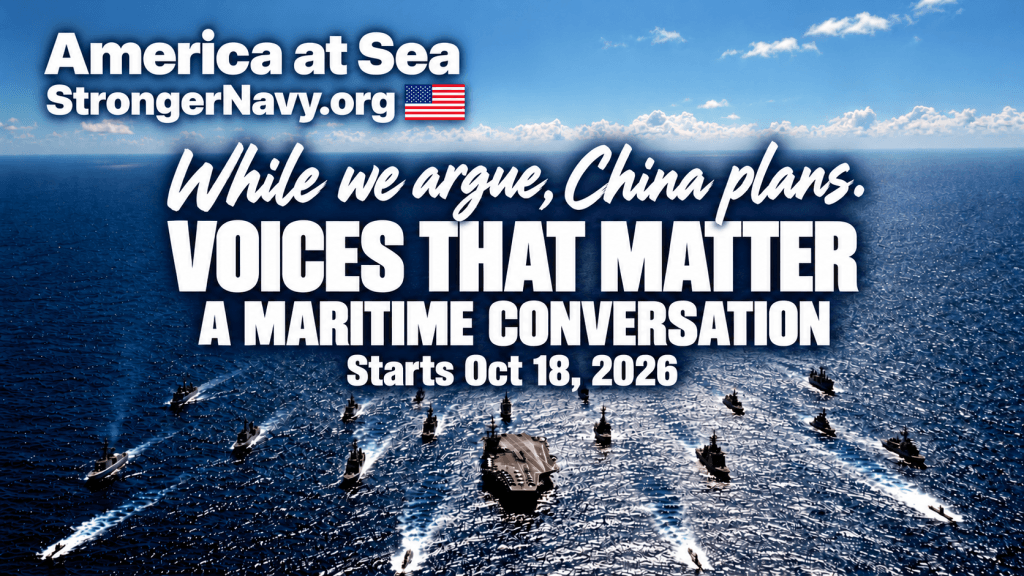
America at Sea: Voices That Matter is a conversation hosted by Americans for a Stronger Navy, supported by U.S. Maritime Action and moderated by Capt. Brent Sadler, USN (Ret.). Shipbuilders, mariners, industry, the Navy community and policy experts answer the same three questions about rebuilding America at sea: What’s working? What’s in the way? What would you fix firstOur guest is Mike Roberts, Senior Fellow at the Hudson Institute’s Center for Defense Concepts and Technology and a nonresident senior fellow with the Navy League’s Center for Maritime Strategy [1][2]. Before Hudson, Mike spent decades inside the American maritime industry. He was general counsel and senior vice president of government relations at Crowley, and he served as president and chairman of the American Maritime Partnership [1][2]. He works from Jacksonville, Florida, and has spent the last few years talking with members of Congress from both parties about how America gets back into the business of building and sailing its own ships.
Question 1: What’s working now?
Mike starts with something easy to overlook: the country is waking up. For decades, he says, Americans have had “sea blindness.” Most people didn’t know where their stuff comes from or why the commercial maritime industry matters, and had at best a vague idea of why the Navy matters. “That is changing,” he says. “The good news is it’s changing. The bad news is it’s changing because there’s a real reason for that.”
He points to three things that are working.
A serious bill in front of Congress. The SHIPS for America Act is bipartisan and bicameral, with support in both the House and the Senate. Mike calls it what would be “the most consequential legislation since 1936,” the year of the Merchant Marine Act. More than 100 lawmakers are now pushing to include it in this year’s defense bill [4].
Trade tools are in play. The Section 301 case at the U.S. Trade Representative put fees on Chinese-built and Chinese-owned ships calling at U.S. ports. The investigation began under the Biden administration, and the Trump administration imposed the fees in 2025. They were suspended for a year in November 2025 under a U.S.-China trade deal, and USTR has proposed extending the pause to January 2027 [5]. “We’ll see where that goes,” Mike says, “but at least that’s in play.”
Private capital is leaning in. The poster child is Hanwha, the Korean shipbuilder that bought Philly Shipyard [6]. Fincantieri owns the Marinette yard in Wisconsin, and other allied shipbuilders are looking at U.S. partnerships because Washington is signaling that real investment may pay off.
“We are well ahead of where we were in terms of an understanding of the need to move forward. And that’s encouraging.”
Question 2: What are the barriers?
The big-picture barrier, Mike says, is a mindset stuck in the 1990s, and it cuts across both parties. In his view, progressives struggle to accept that America has real enemies, while conservatives cling to the idea that the market will solve every problem. Both views made sense for most of a generation, from about 1990 to 2015. “But they leave us very vulnerable,” he says. “We have real enemies, and they are playing a totally different game than we’re playing when it comes to free trade and economics.”
The specific barrier is the lack of a consistent source of demand to build commercial ships in U.S. shipyards and sail them under the U.S. flag. He is not talking about Navy or Coast Guard ships, where demand is way up. He means cargo ships, whose buyers have no reason to be loyal to American yards and buy Chinese ships because that’s where they get the best deal.
Growing that commercial base matters for two reasons. It would diversify and grow the shipbuilding industrial base, meaning the workforce, the facilities and the supplier base, using commercial dollars on top of government dollars. And a larger U.S.-flag fleet gives the Pentagon more ships and more skilled American mariners to keep troops supplied in a conflict. It’s the same dual-use idea America has relied on before.
So where does the demand come from? The domestic Jones Act market is small, about a hundred self-propelled cargo ships, with limited room to grow. The international market is huge, around 60,000 ships, by Mike’s count. But U.S. costs run two to three times China’s before you count Chinese subsidies. American workers have options and need decent pay to work in a shipyard or spend months at sea. Chinese steel is heavily subsidized and costs roughly half as much as American steel. Even Korea, he notes, gets a large share of its steel and components from China.
Mike offers two cautions. First, cutting regulation won’t close the gap. “I have fought unnecessary regulation my whole career,” he says, but the idea that we can make up much ground on China that way “is not remotely realistic.” Second, innovation alone won’t get us back in the game. China builds far more ships than we do – almost 300 for every one of ours (corrected from the 75-to-1 estimate mentioned in the video). And China has more industrial robots than the rest of the world combined. “We can’t expect to lead in shipbuilding if we’re not actually building ships.”
“Shipyards don’t invest in capacity or in upgrades for episodic, ship-by-ship procurement. They do that when they can see a 10-to-15-year production horizon with a lot of contractual certainty.”
Everything tried over the last 50 years, from the Maritime Security Program to Title XI loan guarantees to cargo preference, has been piecemeal. Each program is modest, and none is guaranteed to continue. Meanwhile, Mike says, China holds 75 percent or more of new ship orders, close to 90 percent for some ship types like VLCC supertankers.
“They see decades of guaranteed demand. Our shipyards see appropriation cycles.”
Question 3: What would you fix first?
Mike’s answer is specific: pass and fund the Strategic Commercial Fleet program in the SHIPS for America Act [3][7]. “It’s the one piece of the SHIPS Act that creates sustained demand,” he says: 250 U.S.-built, U.S.-flagged ships over 15 years. Shipyards would get the demand signal, plan against it and innovate.
He likes many other parts of the bill, like rejuvenating Kings Point and the state maritime academies, and grants for shipyards to upgrade. But his test for any provision is how many commercial ships it actually gets built and flagged in the United States. “If we don’t have demand for the ships, there won’t be jobs for the people when they graduate,” he says, and the grant money won’t be used without customers.
The ships in the program would sign emergency preparedness agreements, a national security commitment. Mike says commercial freight revenue would cover roughly half the cost, about a dollar for every federal dollar, and that includes money from Chinese exporters. “It’s not a subsidy program. It’s an industrial policy program that’s disciplined by a competitive bidding process.” The federal share is meant to be covered by trade-related fees through the Maritime Security Trust Fund. He puts the cost at about $1.8 billion a year gross, or $1.3 billion net after savings, such as replacing part of the aging Ready Reserve Force. That fleet keeps about 40 ships, many of them 45-year-old steamships, in storage.
“In federal budget terms, it’s a rounding error. In maritime terms, it will rebuild the industry.”
“If we don’t act on it in this Congress, we’ll be having the same conversation five years from now, and we’ll have an even bigger hole to fill.”
The takeaway
Mike sees real progress: a public waking up, a bipartisan bill, trade tools in play and private money coming in. His core point is simple, though. Shipyards build to steady demand. Training programs, grants and regulatory fixes help, but they don’t put orders on the books. For Mike, the Strategic Commercial Fleet is the piece that does, and the time to act is this Congress. As always, these are the guest’s views, and featuring them is not an endorsement. What do you think?
About America at Sea: Voices That Matter
America at Sea: Voices That Matter is a conversation hosted by Americans for a Stronger Navy, supported by U.S. Maritime Action and moderated by Capt. Brent Sadler, USN (Ret.). Shipbuilders, mariners, industry, the Navy community and policy experts answer the same three questions about rebuilding America at sea. Views expressed are the speaker’s own, and featuring a view is not an endorsement.
Join the conversation on X. What’s working? What’s in the way? What would you fix first?
About the Guest
Michael G. Roberts is a Senior Fellow with the Hudson Institute’s Center for Defense Concepts and Technology and a nonresident senior fellow with the Navy League’s Center for Maritime Strategy. His work focuses on policy affecting the American commercial maritime industry in light of competition with China. He joined Hudson in 2022 after a decades-long career in the maritime industry, including service as general counsel, board secretary and senior vice president of government relations at Crowley, and as president and chairman of the American Maritime Partnership. With Bryan Clark, he co-authored the Hudson report Shoring Up the Foundation: Affordable Approaches to Improve US and Allied Shipbuilding and Ship Repair [1][2][8].
References
[1] Hudson Institute, “Michael Roberts.” https://hudson.org/experts/1427-michael-roberts
[2] Center for Maritime Strategy, “Michael Roberts.” https://centerformaritimestrategy.org/experts/michael-roberts/
[3] Michael Roberts, “The Strategic Commercial Fleet Program: How America Rebuilds Its Maritime Industry,” Hudson Institute. https://www.hudson.org/politics-government/strategic-commercial-fleet-program-how-america-rebuilds-its-maritime-industry-michael-roberts
[4] gCaptain, “More Than 100 Lawmakers Push to Include SHIPS for America Act in Defense Bill,” October 29, 2026. https://gcaptain.com/more-than-100-lawmakers-push-to-include-ships-for-america-act-in-defense-bill/
[5] Holland & Knight, “USTR Proposes 2-Month Extension of Suspension of Section 301 Actions,” October 2026. https://www.hklaw.com/en/insights/publications/2026/10/ustr-proposes-2-month-extension-of-suspension-of-section-301
[6] gCaptain, “Hanwha Completes $100M Acquisition of Philly Shipyard, Marking First Korean Shipbuilder in U.S.” https://gcaptain.com/hanwha-completes-100m-acquisition-of-philly-shipyard-marking-first-korean-shipbuilder-in-u-s/
[7] FreightWaves, “Updated Shipping Bill Calls for 250-Vessel US Cargo Fleet.” https://www.freightwaves.com/news/updated-shipping-bill-calls-for-250-vessel-us-cargo-fleet
[8] Midrats, “Improving US & Allied Shipbuilding & Repair, with Michael Roberts & Bryan Clark.” https://cdrsalamander.substack.com/p/improving-us-and-allied-shipbuilding