The Unsung Heroes of World War II: The Collaborative Effort of the U.S., the U.K., and Australia in Defeating the Axis Powers

Press reports from Politico reflect that a plan by the United States, Australia, and the U.K are to share submarine technology as part of a strategic effort to counter Chinese naval power in the Pacific. The three countries have agreed to deepen their defense cooperation and share information on the development of new submarines, including advanced propulsion systems and stealth technology. The plan is aimed at strengthening the allies’ ability to detect and deter Chinese submarines, which have become increasingly active in the region. The article also notes that the plan is likely to further strain the already tense relationship between the three allies and China.

Takeaways:

  • The US, Australia, and the UK plan to share submarine technology as a strategic effort to counter Chinese naval power in the Pacific.
  • The plan includes deepening defense cooperation and sharing information on the development of new submarines with advanced propulsion systems and stealth technology.
  • The aim is to strengthen the allies’ ability to detect and deter Chinese submarines that have become increasingly active in the region.
  • The plan is likely to further strain the already tense relationship between the three allies and China.

The Power of Collaboration: The Story of the U.S., the U.K., and Australia in World War

Historical Context

  • The U.S., the U.K., and Australia collaborated in World War II to defeat the Axis powers.
  • The allies faced significant challenges, including the threat posed by German U-boats in the Atlantic.
  • The U.S. and the U.K. developed a plan to build aircraft carriers capable of tracking and destroying enemy subs
  • Australia provided the necessary shipbuilding expertise to build two carriers, which played a key role in the final months of the war.
  • The collaboration between the three nations continued after the war and remains strong today, reflecting the enduring power of collaboration and shared values.
  • In the early days of World War II, the United States, the United Kingdom, and Australia came together in a collaborative effort to defeat the Axis powers. The three nations formed an alliance that would prove to be instrumental in turning the tide of the war.

As the war raged on, the Allies faced numerous challenges and setbacks. One of the most significant was the threat posed by German U-boats, which were wreaking havoc on Allied shipping in the Atlantic. To combat this threat, the U.S. and the U.K. came up with a plan to build a new type of vessel – an aircraft carrier that could launch planes capable of tracking and destroying enemy subs.

The U.S. and the U.K. quickly realized that they didn’t have the resources to build these carriers on their own. They needed help from a nation with a strong naval tradition and the necessary shipbuilding expertise. That nation was Australia.

Australia eagerly joined the project and quickly set to work building two of these new carriers – the HMAS Melbourne and the HMAS Sydney. The carriers were launched in 1945 and played a key role in the final months of the war, helping to track down and destroy numerous German U-boats.

The collaboration between the U.S., the U.K., and Australia didn’t end with the war, however. In the years that followed, the three nations continued to work closely together on a wide range of issues, from defense to trade and beyond.

Today, the bond between the U.S., the U.K., and Australia remains strong, a testament to the enduring power of collaboration and the shared values that unite us all.
Secretary of the Navy warns China’s warship production outpacing US, emphasizes need for acceleration

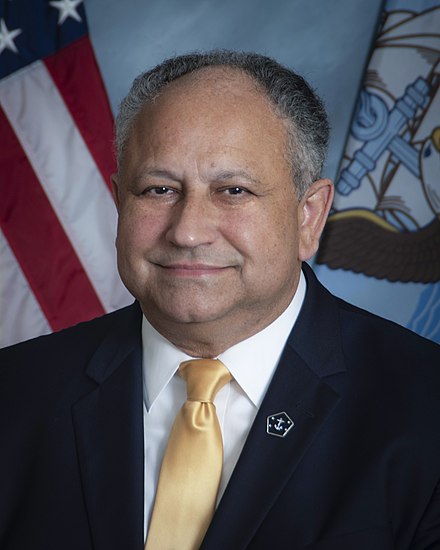
Secretary of the Navy, Carlos Del Toro

The Secretary of the Navy, Carlos Del Toro, has expressed concerns over China’s faster production of warships, which could impact the future of the US Navy. Del Toro has called for an acceleration of efforts to keep up with China’s naval modernization by building more warships and expanding its fleet. The report emphasizes the significance of the US Navy’s industrial base in supporting the production of advanced naval technologies. Del Toro made these remarks during a speech at the National Press Club in Washington, D.C.

Takeaways

The Secretary of the Navy has warned that China is outpacing the US in warship production, posing a threat to American naval supremacy.

The US needs to accelerate its efforts to keep up with China’s naval modernization, including building more warships and expanding its fleet.

The US Navy’s industrial base is crucial in supporting the production of advanced naval technologies.

These remarks were made by the Secretary of the Navy during a speech at the National Press Club in Washington, D.C.

Navy Adopts Augmented Reality and Awards Contract

ThirdEye Gen, a provider of augmented and mixed reality solutions, has won a contract from the US Navy to enhance its operations with augmented reality technology. The company will provide its X2 MR Glasses and software platform to enable hands-free access to critical information in real-time. The technology will improve situational awareness, reduce errors, and enhance the overall performance of Navy personnel. The contract marks a significant milestone for ThirdEye Gen as it expands its presence in the defense industry.

Why does this matter?

The US Navy has recognized the potential benefits of augmented reality technology in enhancing its operations. With the use of ThirdEye Gen’s X2 MR Glasses and software platform, Navy personnel can access critical information in real-time and hands-free, which improves their situational awareness and reduces errors. The technology can also enhance the overall performance of Navy personnel, thereby improving the efficiency and effectiveness of their operations.

How does Augmented Reality work?

Augmented reality (AR) is a technology that overlays digital information or virtual objects onto the real-world environment in real-time. It’s different from virtual reality (VR) which creates a completely immersive, computer-generated environment.

AR can be experienced through devices like smartphones, tablets, or special glasses that use cameras, sensors, and software to superimpose digital content on the user’s view of the physical world. This can include anything from 3D models and animations to text, images, and videos.

AR has a wide range of applications, from gaming and entertainment to education, healthcare, and manufacturing. It can also be used for training and simulation purposes, as well as in military and defense operations to enhance situational awareness and decision-making capabilities.

Retention award for USS George Washington

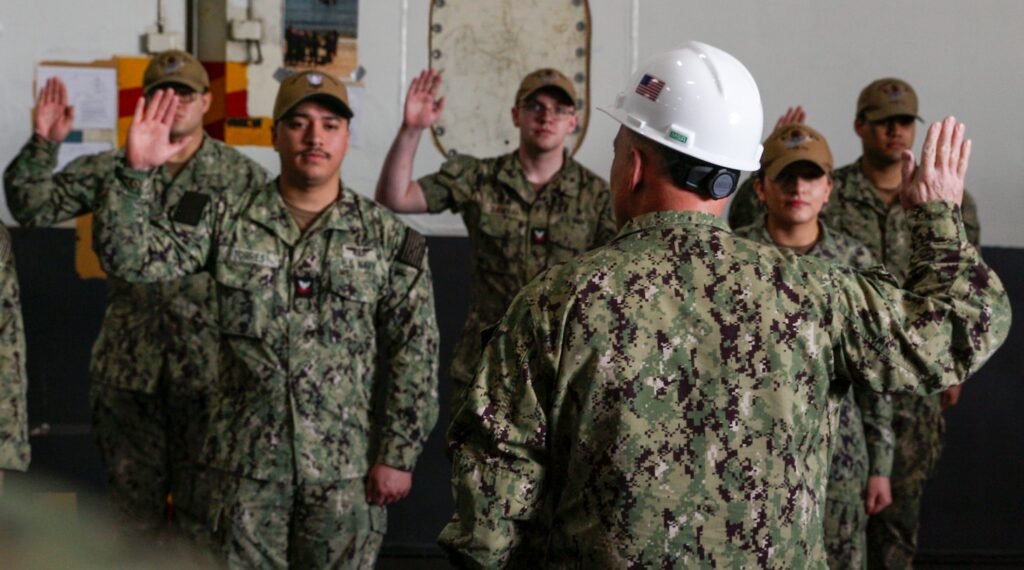
Chief of Naval Operations Adm. Mike Gilday officiates a re-enlistment aboard USS George Washington. The ship received the FY-22 Retention Excellence Best in Class award for U.S. Pacific Fleet.

The USS George Washington, a nuclear-powered aircraft carrier, has been awarded the Distinguished Retention Excellence Award for the 2020 retention cycle. The award recognizes the ship’s outstanding performance in retaining its talented sailors and ensuring that they are able to serve at their highest potential. The ship’s commanding officer praised the crew’s hard work and dedication in achieving this honor, and emphasized the importance of retaining top talent to maintain the ship’s readiness and effectiveness.

The USS George Washington is the fourth United States Navy ship to be named after George Washington, the first president of the United States. Its commissioning in 1992 marked the first time a nuclear-powered aircraft carrier had been built in over a decade, and it has since played a significant role in various military operations and humanitarian missions around the world. The ship can carry up to 90 aircraft and has a crew of over 5,000 personnel, making it one of the largest and most powerful warships in the world.

American Destroyer arrives in Japan

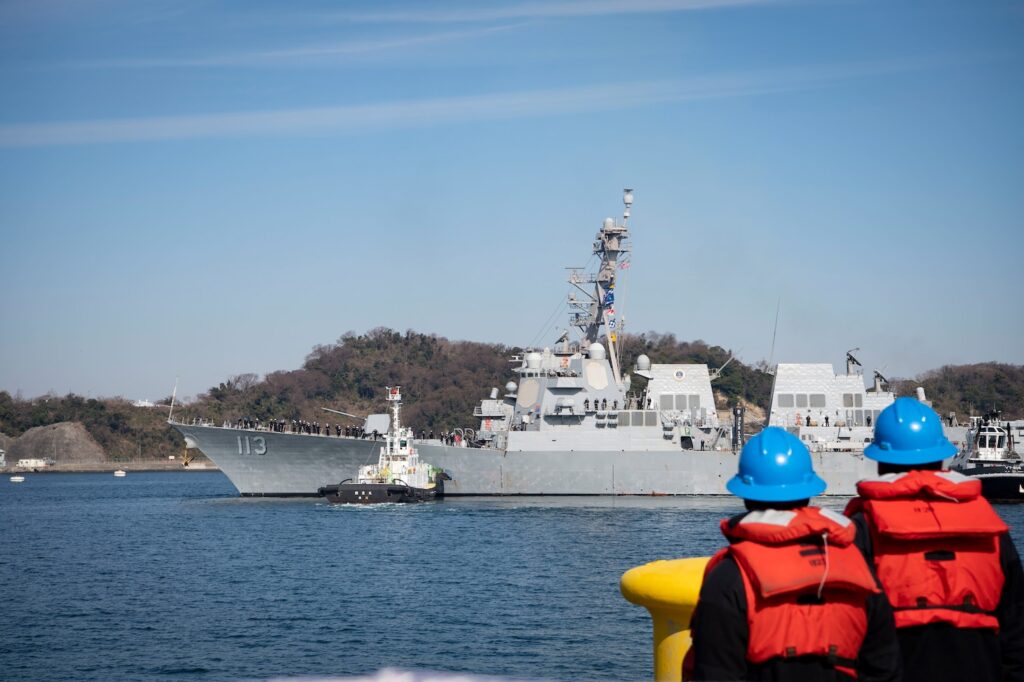
The Arleigh Burke-class guided-missile destroyer USS John Finn (DDG 113) arrives at Commander Fleet Activities Yokosuka (CFAY). Finn arrives from Naval Base San Diego to CFAY, becoming the latest forward-deployed asset in the U.S. (U.S. Navy photo by Mass Communication Specialist 1st Class Kaleb J. Sarten

The USS John Finn (DDG 113), an Arleigh Burke-class guided-missile destroyer, has arrived in Yokosuka, Japan to join Commander, Task Force (CTF 71)/Destroyer Squadron (DESRON) 15. The ship is designed for air warfare, submarine warfare, and surface warfare, and can operate independently or with other groups. Its deployment supports the US commitment to the defense of Japan and the security, stability, and prosperity of the Indo-Pacific region. The ship’s commanding officer, Cmdr. Angela Gonzales, stated that the crew is ready to support allies and partners in maintaining maritime security in the region

In April, 2021, the guided-missile destroyer USS John Finn (DDG 113) launches an Extended Range Active Missile (SM-6) during U.S. Pacific Fleet’s Unmanned Systems Integrated Battle Problem (UxS IBP) 21. UxS IBP 21 integrates manned and unmanned capabilities into challenging operational scenarios to generate warfighting advantages.

Delivery of USNS John Canley

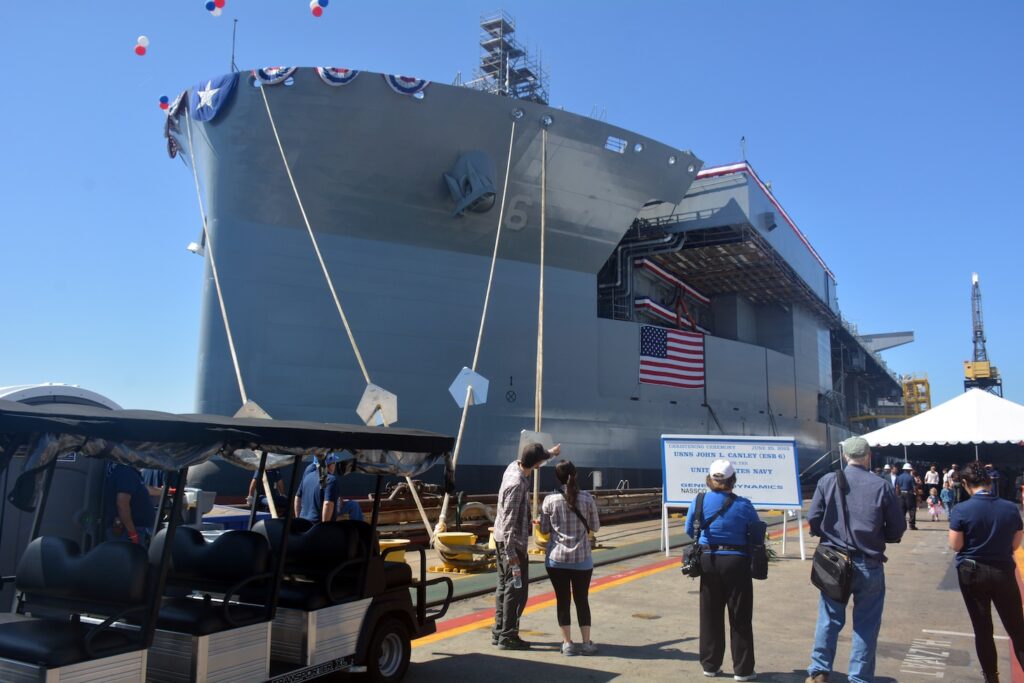
Expeditionary sea base USNS John L. Canley (ESB-6), Military Sealift Command’s newest ship, at its christening ceremony at the General Dynamics NASSCO shipyard in San Diego, Calif.

The US Navy has taken delivery of USNS John L. Canley (ESB 6), an ESB-class ship designed for various military operations such as Airborne Mine Counter Measures, Special Operations Force operations, Crisis Response Sea-basing, Intelligence, Surveillance, and Reconnaissance, and Unmanned Aviation Systems operations. The ESB-class ships have a flight deck capable of supporting MH-53E helicopters, accommodations, workspaces, and ordnance storage for embarked forces, and enhanced command, control, communications, computers, and intelligence. The ship is part of the critical access infrastructure that supports the deployment of forces. The future USS Robert E. Simanek (ESB 7) is currently under construction at the General Dynamics NASSCO shipyard in San Diego.

US Navy has taken delivery of its fourth Lewis B Puller-class expeditionary

The US Navy has taken delivery of its fourth Lewis B Puller-class expeditionary sea base (ESB) ship, USNS John L Canley. The ship was handed over to the Navy during a ceremony at General Dynamics National Steel and Shipbuilding Company’s (GD-NASSCO) shipyard in San Diego. The ESB ships are designed to act as critical infrastructure to support equipment supply and deployment of forces at sea. The highly flexible vessels can perform a wide range of military operations, including Special Operations Force missions, crisis response sea-basing, and intelligence, surveillance and reconnaissance operations. The new ship is named in honour of former US Marine Corps gunnery sergeant John L Canley.

General Dynamics NASSCO has been designing and building ships in San Diego’s industrial corridor since 1960 and is the only full-service shipyard on the West Coast of the United States.

Today, General Dynamics NASSCO has locations on both the West and East Coasts. The company specializes in the design and construction of auxiliary and support ships for the U.S. Navy and oil tankers and dry cargo carriers for commercial markets. It is also a major provider of repair services for the U.S. Navy’s global force for good, with capabilities in San Diego, Norfolk, Mayport, and Bremerton.

General Dynamics NASSCO is one of three shipyards in the Marine Systems group of General Dynamics Corporation (NYSE: GD). General Dynamics, headquartered in Falls Church, Virginia, is a market leader in business aviation; land and expeditionary combat systems, armaments and munitions; shipbuilding and marine systems; and information systems and technologies

8 East Harbor Drive
San Diego, CA 92113
Main: (619) 544-3400
Fax: (619) 544-3541

Navy and Industry Collaborate – Challenges and Opportunities

Industry executives at the WEST 2023 conference have emphasized the need for earlier involvement in the requirements process in order to overcome challenges faced by industry when delivering capabilities to warfighters. Setting unrealistic expectations for requirements leads to poor communication between industry partners and the military, which can be addressed by involving industry experts in the requirements-setting process. Additionally, industry representatives stressed the importance of a steady demand signal and shared commitment to speed in the contracting process, as well as the need for improved training to ensure successful integration between industry-delivered hardware and software capabilities and the sailors operating them. These comments follow criticism from Navy officials in January about the need for shipbuilders to do more with what they already have.

USNS Cody, EPF Vessel Christened

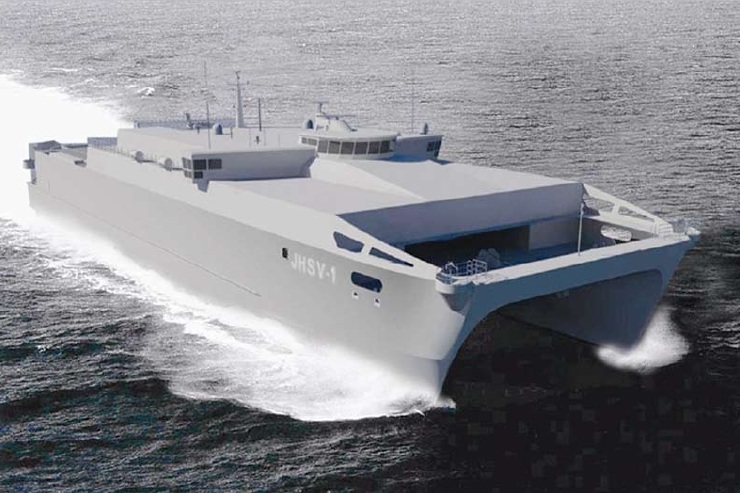
Austal USA has christened the USNS Cody, its 14th Expeditionary Fast Transport (EPF) vessel and the first EPF Flight II. The ceremony was attended by Navy leaders, elected officials, and ship sponsor Averil D. Spencer. The EPF Flight II provides an expanded medical capability, including a basic secondary health care facility, an intensive care unit, and limited x-ray, laboratory, and dental support. The catamaran design of the EPF provides stability for onboard medical procedures, and enhanced capabilities support V-22 flight operations and the launch and recovery of 11-meter Rigid Hull Inflatable Boats. Austal USA has two more EPF Flight II ships under construction and a third under contract.

The vision of Austal USA, located in Mobile, Alabama, was realized in 1999 for the purpose of reaching the ever increasing commercial and defense aluminum vessel market in the United States. Our shipbuilding facility occupies 164 acres on the eastern shore of the Mobile River and is strategically positioned at the mouth of the Gulf of Mexico.

Austal USA

100 Austal Way
Mobile, Alabama 36602
(251) 434-8000

Autonomous Navy Ship Delivered

Americans for a Sronger Navy Reporting

The sun was shining over the Austal USA shipyard in Mobile, Alabama, as the Expeditionary Fast Transport USNS Apalachicola (EPF 13) was handed over to the U.S. Navy. This was a significant moment for Austal USA, as the ship was not only the second Navy vessel to be named after the coastal Florida city, but also the largest surface ship in the Navy fleet with autonomous capability.

The ship had undergone several months of testing, during which Austal USA and their partners, L3Harris and General Dynamics Mission Systems, analyzed not only its typical ship systems, but also those resulting from the autonomous design and construction contract modifications required by the Navy to establish EPF 13 as an autonomous prototype.

Austal USA President Rusty Murdaugh was proud of his team of shipbuilders and the innovative capabilities they had delivered with this ship. The EPF 13 had the ability to conduct V-22 flight operations and launch and recover 11-meter Rigid Hull Inflatable Boats (RHIBs), making it an ideal candidate for large vessel autonomous operations, including logistics, tendering, and adjunct magazine mission profiles.

The ship’s machinery control system (MCS) was fundamental to the autonomy effort, enabling the ship to be minimally manned by centralizing machinery operations to the bridge. Additionally, the ship was equipped with automated maintenance, health monitoring, and mission readiness systems, providing the capability to conduct up to 30 days of operation without human intervention.

EPF 13 was also the first Expeditionary Fast Transport vessel to be delivered to the Navy with enhanced capabilities to support V-22 flight operations and launch and recover 11-meter RHIBs. These upgrades, combined with the EPF’s speed, maneuverability, and shallow water access, were key enablers for supporting future Expeditionary Advanced Base Operations around the world.

Austal USA’s work on autonomous vessel capability has been identified as an area of strategic importance by the Navy. The company is partnering with L3Harris on the MCS upgrade of Overlord vessel, Mariner (OUSV 3), and construction of Vanguard (OUSV 4), as well as with Saildrone, Inc. on the manufacture of Surveyor unmanned surface vehicles. The investments from academia in uncrewed technology, combined with Austal USA’s efforts, are quickly making south Alabama the epicenter of autonomous naval architecture.

The delivery of EPF 13 was a proud moment for Austal USA, and it marked a significant step forward in the Navy’s autonomous capabilities. With this ship’s advanced features, the Navy’s ability to conduct missions and operations around the world will be greatly enhanced.