Naval Advocacy Group Calls for “Strategic Seas Act” Requiring Tech Companies Profiting from China to Fund Fleet Modernization
December 31, 2025 — Americans for a Stronger Navy today released new data showing the U.S. Navy is projected to commission only 2 ships in 2025, marking the steepest decline in naval shipbuilding in modern history and creating a critical gap in America’s ability to counter China’s rapidly expanding fleet.
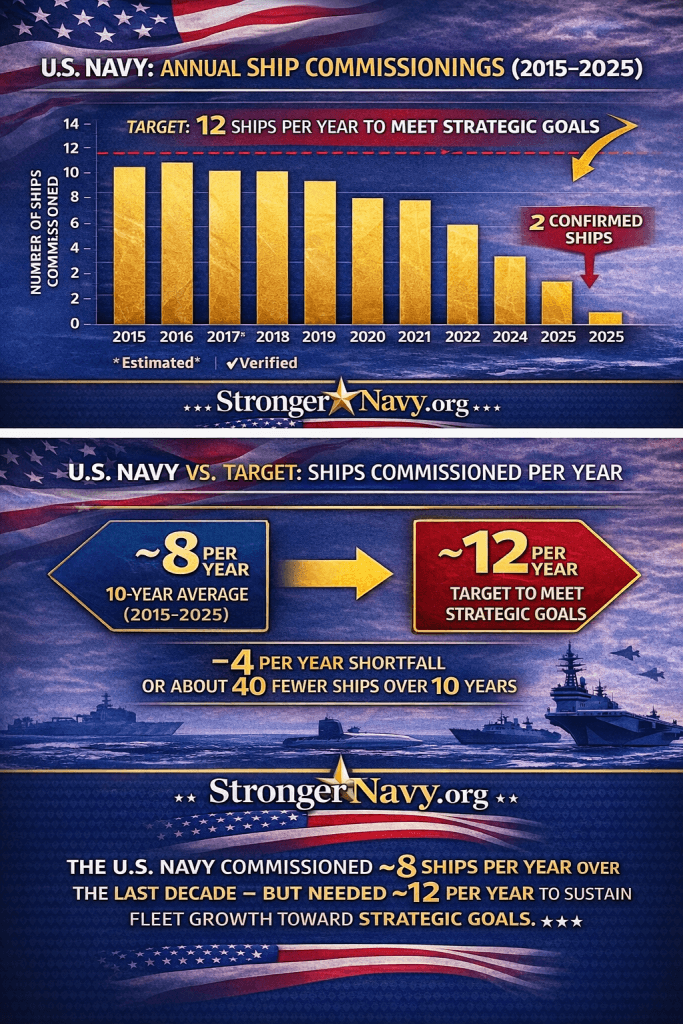
The analysis reveals a stark 10-year trend: from 2015 to 2025, the Navy averaged just 8 ships commissioned per year — falling far short of the 12 ships per year required to meet strategic goals. This represents a shortfall of approximately 40 fewer ships over the decade, occurring precisely as China’s People’s Liberation Army Navy has become the world’s largest naval force.
“We’re watching American naval power erode in real time,” said Bill Cullifer, founder of Americans for a Stronger Navy. “The 2025 commissioning rate of just 2 ships isn’t a budget blip — it’s a strategic crisis that threatens our ability to maintain freedom of navigation in the Pacific and protect the very trade routes that make Silicon Valley’s global business model possible.”
The Taxpayer-Funded Tech Paradox
The organization notes a troubling disconnect: many of Silicon Valley’s most profitable companies were built on taxpayer-funded research from DARPA, the National Science Foundation, and Department of Defense programs — yet now generate billions in revenue from China while the Navy that protects their supply chains faces resource constraints.
“American taxpayers funded the fundamental research that created Google, GPS, the internet, smartphone AI, and semiconductor breakthroughs,” Cullifer said. “These companies now generate enormous profits from Chinese markets, yet contribute nothing directly to the naval forces that secure the Pacific shipping lanes their business depends on.”
The Strategic Seas Act: A Solution
Americans for a Stronger Navy is calling for Congress to pass a “Strategic Seas Act” that would require technology companies with significant China operations to contribute a modest percentage of those revenues to a dedicated Naval Modernization and Maintenance Fund.
Key provisions would include:
- Companies with over $5 billion in annual China revenue contribute 2% to the fund
- Revenues earmarked specifically for ship repair backlogs, shipyard modernization, and Pacific Fleet readiness
- Projected to generate billions annually based on current tech sector China operations
- Estimated to fund 4-6 additional ship commissionings per year, substantially closing the strategic gap
“This isn’t a tax — it’s a user fee,” Cullifer explained. “If you’re generating billions moving products and data across the Pacific, you should help pay for the destroyers and submarines that keep those sea lanes open. If you’re profiting from China’s market, you should help fund our ability to compete with China’s military.”
Bipartisan Issue Gaining Momentum
The proposal has gained interest across the political spectrum, appealing to defense hawks concerned about Chinese military expansion, economic populists focused on corporate responsibility, and fiscal conservatives seeking efficient solutions to readiness gaps.
“This issue transcends party politics,” said Cullifer. “Whether you’re concerned about China as a strategic competitor, frustrated by corporate tax avoidance, or worried about return on taxpayer investment in R&D, the answer is the same: those who profit most from the Pacific trade system should contribute to its protection.”
By The Numbers
U.S. Navy Ship Commissioning (2015-2025):
- 2015: 11 ships
- 2016: 11 ships
- 2018: 10 ships
- 2020: 8 ships
- 2022: 6 ships
- 2024: 3 ships
- 2025: 2 ships (confirmed)
Strategic Requirement: 12 ships per year
10-Year Average: ~8 ships per year
Cumulative Shortfall: ~40 ships
Call to Action
Americans for a Stronger Navy is calling on Congress to:
- Hold hearings on the naval shipbuilding crisis and its implications for Pacific deterrence
- Commission a GAO study examining the relationship between taxpayer-funded tech R&D, corporate profits from China operations, and naval readiness gaps
- Introduce and pass the Strategic Seas Act in the 119th Congress
- Ensure 2026 defense authorization bills include dedicated funding to address the ship commissioning shortfall
“China is building a fleet designed to push the U.S. Navy out of the Western Pacific,” Cullifer concluded. “We built Silicon Valley with taxpayer dollars. Silicon Valley profits from Pacific trade. It’s time Silicon Valley helps us maintain the naval power that makes their business model possible. This isn’t just fair — it’s strategically essential.”
About Americans for a Stronger Navy
Americans for a Stronger Navy (StrongerNavy.org) is a non-partisan advocacy organization dedicated to ensuring the United States maintains the naval capabilities required to protect American interests, support allies, and preserve freedom of navigation in an era of great power competition.
For full data, graphics, and supporting documentation, visit StrongerNavy.org/shipbuilding-crisis
EDITOR’S NOTE: High-resolution graphics showing ship commissioning trends, comparative data with Chinese naval expansion, and the taxpayer investment in Silicon Valley technologies are available upon request.