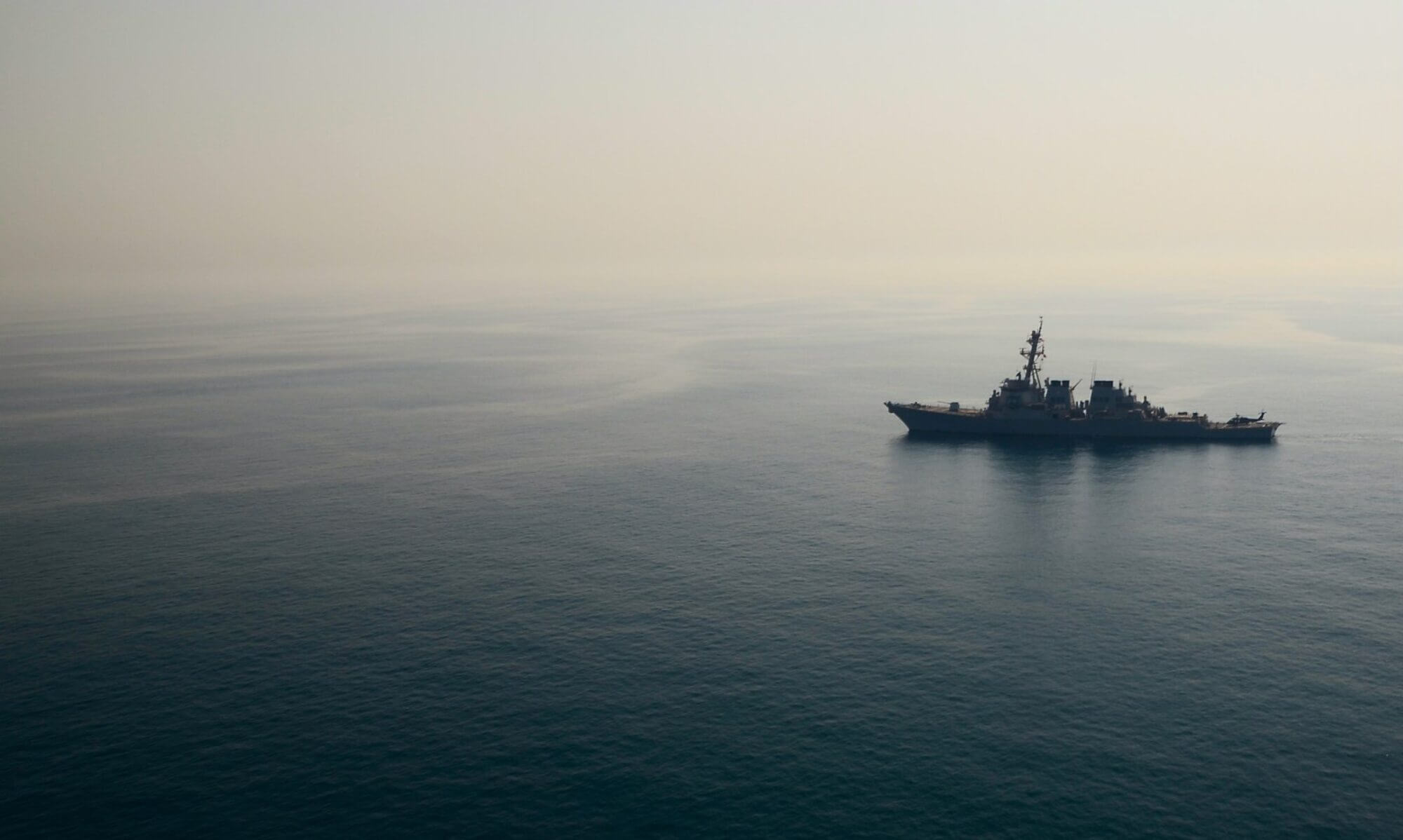
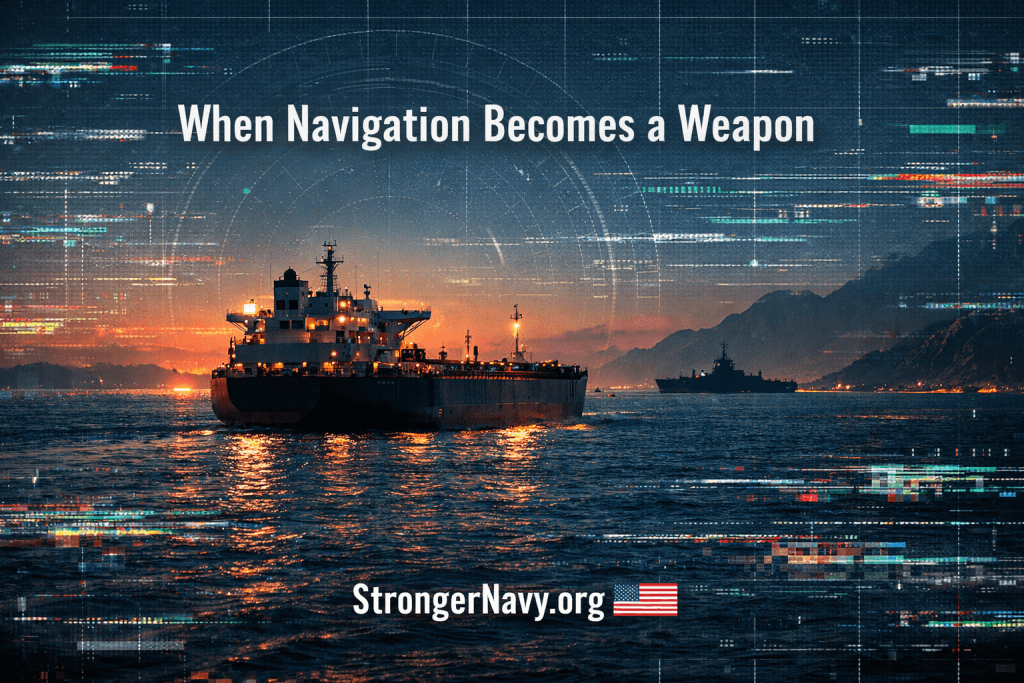
Strength at sea now includes protecting the invisible systems that guide global trade.
Electronic warfare is no longer confined to the battlefield. In the days following U.S. and Israeli strikes on Iran, maritime intelligence firms reported that more than 1,100 ships operating in and around the Strait of Hormuz experienced GPS or AIS disruption. Vessels appeared inland on digital maps. Others showed strange circular patterns off the coasts of the United Arab Emirates, Qatar, and Oman. Maritime officials described the risk level in the region as “critical.”
This is what modern conflict looks like.
Not just missiles. Not just drones.
Navigation. Commerce. Confidence.
The Strait of Hormuz is one of the most important maritime chokepoints on Earth. Roughly a fifth of the world’s oil moves through that narrow passage. When positioning systems degrade in such a congested, militarized waterway, the risk of collision, grounding, or miscalculation rises sharply. Add aerial threats and naval maneuvering to the equation, and degraded navigation becomes a risk amplifier.
Why Americans Should Care
Most Americans will never sail through the Strait of Hormuz. But they will feel the effects if shipping slows, insurance premiums spike, or energy markets react to instability. Maritime security is economic security. The sea lanes quietly underpin global supply chains, energy flows, and financial stability. When GPS signals flicker in a strategic chokepoint, markets notice.
Electronic interference aimed at navigation systems is not just a military tactic. It directly impacts civilian shipping. Tankers hesitate. Routes change. Traffic patterns compress. The cost of uncertainty ripples outward. In a globally connected economy, those ripples eventually reach American households.
For years, we have warned that maritime chokepoints are soft underbellies in a fragile system. This latest episode underscores that warning. The battlespace now includes the invisible infrastructure of positioning, navigation, and timing.
Implications for the Navy
When commerce comes under electronic pressure, the U.S. Navy becomes the stabilizer. Escort missions, presence operations, surveillance, and deterrence all require ships, crews, logistics depth, and technological resilience. Strength at sea is not abstract. It is measured in hulls, readiness, training, and industrial capacity.
Yet we continue to fund our maritime industrial base through unstable, year-to-year appropriations cycles. We debate ship counts while the underlying architecture remains fragile. Predictable investment is not about expansion for its own sake. It is about reducing systemic risk.
Electronic warfare against commercial shipping highlights the need for redundancy. Redundancy in fleet capacity. Redundancy in basing and logistics. Redundancy in navigation technologies. If GPS can be degraded in one of the world’s most vital trade routes, resilience cannot be optional.
The Case for Predictable Maritime Investment
This moment should not trigger panic. It should prompt clarity.
America’s maritime security underwrites global commerce. Yet the economic beneficiaries of secure sea lanes are not structurally aligned with long-term investment in the maritime industrial base. That mismatch creates vulnerability.
The Strategic Economic Alignment for the Maritime Industrial Base Act, the SEAS Act, is about architecture, not urgency. It seeks to create stability and predictability in funding so that shipyards, suppliers, and maritime infrastructure can plan for the long term. It recognizes that maritime security is foundational economic infrastructure.
If navigation becomes a weapon, then resilience becomes a responsibility.
Strength is built on redundancy. Stability is built on predictability. The events in the Strait of Hormuz are a reminder that modern conflict increasingly targets the connective tissue of commerce. We can either respond episodically, or we can build a durable framework that matches the strategic environment.
At Americans for a Stronger Navy, we believe the American people must understand what is at stake. The Navy belongs to the nation. Its readiness, its resilience, and its industrial foundation require public awareness and engagement.
That’s why we launched Charting the Course: Voices That Matter — an ongoing educational series breaking down how we got here, what went wrong, and what must happen next. Our goal is simple: educate the public, connect the dots, and build the support needed to close the readiness gap before it’s too late.
Let’s roll.