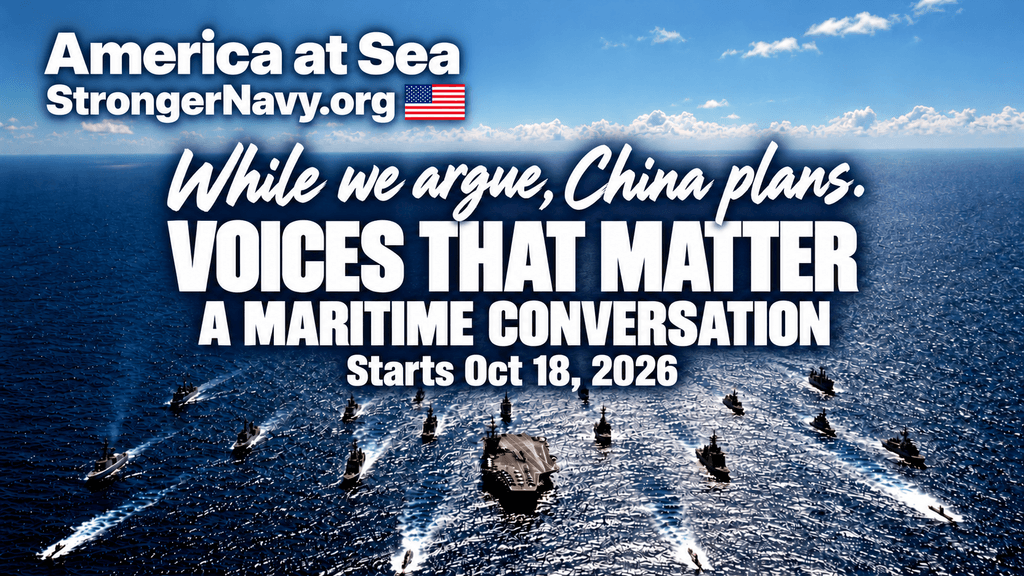
Over the next 45 days, we’ll hear from voices across America’s maritime world, each answering the same three questions. Watch the kickoff below, then join the conversation.
Join the conversation. Reply to the post above on X and tell us what’s working, what’s in the way, and what you’d fix first. Not on X? Reach us through StrongerNavy.org.
The three questions
1. What’s working right now that we should do more of?
2. What’s the biggest barrier to rebuilding America at sea?
3. If you could fix one thing first, what would it be?
Transcript
Greetings. I’m Bill Cullifer, founder of Americans for a Stronger Navy. Welcome to America at Sea: Voices That Matter. This is a 45-day conversation about one question: how do we rebuild America at sea?
Why it matters
Here’s where we are. Last year China built more than half of all the new commercial ships in the world. The United States built about one-tenth of one percent [1][2].
China’s navy has more than 370 ships and is headed to 435 by 2030. Ours is about 290 [3][4]. And China builds its warships in the same yards as its cargo ships, so when it needs more, it can surge. We can’t.
Ask yourself why. A country doesn’t build a fleet like that by accident. It builds one to control the waters around it and to put its hand on the trade routes the rest of the world depends on. This summer, off Taiwan’s east coast, a Chinese fishing boat that’s part of its maritime militia was spotted working alongside its coast guard for the first time. Taiwan believes China is rehearsing a blockade [5].
Almost everyone in Washington agrees we need more ships. The arguments are about which ships, who builds them and who pays. And while we argue, China plans. So we’re trying something different. Instead of starting with the fights, we’re starting with what we already agree on.
Why start with common ground
Because agreement is where action begins. When shipbuilders, mariners, labor and the Navy community say the same thing, it’s hard to ignore, and much easier to get done.
Arguments stall. Common ground moves.
And for you, this is a chance to hear from the people doing the work, in their own words, without the spin. Much of what you buy comes to this country by sea. The ships that protect those sea lanes, and the jobs that build them, are in communities across America. This is your chance to understand what it will take, and what it means for you.
What we’re doing
Over the next 45 days, we’ll hear from voices across America’s maritime world. Each gets about ten minutes and the same three questions. What’s working right now that we should do more of? What’s the biggest barrier to rebuilding America at sea? And if you could fix one thing first, what would it be?
Same questions for everyone. Shipbuilders, large and small. Merchant mariners and the unions that train them. The skilled workers in our yards and ports. The companies that move our cargo. The Navy and Coast Guard community, active and retired. The people in Congress and their staffs who write the laws. And the writers and analysts who have been making the case for years. The shipyard worker and the admiral, side by side. We don’t all agree, and that’s the point.
The SHIPS for America Act
You’ll hear a lot about the SHIPS for America Act in this series. It’s the most comprehensive bipartisan effort in decades to rebuild our commercial fleet, our shipyards and our maritime workforce. Parts of it passed the House this summer, and Congress is deciding the rest now [6]. We’ll come back to it often, and we’ll hear from experts on where it stands.
One piece of it is worth knowing from the start. The bill creates a Maritime Security Advisor in the White House [7]. Today our maritime policy is spread across the Navy, the Coast Guard, Transportation, Commerce, Labor and more. No one person owns the whole picture. The Maritime Security Advisor would. That person would lead a board of every agency with a stake at sea, keep the national maritime strategy, and oversee a dedicated fund to pay for it. One hand on the helm.
How you can take part
The ten-minute voices are by invitation, so we can keep the conversation focused. But everyone has a part to play. Watch. Listen. Share it with someone who cares about this. And most important, weigh in. Reply on X and tell us what you think. If you know someone who should be heard, tell us that too. We read every response.
We’ll post each voice here as it comes in, starting today. And at the end of November, as Congress works to finish this year’s defense bill, we’ll publish a common-ground report: what these voices agree on, in their own words.
America at Sea is hosted by Americans for a Stronger Navy. It’s free, it’s open to everyone, and it’s nonpartisan.
Coming next
Tomorrow, you’ll meet the two people who will be with me to the finish line.
The first is Captain Brent Sadler, U.S. Navy, retired: a former nuclear submarine officer, diplomat and strategist. We asked Brent to be our moderator, and he graciously agreed. That doesn’t mean running a panel. It means guiding this series and advising us along the way. Few people know both the Navy and the maritime world the way Brent does, and he’s widely respected by his peers in both.
The second is Clay Wirsing, founder of U.S. Maritime Action, which is hosting this series with us. Clay spent eight years in American shipyards building and repairing carriers, destroyers and submarines.
Each of them will tell you, in his own words, why this matters to him.
While we argue, China plans. It’s time we started building.
Let’s roll.
Americans for a Stronger Navy is a nonpartisan 501(c)(3) organization. America at Sea is educational and does not urge support for or opposition to any legislation.
References
[1] China Ministry of Industry and Information Technology, 2025 shipbuilding figures, via Invest in China: https://investinchina.chinaservicesinfo.com/s/202602/09/WS698968cd498e23165e06d613/chinas-shipbuilding-sector-maintains-global-lead-in-2025.html
[2] CSIS, “Are U.S. Policies Eroding China’s Dominance in Shipbuilding?”: https://www.csis.org/analysis/are-us-policies-eroding-chinas-dominance-shipbuilding
[3] Congressional Research Service, China Naval Modernization (RL33153): https://www.everycrsreport.com/files/2024-08-16_RL33153_2580aa1e1d4021a5a9beb242ca3ee7aa56e21743.html
[4] U.S. Navy FY2027 shipbuilding plan, via World Ports: https://www.worldports.org/?p=742671
[5] Taipei Times (Reuters), “Taiwan spots first China militia boat in east,” Oct. 9, 2026: https://www.taipeitimes.com/
[6] K&L Gates, “House Passes Historic NDAA Maritime Amendments,” July 24, 2026: https://www.klgates.com/thought-leadership/House-Passes-Historic-NDAA-Maritime-Amendments-7-24-2026
[7] S. 1541, SHIPS for America Act of 2025, Sec. 101: https://www.govinfo.gov/content/pkg/BILLS-119s1541is/html/BILLS-119s1541is.htm
We’re publishing this ahead of Hudson Institute’s September 16 gathering on the SHIPS for America Act’s prospects, deliberately. Every name in this piece — Sen. Young, Bryan Clark, Brent Sadler, and the industry and labor voices joining them — will be in that room discussing exactly the questions this report raises. We’d rather put our read on the record first and let it be tested by the people actually doing the work than publish a victory lap after the fact. If we’ve got the balance wrong, we want to hear it there. If we’ve got it right, we hope it moves the conversation in the room toward the accountability this moment actually calls for.
Who You’ll Be Hearing From on September 16
For readers who want to follow the event itself, here’s who’s in the room and why they matter to the questions this piece raises:
Sen. Todd Young (R-IN) — Co-lead of the SHIPS for America Act, returning to Hudson to address the bill’s odds in what’s being called this Congress’s “homestretch.” His read on the September conference timeline is the single most consequential data point this piece’s “In Motion” section is waiting on.
Joe Russell — Deputy Legislative Director for Sen. Mark Kelly, the bill’s other lead sponsor. The clearest inside view on where the Maritime Security Trust Fund actually stands in negotiations.
Bryan Clark — Senior Fellow and Director, Center for Defense Concepts and Technology, Hudson Institute. The connective tissue across SFAA, FLEETS Now, and the Navy’s own Golden Fleet plan; moderating the day’s discussion.
Brent Sadler — Senior Research Fellow, Naval Warfare and Advanced Technology, Heritage Foundation. A 26-year Navy veteran and former nuclear submariner; the sharpest read available on whether the fleet-size numbers this piece flags as stalled are likely to turn, and when.
Michael Roberts — Senior Fellow, Center for Defense Concepts and Technology. Focused on the commercial-shipbuilding side of the bill — the Strategic Commercial Fleet Program mechanics behind the 250-ship target.
Todd Tucker — Director of Industrial Policy & Trade, Roosevelt Institute. An industrial-policy perspective on whether investments like Factory 4 can outpace the broader waterfront erosion this piece cites from MARAD’s own data.
David Sullivan — General Vice President, Eastern Territory, International Association of Machinists & Aerospace Workers. The labor voice missing from most of these conversations — directly relevant to the wage-and-conditions workforce argument this piece raises.
Chris McVickers — Chief Financial Officer, Fairbanks Morse. A finance-side read on whether capital is actually moving into the industrial base, or still sitting on the sidelines as the skeptics argue.
Bleu Hilburn — VP Government Business Development, Crowley Maritime Corp. Established commercial-shipping industry perspective on cargo preference enforcement and fleet expansion.
Larry Ryder — SVP Business Development, Naval Programs, Hanwha Defense USA. A shipbuilder’s-eye view on distributed shipbuilding and where the Navy’s 10-to-50-percent goal actually stands on the shop floor.
Ian Bennitt — Senior Director of Government Relations and Shipbuilding, Saronic. Ben Cipperly — Chief Strategy Officer, Havoc AI. Both represent the newer, autonomous-vessel side of the industrial base — the “we can build this now” posture this piece’s “What We’ve Learned” section points to.
We’ll be watching for direct answers on the appropriations timeline, the fleet-size trendline, and the workforce diagnosis — the same three items on our own scorecard below.
Three years ago is when we started Americans for a Stronger Navy, because the country had stopped noticing its own vulnerability at sea. That was the easy part to fix — awareness. The harder question was always going to be: once people noticed, would anything actually move?
Three years later, we can say something we couldn’t say when we started: yes, something is moving. Not everything. Not fast enough. But the shift from “recognizing the problem” to “building the fix” is real, and it’s worth an honest accounting — the wins that are locked in, the ones still being fought for, and the ones that will only be real if the country holds people to them.
What’s Actually Law and Funded
Two things in this list are not proposals. They happened.
Executive Order 14269. Signed April 9, 2025, “Restoring America’s Maritime Dominance” directed a whole-of-government Maritime Action Plan, mandated an assessment of tools like the Defense Production Act to rebuild the maritime industrial base, and created the framework for a national Maritime Security Advisor [1]. The White House released the resulting Maritime Action Plan in February 2026 [2]. This is a standing directive, not a bill waiting on a vote.
The FY2027 30-Year Shipbuilding Plan. The Department of the Navy’s “Golden Fleet” plan requests $65.8 billion in shipbuilding funding for FY2027 alone, targeting a battle force of roughly 450 manned and unmanned vessels by FY2031, up from 291 ships today [3][4]. Worth being precise here: this is a budget request, not an appropriation. Congress still has to fund it. But the plan itself — including the goal of moving distributed shipbuilding work from about 10 percent to 50 percent of Navy projects across non-traditional industrial sites — is now the Navy’s official position, not a think-tank white paper [4].
Factory 4, Muscle Shoals, Alabama. This $2.4 billion public-private facility (roughly $900 million in federal investment layered with $1.5 billion in private capital) opened in March 2026 and is already producing components for Virginia- and Columbia-class submarines [5]. It’s worth being specific about what it is: a submarine-component manufacturing hub, not a general hull-construction yard. Navy leadership has said it’s the first of three planned facilities meant to relieve industrial bottlenecks [5]. One factory doesn’t fix the industrial base. But it’s steel in the ground, not a slide in a briefing.
“This factory is the first of three facilities designed to address the most critical bottlenecks in the maritime industrial base.” — Secretary of the Navy John C. Phelan [5]
What’s Still In Motion — and Why That Matters
This is the part of the report that’s easy to get wrong, and we’d rather get it right than get it impressive.
The SHIPS for America Act (S. 1541). This bill, led by Sens. Mark Kelly and Todd Young with Reps. Trent Kelly and John Garamendi, would establish a Maritime Security Trust Fund and a Strategic Commercial Fleet Program aimed at growing the U.S.-flagged international fleet by 250 ships over a decade [6]. It has genuine bipartisan authorship and real momentum. It is not law. It’s been reintroduced, it has committee support, and companion legislation (the FLEETS Now Act, the Ready Reserve Force Modernization Accountability Act) is moving alongside it — but as of this writing, the path forward runs through a House-Senate conference expected this fall, likely bundled with the FY27 NDAA [7]. Anyone who tells you this fund already exists is ahead of the facts. It’s close. It isn’t done.
The workforce and unmanned-systems provisions — folding uncrewed surface and undersea vehicles into official force-structure procurement counts, and standing up maritime academy and mariner-credentialing incentives — are part of the same legislative and budgetary picture: real proposals with real support, still working their way through appropriations rather than sitting on the books as settled policy.
Why the distinction matters for this movement specifically: our credibility with the people who actually read this stuff — Hill staffers, the Midrats and USNI crowd, the shipyard workforce we claim to speak for — depends on us being the group that doesn’t round up. Overstating “passed” when the real status is “introduced” costs us the next argument we need to win.
What the Skeptics Are Saying
An honest progress report has to sit with the people who don’t think there’s much progress to report. Three worth taking seriously:
The fleet number moved the wrong way. WorkBoat’s own progress check in January 2026 cited Center for Maritime Strategy data showing the U.S.-flagged oceangoing fleet actually fell to 178 cargo ships, about 0.57 percent of world tonnage, even after the executive order and the SHIPS Act push began [8]. If the goal is closing the gap with a 5,500-ship Chinese fleet, that’s the one number that should be climbing, and as of this writing it hasn’t.
The money hasn’t landed yet. At a February 2026 maritime finance conference, one shipyard-side capital advisor put it bluntly: interest is real, but results are not [9].
“Tangible results to date – no.” [9]
That’s a financing-industry read on the same gap this report flags in its “In Motion” section — plans and requests are not yet appropriated dollars or delivered ships.
The industrial base has kept eroding underneath the good news. A MARAD report — reportedly held back internally for nine months before its release — found that 27 to 40 percent of U.S. waterfront industrial facilities have disappeared over the past twenty years [10]. New facilities like Factory 4 are real, but they’re being built against a backdrop of continued, not yet reversed, decline elsewhere on the waterfront.
The workforce fix may be aimed at the wrong pool. A Wharton graduate student who has studied U.S., Chinese, Japanese, and Korean yards — and who served as a junior officer with Navy construction units in Asia — argues the real workforce question isn’t why we can’t recruit 150,000 new kids into shipbuilding, but why the 30 million Americans already in construction, manufacturing, and transportation refuse shipyard jobs [11]. His answer: shipyard work sits on the wrong side of the toil-versus-earnings line compared to what construction and auto work now offer, because pay and conditions in those industries improved over the past 30 years in ways shipbuilding didn’t. If that diagnosis holds, academy incentives and credentialing streamlining address supply for new entrants, not the wage-and-safety gap keeping the existing skilled workforce away — which means our own scorecard needs to track pay and working-condition trends at the yards, not just enrollment and hiring counts.
We’re not citing these to talk ourselves out of the progress documented above — the EO, the budget request, and Factory 4 are real regardless of what the skeptics think. We’re citing them because a movement that only quotes its own wins isn’t one the public should trust, and because these are exactly the kind of numbers our own scorecard needs to keep watching.
The Accountability Scorecard: What We’re Watching Next
Building consensus on the problem was phase one. This is phase two — and it means holding institutions to the numbers they’ve put on paper, including our own.
1. Appropriation, not just authorization. Does the FY2027 defense package actually fund the $65.8 billion shipbuilding request, and does the SHIPS for America Act’s Maritime Security Trust Fund get enacted in the September conference — or slip again?
2. Yard output versus dollars in. Distributed shipbuilding is supposed to move from 10 percent to 50 percent of Navy projects. We’ll be tracking whether ship deliveries and on-time performance at key yards actually move, not just whether the money shows up.
3. Real people in real jobs — and what those jobs actually pay. Factory 4 promises up to 1,000 skilled manufacturing jobs [5]. Maritime academy incentives and mariner credentialing reforms are supposed to rebuild the workforce pipeline. But if the diagnosis above is right, the test isn’t just enrollment and hiring numbers a year from now — it’s whether entry-level shipyard pay and working conditions actually close the gap with construction and manufacturing, since that’s the gap keeping the existing skilled workforce away in the first place.
We’ll publish updates against these three benchmarks as the facts come in — credit where it’s earned, and a flag where it isn’t.
What We’ve Learned — and What We Actually See Improving
Numbers and bill statuses are one way to measure three years. Here’s the other way: what’s changed in the room, not just on paper.
The conversation itself has moved. Three years ago, “why does the Navy matter” was still a question we had to answer from scratch, on almost every call, with almost every audience. We don’t get that question much anymore. The “who pays” framing — the idea that national will has to turn into budgets, budgets into priorities, priorities into behavior, and behavior into readiness — used to be a hard sell. Now it’s closer to common ground, even across people who disagree about almost everything else in this fight.
The bipartisan coalition is more durable than we expected. A Navy-veteran-turned-astronaut Democrat and a Naval Academy Republican leading the same bill together isn’t a coincidence three years in — it’s a sign the “national security, not partisan security” framing we’ve pushed from the start actually took. That coalition surviving a change in administration, an election cycle, and a government funding fight is itself a data point.
Industry is showing up before Washington asks it to. The volunteered testimony, the willingness of yards, suppliers, and even new entrants like the autonomous-vessel builders to say “we can do this now, fund us or not” — that’s a different posture than three years ago, when the industrial base mostly waited to be told what to build.
What we’ve learned, plainly: awareness moves faster than appropriations, and appropriations move faster than delivered ships. Each stage takes longer than the one before it, and it would be a mistake to assume this pace picks up just because the last stage did. We also learned that the “builders not critics” posture works better than we expected at keeping doors open on both sides of the aisle — and that it only keeps working if we stay honest about what hasn’t happened yet, which is exactly why the sections above separate the real from the pending.
Where We Go From Here
We’re not critics of this effort. We’re builders who happen to think the public deserves the real state of play, not the highlight reel. The country spent two decades not noticing its own maritime decline. It would be a strange way to fix that to start exaggerating the recovery. The honest version of this story is good enough to tell on its own — and it’s the only version worth standing behind a year from now.
References
[1] Executive Order 14269, “Restoring America’s Maritime Dominance,” The White House, April 9, 2025. [2] Seward & Kissel, “White House Releases Maritime Action Plan Following April 9, 2025 Restoring America’s Maritime Dominance Executive Order,” February 2026. [3] The Defense Post, “US Navy Unveils 30-Year ‘Golden Fleet’ Modernization Plan to Reach 450+ Ships,” May 2026. [4] ExecutiveGov, “Navy Unveils FY2027 Shipbuilding Plan,” 2026. [5] U.S. Navy Office of Information / Navy.mil, “Advanced Shipbuilding ‘Factory of the Future’ Opens in Alabama,” March 20, 2026. [6] Cozen O’Connor, “The SHIPS for America Act,” May 7, 2025; Rep. John Garamendi press release, April 30, 2025. [7] Jones Walker LLP, “Update on the SHIPS for America Act.” [8] WorkBoat, “Gauging Progress on US Shipbuilding After Trump’s Pledge,” January 28, 2026. [9] Seatrade Maritime, “Momentum Slows on Trump’s US Maritime Action Plans,” February 13, 2026. [10] Craig Hooper, Forbes, “MARAD: 27-40% U.S. Waterfront Industrial Facilities Gone In 20 Years,” March 3, 2026. [11] The Philadelphia Inquirer, “Why Don’t Construction and Factory Workers Want to Build Ships?” interview with Gary Kim, September 2026.
If you’ve been following us over the past couple of years, you already know—we’ve been sounding the alarm.
Bill Cullifer, Founder
Introduction
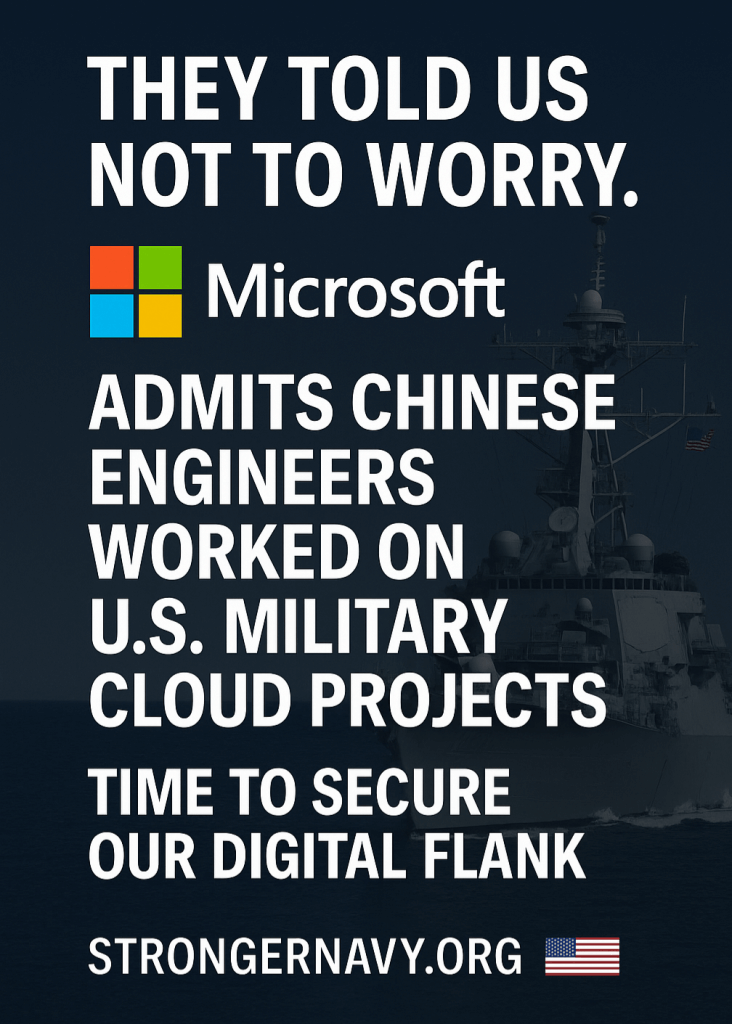
This week’s news confirms it: Microsoft allowed China-based engineers to support U.S. military cloud systems, including infrastructure tied to the Navy. It took a journalistic exposé, a senator’s inquiry, and finally a directive from the Secretary of Defense to shut it down.
Let’s be clear—this is systemic.
This wasn’t one company’s mistake. It reflects a broader failure—where critical defense infrastructure is entangled with adversarial regimes, our tech workforce has been hollowed out, and profit has been prioritized over patriotism.
This Is My Journey—and My Shout: From Destroyer Sailor to Digital Sentinel
My early days as a U.S. Navy destroyer sailor in the 1970s gave me a global perspective that’s stayed with me ever since. I saw firsthand how the world’s most critical maritime trade routes—from the Malacca Strait to the South China Sea—could quickly become flashpoints when adversaries or their proxies seized control. I came to understand just how vital the U.S. Navy’s role in freedom of navigation is—not only in defending democracy abroad, but in protecting our economic and strategic interests here at home.
After a career in telecommunications, I turned my focus to education. In 1997, I founded a national association committed to building America’s digital workforce. We trained web developers, server administrators, and IT professionals—because I believed then, as I still do, that digital strength is national strength.
Even back then, the writing was on the wall: rising dependence on China, fragile supply chains, and a dangerous complacency about safeguarding America’s digital and strategic backbone.
What I Saw Coming
I could see where this was headed. The decisions being made in boardrooms and bureaucracies—about outsourcing, offshoring, and chasing short-term profits—were creating long-term risks. And I knew exactly who would be left to deal with the fallout: our Navy and the sons and daughters of those I served with.
They’d be the ones sent to navigate hostile waters, defend contested choke points, and hold the line during crises that began far from the sea.
Why I Launched Americans for a Stronger Navy
I couldn’t sit back and hope it would all work itself out. I’ve seen too much. And frankly, it pains me to see the Navy have to grovel for support in an era where threats are multiplying—not receding.
That’s why I founded Americans for a Stronger Navy—to push for the readiness, resources, and respect our Navy needs. Because I know what’s at stake—not just for this country’s future, but for the safety of our allies and the stability of the global order.
This is just the beginning. In the weeks ahead, I’ll be breaking down what went wrong—and how we fight back.
More Than Microsoft: A National Security Crisis
The Navy—and the rest of our armed forces—now depends on cloud systems for everything from warfighting logistics to operational readiness. But when those systems are built or maintained by foreign nationals under weak supervision, our adversaries don’t need to hack their way in. They’re already inside.
This Microsoft scandal is just the latest proof point. Behind it lies:
* A depleted domestic technical base
* A defense industry over-leveraged to foreign subcontractors
* Big Tech firms chasing margins—not national security
And at the center of it all? A Navy that’s being asked to do more with less—and too often, without the tools it needs.
What Comes Next: Charting the Course
That’s why we’re launching Charting the Course: Voices That Matter—a comprehensive 24-session educational series designed to peel back the layers of how we got here, what went wrong, and what must happen next.
Each session will tackle a specific facet of the crisis—from the outsourcing of digital infrastructure and the hollowing out of our industrial base, to the cybersecurity vulnerabilities inside the Navy’s digital backbone. We’ll examine the influence of adversarial regimes, the failure of public-private accountability, and the high-stakes strategic chokepoints where our forces may soon be tested.
But this isn’t just about understanding the problem. It’s about charting a path forward.
We’ll offer concrete proposals to revitalize American shipbuilding, retrain our tech workforce, and rebalance the defense-industrial ecosystem to serve national—not corporate—interests. And yes—we’ll ask the tough question: how do we pay for it?
Because the days of bloated, inefficient spending are over. We need what Navy leadership is already calling for: a leaner, more lethal, and more disciplined force. As Acting CNO Admiral James Kilby put it, the Navy must:
“Exercise strategic discipline… while increasing surge readiness… without sacrificing scheduled maintenance,” with a goal of achieving “an 80% combat‑surge ready posture by 2027.”
We’ll explore potential solutions ranging from public-private innovation partnerships and industrial reinvestment incentives, to reallocating wasteful spending and rethinking procurement models that reward results—not red tape.
These sessions are designed to educate the public, inform policymakers, and mobilize everyday Americans—because this is not just a military issue.
We’re entering a new era of naval warfare—one where drones can fly farther than planes, submarines can think for themselves, and enemies strike not just with missiles, but with malware. But amid all the noise about autonomous systems and AI, let’s be clear:
America still needs sailors at sea.
Nothing can replace the judgment, courage, and leadership of a U.S. Navy crew. But we would be wrong not to give them every technological edge available. That’s where innovators like Palmer Luckey are stepping in—with bold ideas, operational tools, and a firm belief that deterrence should be smart, scalable, and American-made.
Meet the Man Behind the Disruption
Palmer Luckey is no ordinary defense entrepreneur. Best known as the creator of Oculus VR, Luckey turned his attention from gaming to national security in 2017 when he founded Anduril Industries. His mission: disrupt the bloated defense procurement system and deliver real-world, ready-to-use military tools at Silicon Valley speed.
Today, Anduril is producing drone interceptors, electromagnetic warfare systems, autonomous submarines, and smart command platforms that are already in service—supporting U.S. forces and our allies abroad.
“Porcupines, Not Policemen”
One quote from Palmer Luckey, shared in his 60 Minutes interview, captures the heart of a smarter deterrence strategy:
“My position has been that the United States needs to arm our allies and partners around the world so that they can be prickly porcupines that nobody wants to step on, nobody wants to bite them.” — Palmer Luckey, 60 Minutes, July 2025
We believe Luckey’s philosophy echoes the enduring wisdom of peace through strength. The goal isn’t global policing. It’s creating strong allies, hardened targets, and enough capability across our partnerships that no aggressor wants to test the waters.In Luckey’s view, deterrence isn’t about overwhelming presence—it’s about posture. And in today’s world, that posture needs to be smart, fast, and often unmanned.
Why Americans Should Care
Our adversaries are innovating relentlessly—China with hypersonics, Russia with cyber sabotage, Iran with drone warfare. If America lags in defense innovation, we risk far more than budgets—we risk blood.
Luckey’s approach embodies the kind of entrepreneurial urgency that once won us wars and landed men on the Moon. He’s not waiting for a contract. He’s building the future now.
The government isn’t always fast. But the American spirit—when unleashed—is faster.
Smart Tools for a Stronger Fleet—Not a Sailorless One
Let’s be clear: We’re not advocating for ghost fleets. We’re calling for smarter fleets.
Destroyers, submarines, and aircraft carriers remain the bedrock of American sea power. But in today’s threat landscape, steel without software is just a target. Our Navy must be equipped to launch and command advanced tools—like the Roadrunner drone interceptor or Dive XL autonomous submarine—from the decks of manned ships.
Autonomous platforms shouldn’t replace sailors. They should protect them. Empower them. Extend their reach.
When a U.S. warship can deploy swarms of AI-powered sensors or coordinate with allies via a shared AI battlefield platform like LATTIS, our sailors gain more than data—they gain the upper hand.
A New Era of Deterrence
The old model—sending troops into every hot zone—no longer fits a world of proxy wars, satellite surveillance, and cyber infiltration. Instead, we need to export capability, not just commitment. Give our partners the power to defend themselves, and America’s deterrent grows without overextending our forces.
That’s the heart of the porcupine strategy: Don’t invite a fight. But make it painful to start one.
The Bottom Line A Navy without sailors? That’s not America’s way. But a Navy without innovation? That’s a risk we can’t afford.
Let’s give our fleets and our friends the tools they need to defend freedom—above, below, and beyond the sea.
Let’s Talk to the Man Himself At Americans for a Stronger Navy, we believe voices like Palmer Luckey’s deserve a national stage. We’ve invited him to join us for a conversation—about innovation, entrepreneurship, and what the next generation of defense leadership looks like.
Palmer, if you’re reading this: the invitation is open.
👉 Subscribe at StrongerNavy.org 👉 Follow the mission: #StrongerNavy #PorcupineStrategy #SeaPower2
A Tribute to the Blue Water, Brown Water Navy – and Our POWs | March 29
As we mark this solemn and significant moment of remembrance, Americans for a Stronger Navy extends heartfelt gratitude to all who served during the Vietnam War—especially those in the U.S. Navy. Whether you were steaming offshore on a destroyer, carrier, or support ship, or navigating the dangerous inland waterways of the Mekong Delta, your courage and commitment mattered. You stood watch in some of the most complex and grueling conditions in modern warfare.
The Navy’s Role in Vietnam
The Navy’s role in Vietnam was extensive and essential. From launching air strikes from carriers during Rolling Thunder and Linebacker, to conducting coastal bombardments and halting enemy supply lines through Operation Market Time, the Navy was always on the front line. In the rivers and canals of the Delta, sailors in Task Forces 115, 116, and 117 faced ambushes and booby traps daily as they fought to secure the waterways in what became known as the “Brown Water Navy.”
Among those who served with distinction was the USS Henry B. Wilson (DDG-7). During the first three months of 1967, she cruised the South China Sea and Gulf of Tonkin, performing search and rescue missions and pounding enemy coastal positions in support of ground operations. Throughout the war, Henry B. Wilson served as plane guard for carriers on Yankee Station, participated in Sea Dragon operations, and provided naval gunfire support.
In April 1975, she took part in Operation Eagle Pull, assisting in the evacuation of Phnom Penh during its fall to the Khmer Rouge. Just weeks later, she was on the front lines again for Operation Frequent Wind, helping evacuate South Vietnam during its final collapse. Her role included drawing enemy fire away from the ships loading evacuees—demonstrating extraordinary bravery. In May 1975, she was also one of the lead ships in the dramatic rescue operation of the hijacked SS Mayaguez in Cambodian waters.
Why America Should Care
Today, many Americans may not know that 1.8 million Sailors served in Southeast Asia during the war. They may not realize that 95% of supplies reached Vietnam by sea, or that Navy Seabees built the logistical lifelines that made the war effort possible. And perhaps most importantly, many don’t know that over 1,600 Navy personnel lost their lives, thousands more were wounded—and some were taken as prisoners of war.
We especially honor those who endured captivity, often under brutal conditions, refusing to break and continuing to serve their country with dignity and resolve. Their courage is a testament to the strength of the human spirit and the values we hold dear.
We care because these men and women served their country without question—even when the country questioned the war. They are part of the fabric of American history and the foundation of our maritime security.
A Personal Note of Gratitude
As a former sailor on the USS Henry B. Wilson (DDG-7), I want to give a special shout-out to my shipmates that served during Vietnam and beyond. Our service mattered, and it still does.
I also want to honor my older brother, Chuck. He volunteered in 1968 as a U.S. Army photographer. Wounded in combat and granted a pass to come home, he made the extraordinary choice to go back—to help his buddies. Many of them never made it back. Chuck did, but not before being called a “baby killer” by his own countrymen—while still in bandages from his first Purple Heart. Still, he went back and served his country the best he could. RIP, brother. That’s the kind of quiet heroism that deserves recognition.
Never Forgotten
On behalf of Americans for a Stronger Navy, we say thank you. To the Blue Water sailors who braved open seas, the Brown Water warriors who navigated narrow rivers under fire, the POWs who endured unthinkable hardship, and the crew of the USS Henry B. Wilson—you made history. And to those like many of my shipmates and my brother Chuck, who showed what real duty looks like, your service continues to inspire.
Let’s remember them not just on designated days, but every day.
Learn more, get involved, and stand with us at StrongerNavy.org.
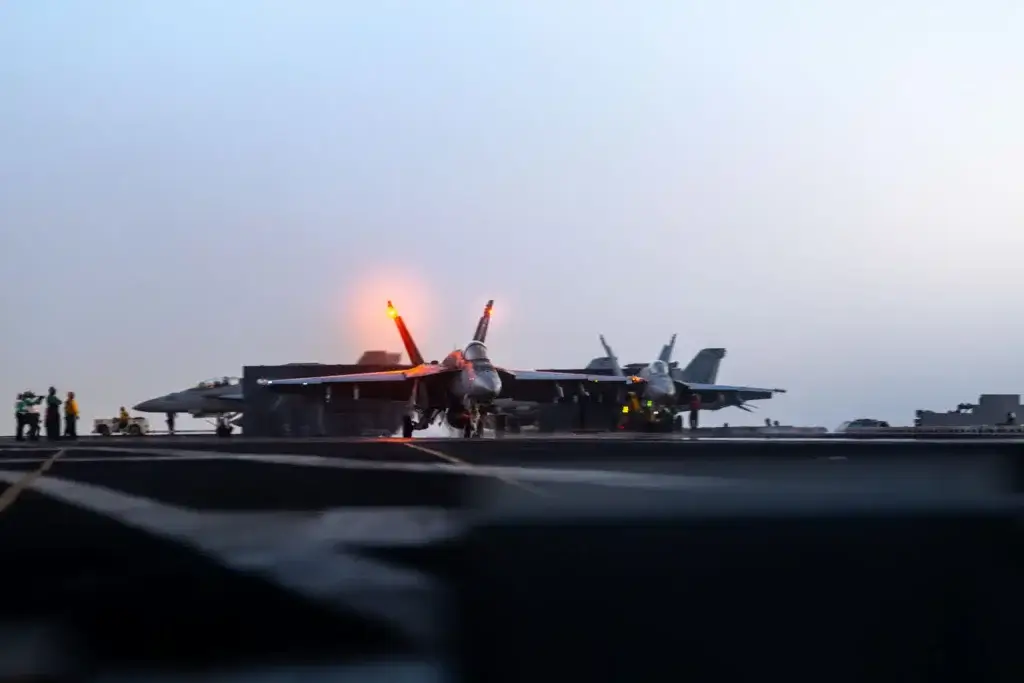
Air Wing (CVW) 1, a part of the Harry S. Truman Carrier Strike Group (HSTSCG), conducts flight operations from the Nimitz-class aircraft carrier USS Harry S. Truman (CVN 75)
A New Phase in the Red Sea Conflict
The U.S. Navy has officially escalated its engagement in the Red Sea, transitioning from defensive posturing to sustained combat operations against Iran-backed Houthi forces. This shift follows President Donald Trump’s pledge to employ “overwhelming lethal force” in response to persistent Houthi attacks on commercial and military vessels.
The Mission: Neutralizing Houthi Anti-Ship Capabilities
In a press statement, U.S. Secretary of State Marco Rubio confirmed that the campaign aims to dismantle the Houthis’ ability to target international shipping and U.S. assets. Unlike previous limited retaliatory strikes, this new phase includes proactive, sustained efforts to eliminate threats, including:
Additionally, sources indicate that Iranian assets—such as the intelligence-gathering vessel MV Behshad, which has reportedly provided targeting data to Houthi forces—may also be targeted.
Combat Operations Underway
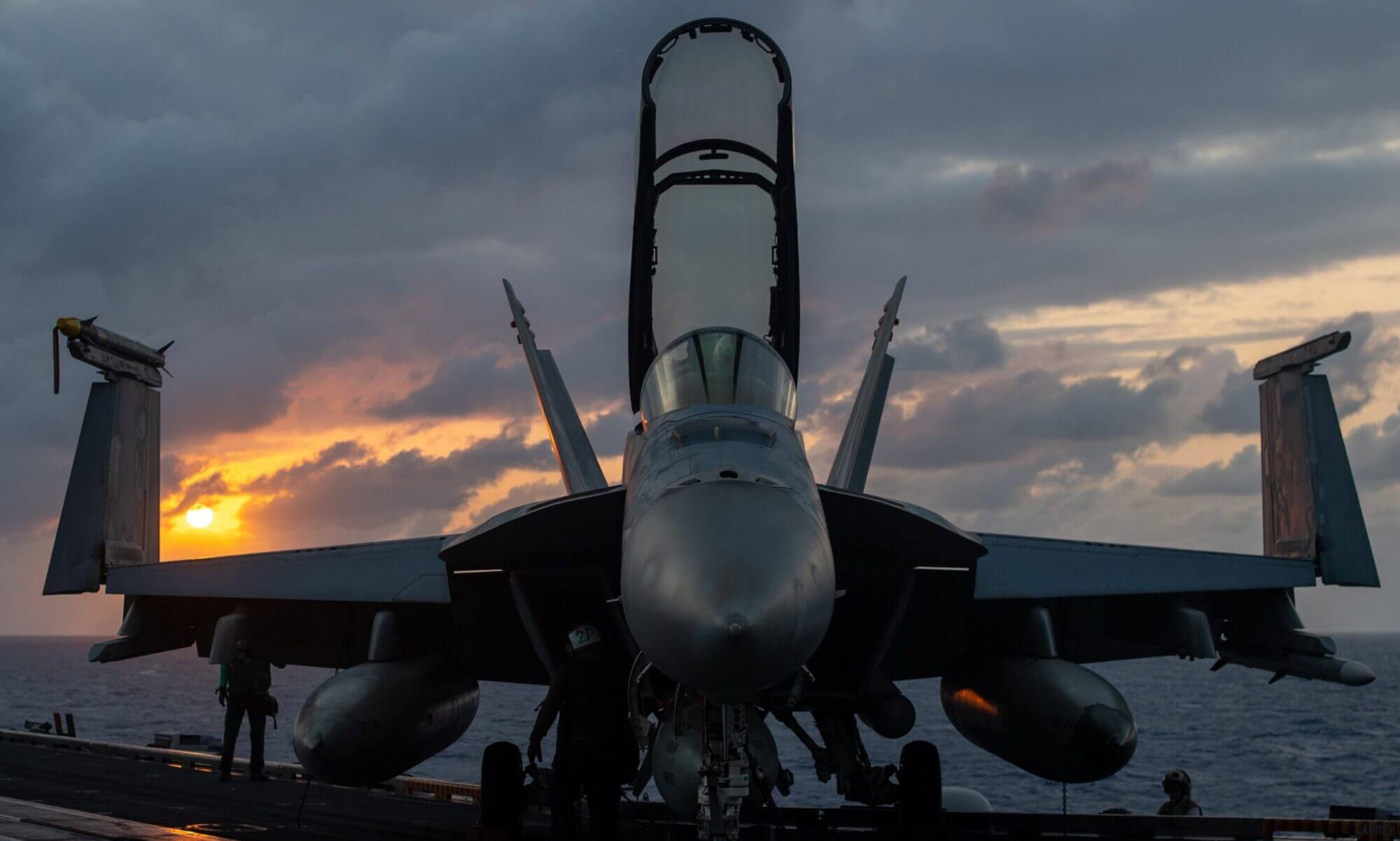
In the past 24 hours, U.S. Navy F/A-18 Super Hornets launched from USS Harry S. Truman (CVN 75) have carried out dozens of strikes across Houthi-controlled territory in Yemen. These operations were supported by Tomahawk cruise missile strikes from Arleigh Burke-class guided-missile destroyers in the region.
President Trump’s Warning to Iran
In a post on Truth Social, President Trump issued a direct warning to Iran, stating that any Houthi attack would be treated as an Iranian attack:
“Every shot fired by the Houthis will be looked upon, from this point forward, as being a shot fired from the weapons and leadership of IRAN, and IRAN will be held responsible… and those consequences will be dire!”
The statement underscores growing concerns that the conflict could escalate into a broader regional war.
Houthi Retaliation and U.S. Response
Despite these warnings, Houthi forces launched 10 attack drones at the USS Truman less than a day after the U.S. strikes. All drones were intercepted before reaching the carrier.
According to CENTCOM, since 2023, Houthi forces have attempted:
174 attacks on U.S. Navy ships
145 attacks on commercial vessels
While no U.S. Navy ship has been successfully struck, commercial shipping has suffered multiple hits, including the sinking of the bulk carrier MV Tutor last year.
Preparing for a Prolonged Conflict
The U.S. Navy has been preparing for this scenario for months, including:
Prepositioning missiles and munitions
Deploying airborne minesweepers
Coordinating additional forces
As tensions escalate, the USS Gerald R. Ford (CVN 78) Carrier Strike Group is completing COMPUTEX training and may be deployed to reinforce U.S. forces in the region.
Why Americans Should Care
Strategic Waterways Under Threat: The Bab al-Mandab Strait and Red Sea are critical for global trade. Disruptions could impact oil prices and supply chains.
Broader Implications for U.S. National Security: Iran’s role in these attacks highlights the risk of expanded conflict in the Middle East.
Protecting U.S. and Allied Assets: The safety of commercial shipping, as well as military and civilian personnel in the region, remains a top priority.
Implications for the U.S. Navy
Sustained combat operations will test the Navy’s ability to conduct extended engagements while maintaining readiness elsewhere.
Increased missile defense efforts will be critical to counter future threats.
Potential strain on resources could impact deployments in the Pacific and other high-priority regions.
Implications for U.S. Allies
Increased pressure on regional partners (Saudi Arabia, UAE) to respond to Iranian-backed aggression.
Possible involvement of NATO and European allies in securing international shipping routes.
Greater U.S. military presence in the region could shape future diplomatic efforts.
Final Thoughts
With the U.S. Navy now in active combat and President Trump’s warning to Iran, the stakes in the Red Sea have never been higher. Whether this campaign will succeed in neutralizing the Houthi threat or escalate into a larger regional conflict remains to be seen.
One thing is certain—this is a defining moment for U.S. maritime power and its role in global security. Join the discussion on X.
We stand at a crossroads in our nation’s history—one that will determine the future of our Navy, our national security, and the very strength of our industrial base. The question before us is clear: Should we rebuild our naval shipbuilding capabilities here at home, seek foreign assistance, or attempt a hybrid approach?
This is not just a debate about policy. It’s a decision that affects every American—from those who serve at sea to the workers who build our ships, to the families and businesses that rely on safe and open trade routes secured by the U.S. Navy.
A Crisis Decades in the Making
The United States Navy, once unrivaled, now finds itself struggling to maintain a fleet large enough to meet global threats. At the same time, our domestic shipbuilding industry has shrunk to a fraction of its former strength.
Fewer Shipyards: During World War II, the U.S. built a ship a day. Now, we are lucky to produce a handful of warships per year due to limited shipyard capacity.
Aging Repair Facilities: The few remaining naval repair yards are overburdened and outdated, leading to costly maintenance delays.
Worker Shortages: The skilled workforce needed to build and maintain ships has dwindled, leaving shipyards struggling to meet demand.
Rising Threats: China now produces more naval tonnage every year than the U.S. does in a decade. Russia and other adversaries are also modernizing their fleets.
The urgency is real. The Navy’s shipbuilding plan is behind schedule, over budget, and falling short of strategic needs. Simply put, we need more ships, more shipyards, and more skilled workers to build and sustain them.
The Debate: Build Here, Look Abroad, or Both?
President-elect Donald Trump recently suggested leaning on allies to help build U.S. Navy ships. His words have sparked a debate with far-reaching consequences.
There are three paths forward:
1. Fully Rebuild U.S. Shipbuilding Capacity (America First Approach)
Invest in more shipyards and repair facilities to increase production.
Expand apprenticeship and workforce training programs to address skilled labor shortages.
Modernize naval infrastructure to improve efficiency and speed of delivery.
✅ Pros: Strengthens U.S. industry, creates jobs, ensures security. ❌ Cons: Takes time, requires significant investment.
2. Use Allied Shipyards for Basic Infrastructure (Hybrid Approach)
Partner with allies (e.g., Japan, South Korea, Italy) to build less complex vessels while reserving warship production for U.S. yards.
Temporarily relieve the burden on U.S. shipyards while domestic capacity is rebuilt.
✅ Pros: Speeds up production, allows time for U.S. shipbuilding expansion. ❌ Cons: Security risks, reliance on foreign suppliers, potential job losses.
Contract allied nations to build support ships and basic naval infrastructure abroad.
Focus U.S. shipyards solely on high-end warship production.
✅ Pros: Short-term boost in fleet numbers, cost savings. ❌ Cons: Weakens U.S. shipbuilding industry, risks foreign dependency.
What’s at Stake?
No matter which path we take, one fact remains: The U.S. Navy needs more ships—and we need them faster. The growing threats on the world stage do not wait for political debates or bureaucratic delays.
America must decide:
Do we commit to fully restoring our shipbuilding industry, investing in shipyards, repair facilities, and workforce training?
Do we pursue a temporary partnership with allies to fill immediate gaps?
Do we accept foreign-built support ships, potentially at the cost of domestic industry?
This is not just a decision for policymakers—it is a choice for every American. The strength of our Navy is the strength of our nation.
A Call to Action
We need a national shipbuilding strategy that prioritizes American security, economic resilience, and industrial strength.
Expand our domestic shipbuilding capacity.
Modernize and build more repair facilities.
Train and recruit more American workers to sustain naval readiness.
Ensure the Navy has the fleet it needs to protect global commerce and national security.
History shows us that when America builds, America wins. The decision before us will shape the Navy for generations to come. Let’s make sure it’s a future built on strength. Americans for a Stronger Navy StrongerNavy.org. Join the discussion on X.com/strongernavy