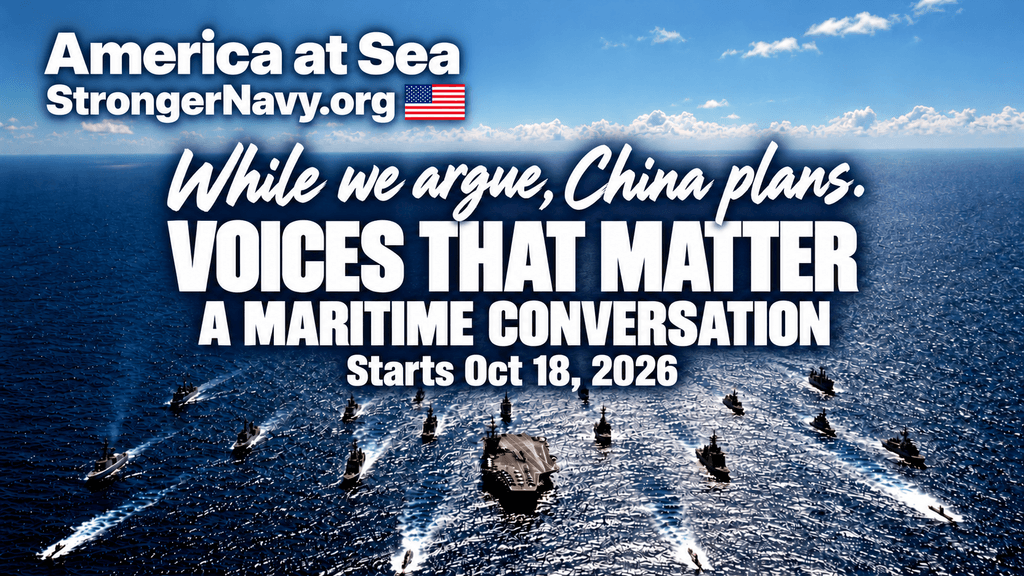
Over the next 45 days, we’ll hear from voices across America’s maritime world, each answering the same three questions. Watch the kickoff below, then join the conversation.
[PASTE THE X POST LINK HERE ON ITS OWN LINE]
Join the conversation. Reply to the post above on X and tell us what’s working, what’s in the way, and what you’d fix first. Not on X? Reach us through StrongerNavy.org.
The three questions
1. What’s working right now that we should do more of?
2. What’s the biggest barrier to rebuilding America at sea?
3. If you could fix one thing first, what would it be?
Transcript
Greetings. I’m Bill Cullifer, founder of Americans for a Stronger Navy. Welcome to America at Sea: Voices That Matter. This is a 45-day conversation about one question: how do we rebuild America at sea?
Why it matters
Here’s where we are. Last year China built more than half of all the new commercial ships in the world. The United States built about one-tenth of one percent [1][2].
China’s navy has more than 370 ships and is headed to 435 by 2030. Ours is about 290 [3][4]. And China builds its warships in the same yards as its cargo ships, so when it needs more, it can surge. We can’t.
Ask yourself why. A country doesn’t build a fleet like that by accident. It builds one to control the waters around it and to put its hand on the trade routes the rest of the world depends on. This summer, off Taiwan’s east coast, a Chinese fishing boat that’s part of its maritime militia was spotted working alongside its coast guard for the first time. Taiwan believes China is rehearsing a blockade [5].
Almost everyone in Washington agrees we need more ships. The arguments are about which ships, who builds them and who pays. And while we argue, China plans. So we’re trying something different. Instead of starting with the fights, we’re starting with what we already agree on.
Why start with common ground
Because agreement is where action begins. When shipbuilders, mariners, labor and the Navy community say the same thing, it’s hard to ignore, and much easier to get done.
Arguments stall. Common ground moves.
And for you, this is a chance to hear from the people doing the work, in their own words, without the spin. Much of what you buy comes to this country by sea. The ships that protect those sea lanes, and the jobs that build them, are in communities across America. This is your chance to understand what it will take, and what it means for you.
What we’re doing
Over the next 45 days, we’ll hear from voices across America’s maritime world. Each gets about ten minutes and the same three questions. What’s working right now that we should do more of? What’s the biggest barrier to rebuilding America at sea? And if you could fix one thing first, what would it be?
Same questions for everyone. Shipbuilders, large and small. Merchant mariners and the unions that train them. The skilled workers in our yards and ports. The companies that move our cargo. The Navy and Coast Guard community, active and retired. The people in Congress and their staffs who write the laws. And the writers and analysts who have been making the case for years. The shipyard worker and the admiral, side by side. We don’t all agree, and that’s the point.
The SHIPS for America Act
You’ll hear a lot about the SHIPS for America Act in this series. It’s the most comprehensive bipartisan effort in decades to rebuild our commercial fleet, our shipyards and our maritime workforce. Parts of it passed the House this summer, and Congress is deciding the rest now [6]. We’ll come back to it often, and we’ll hear from experts on where it stands.
One piece of it is worth knowing from the start. The bill creates a Maritime Security Advisor in the White House [7]. Today our maritime policy is spread across the Navy, the Coast Guard, Transportation, Commerce, Labor and more. No one person owns the whole picture. The Maritime Security Advisor would. That person would lead a board of every agency with a stake at sea, keep the national maritime strategy, and oversee a dedicated fund to pay for it. One hand on the helm.
How you can take part
The ten-minute voices are by invitation, so we can keep the conversation focused. But everyone has a part to play. Watch. Listen. Share it with someone who cares about this. And most important, weigh in. Reply on X and tell us what you think. If you know someone who should be heard, tell us that too. We read every response.
We’ll post each voice here as it comes in, starting today. And at the end of November, as Congress works to finish this year’s defense bill, we’ll publish a common-ground report: what these voices agree on, in their own words.
America at Sea is hosted by Americans for a Stronger Navy. It’s free, it’s open to everyone, and it’s nonpartisan.
Coming next
Tomorrow, you’ll meet the two people who will be with me to the finish line.
The first is Captain Brent Sadler, U.S. Navy, retired: a former nuclear submarine officer, diplomat and strategist. We asked Brent to be our moderator, and he graciously agreed. That doesn’t mean running a panel. It means guiding this series and advising us along the way. Few people know both the Navy and the maritime world the way Brent does, and he’s widely respected by his peers in both.
The second is Clay Wirsing, founder of U.S. Maritime Action, which is hosting this series with us. Clay spent eight years in American shipyards building and repairing carriers, destroyers and submarines.
Each of them will tell you, in his own words, why this matters to him.
While we argue, China plans. It’s time we started building.
Let’s roll.
Americans for a Stronger Navy is a nonpartisan 501(c)(3) organization. America at Sea is educational and does not urge support for or opposition to any legislation.
References
[1] China Ministry of Industry and Information Technology, 2025 shipbuilding figures, via Invest in China: https://investinchina.chinaservicesinfo.com/s/202602/09/WS698968cd498e23165e06d613/chinas-shipbuilding-sector-maintains-global-lead-in-2025.html
[2] CSIS, “Are U.S. Policies Eroding China’s Dominance in Shipbuilding?”: https://www.csis.org/analysis/are-us-policies-eroding-chinas-dominance-shipbuilding
[3] Congressional Research Service, China Naval Modernization (RL33153): https://www.everycrsreport.com/files/2024-08-16_RL33153_2580aa1e1d4021a5a9beb242ca3ee7aa56e21743.html
[4] U.S. Navy FY2027 shipbuilding plan, via World Ports: https://www.worldports.org/?p=742671
[5] Taipei Times (Reuters), “Taiwan spots first China militia boat in east,” Oct. 9, 2026: https://www.taipeitimes.com/
[6] K&L Gates, “House Passes Historic NDAA Maritime Amendments,” July 24, 2026: https://www.klgates.com/thought-leadership/House-Passes-Historic-NDAA-Maritime-Amendments-7-24-2026
[7] S. 1541, SHIPS for America Act of 2025, Sec. 101: https://www.govinfo.gov/content/pkg/BILLS-119s1541is/html/BILLS-119s1541is.htm