

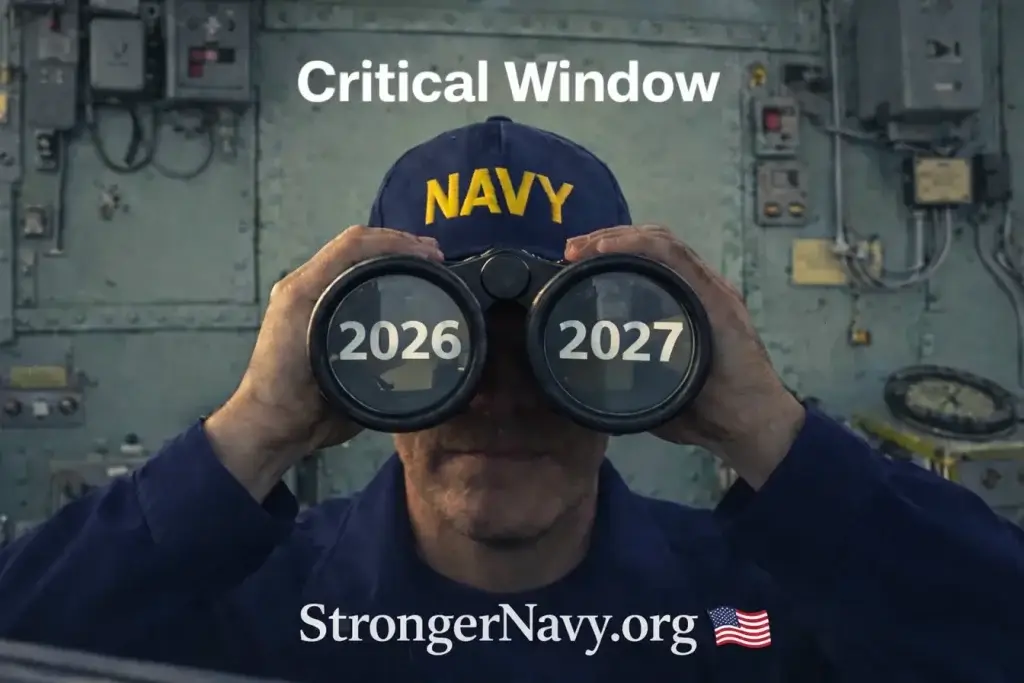

There’s a concept every naval planner understands but few Americans realize – one that I’ve come to appreciate over time: the decisions we make today about shipbuilding, maintenance, and industrial capacity don’t affect today’s Navy – they determine what Navy we’ll have seven to ten years from now.
This creates what I call the Critical Window – a concept familiar to anyone who’s managed large-scale projects. It’s that narrow period when decisions made now lock in outcomes years down the line. For shipbuilding, budget decisions, industrial investments, and strategic commitments made in 2026-2027 will directly shape our naval capabilities in the 2030s.
After this window closes, the die is cast. The industrial base will be committed. The budgets will be locked in. The ships – or the absence of ships – will be determined by choices we’re making right now.
Why 2026-2027 Is The Critical Window
The mathematics of naval construction are unforgiving:
- Attack submarines take 7-8 years from contract award to delivery. A Virginia-class submarine ordered in FY2027 enters the fleet in 2034-2035.
- Surface combatants take 4-5 years to build. An Arleigh Burke-class destroyer funded in FY2027 delivers in 2031-2032.
- Shipyard expansions take 3-4 years to become operational. Capacity investments made in FY2027 start producing results in 2030-2031.
- Columbia-class ballistic missile submarines require 7+ years and are consuming enormous portions of the shipbuilding budget through the end of this decade.
This isn’t abstract policy planning – it’s industrial reality. You cannot surge naval capability. You cannot speed up physics, metallurgy, or the skilled workforce required to build nuclear-powered warships.
Several factors converge to make 2026-2027 uniquely consequential:
- The Big Beautiful Bill Timeline: The $150 billion defense investment passed in July 2025 is one-time funding available through 2029. By 2027, Congress must decide whether to sustain these investments with recurring appropriations or let them lapse.
- The 2030s Capability Gap: Multiple studies project the Navy falling below required force structure in the early 2030s as older ships retire faster than new ones are built.
- The China Pacing Challenge: China’s shipbuilding capacity far exceeds America’s. The gap between their naval growth and ours widens with each passing year we fail to accelerate production.
- The Commission Opportunity: The National Commission on the Future of the Navy becomes operational in 2026. This represents a once-in-a-generation chance to reshape naval policy.
Looking Through The Binoculars: What We See In The 2030s
What you see depends entirely on decisions being made right now. If we maintain the current trajectory, the total battle force will decline by 2030, and the attack submarine fleet will reach minimum viable numbers by 2032. By 2035, China’s navy will be substantially larger, exploiting our constrained shipbuilding.
If we use the Critical Window wisely, shipyard expansions funded in 2026-2027 will come online by 2030. Accelerated production will begin delivering boats by 2032, and industrial base investments will enable us to match strategic requirements by 2035.
What The Critical Window Requires
Using this window effectively demands moving beyond one-time supplemental funding to sustained, recurring appropriations. The Big Beautiful Bill provided a down payment, but the FY2027 and FY2028 budgets must demonstrate a commitment to sustaining those investments. We also need acquisition reform to reduce the time from budget authorization to ship delivery and alternative funding mechanisms to supplement traditional appropriations.
From Experience: The Hollow Navy and The Reagan Response
I served during the 1970s hollow Navy – ships that couldn’t deploy and maintenance deferred. I also witnessed the Reagan administration’s response: a commitment to rebuild the Navy to 600 ships. That wasn’t just rhetoric – it was budget authority and political will sustained across multiple cycles. We face the same choice now. The 1980s rebuild succeeded because leaders recognized their Critical Window. We must do the same.
What You Can Do During The Critical Window
For veterans and advocates, understand that your voice matters most during the budget markup season. For policymakers, recognize that today’s choices have 10-year consequences. For concerned citizens, ask candidates about their plans for sustaining naval investment. Peace through strength requires backing rhetoric with budget authority.
The Bottom Line
The Critical Window of 2026-2027 is closing. We cannot change the physics of shipbuilding, but we can recognize this moment for what it is. The decisions made in the next 18 months will determine what Navy America has in the 2030s.
Americans for a Stronger Navy advocates for naval transparency, readiness, and strategic policy development. Learn more: StrongerNavy.org
Follow the Commission: National Commission on the Future of the Navy
The Critical Window is now. The time to act is today.