
MASGA Marks a Critical Milestone—But the U.S. Navy Still Needs Urgent Industrial Surge

Bill Cullifer, Founder

Introduction

From Waltz’s Warning to MASGA’s Launch

On September 27, 2023, Congressman Mike Waltz published “America Needs a National Maritime Strategy,” warning that the United States lacked the shipbuilding capacity and strategic alignment needed to counter China and sustain a maritime advantage.

Nearly two years later, that warning has materialized into policy.

On April 9–10, 2025, the White House issued the executive order “Restoring America’s Maritime Dominance,” launching the Maritime Action Plan and creating the new Office of Shipbuilding under the National Security Council.

Then, on July 31, 2025, South Korea’s Finance Minister confirmed the formal launch of Make America Shipbuilding Great Again (MASGA)—a $150 billion industrial partnership investing in U.S. shipyards, workforce development, and dual-use naval-commercial platforms.

What MASGA Does

MASGA is the largest public-private shipbuilding effort since the Cold War and includes:

  • Investment from South Korean giants like Hanwha Group into American yards (including the acquisition of Philly Shipyard)
  • Joint U.S.–ROK workforce training programs to close skilled labor gaps
  • New production of replenishment, patrol, and logistics vessels for both Navy and commercial use
  • Maintenance and drydock support for U.S. Navy ships on U.S. soil

It’s a big step forward—but one that must be matched with urgency.

Admiral Caudle’s Stark Warning: “We Need a 100% Industrial Surge”

On July 29, 2025, during his confirmation hearing for Chief of Naval Operations, Admiral Daryl Caudle delivered a sobering message to the Senate Armed Services Committee.

To meet U.S. obligations under the AUKUS agreement—selling up to five Virginia-class submarines to Australia while sustaining our own fleet—the Navy must double its submarine output:

  • Current production: ~1.3 Virginia-class submarines per year
  • Required output: 2.3 per year

“We need a transformational improvement,” Caudle testified. “Not a 10 percent improvement, not a 20 percent—a 100 percent improvement.”

He added that international partnerships would be essential as the U.S. works to rebuild its organic capacity:

“There are no magic beans to that. The solution space must open up. We need ships today.”

Committee Chairman Roger Wicker stressed creativity, outsourcing, and urgency. Admiral Caudle agreed, calling for “an all-hands-on-deck approach.”

This is precisely where MASGA comes in.

Why MASGA Matters for the Navy

MASGA’s structure provides the kind of foreign capacity support and workforce relief Caudle explicitly called for. It aligns directly with the Navy’s urgent need for:

  • Surge production of submarines and surface combatants
  • Expanded maintenance infrastructure
  • Shipyard partnerships to relieve domestic pressure

Congressman Waltz anticipated this crisis in 2023. MASGA is the first large-scale step toward solving it.

The Broader Navy Production Challenge

Submarines aren’t the only problem. The Navy’s broader industrial needs remain acute:

  • Destroyer production has slipped behind plan; the Navy aims to buy 51 new destroyers over the next 30 years, but current yards are falling short.
  • Aircraft carriers like the USS John F. Kennedy (CVN‑79) are years behind schedule.
  • The Navy’s long-term fleet goal of 381 ships by 2042 will remain aspirational without massive industrial acceleration.

And even with MASGA, the Navy is still contending with an aging Military Sealift Command, an undersized Merchant Marine, and shipyard repair backlogs.

Modernization Means Autonomy—And We’re Behind

Modernizing the fleet doesn’t just mean more hulls—it means smarter platforms. The future of naval warfare will be shaped by autonomous surface and undersea vehicles, from uncrewed missile boats to AI-enabled minehunters and refueling drones. China is already fielding swarms of semi-autonomous systems in contested waters. Meanwhile, the U.S. Navy’s efforts under programs like the Medium and Large Unmanned Surface Vessel (MUSV/LUSV) remain limited by slow procurement and industrial bottlenecks. MASGA can accelerate the integration of autonomous systems by expanding modular shipbuilding capacity, repurposing civilian infrastructure, and enabling faster tech deployment across the fleet. Without autonomy, we fall behind—not just in numbers, but in survivability and battlefield adaptability.

What Must Come Next

MASGA is a launchpad, not a destination. To restore maritime power, the U.S. must:

Expand submarine production
Reach 2.3 attack subs/year by 2030. This requires labor, capital, and process modernization on a scale not seen in decades.

Accelerate surface fleet output
Ramp up destroyers, amphibious vessels, and support ships. Congress must deliver multi-year procurement and budget certainty.

Fix regulation and finance
Incentivize private capital to flow into U.S. shipyards, not Chinese ones. Close loopholes and create new maritime investment channels for Americans.

Grow the skilled workforce
Welders, naval architects, systems engineers—we need tens of thousands more. Joint international training must be paired with U.S. educational investments.

Modernize the Merchant Marine
We once had over 5,000 ships. Today, we have fewer than 80 engaged in international trade. This is a critical national vulnerability.

Closing Message: MASGA Is a Start, Not a Solution

MASGA validates the vision Mike Waltz articulated in 2023. It meets Admiral Caudle’s call for relief through allied partnerships. It aligns with the Navy’s production and readiness needs.

But China is still building. Delays persist. And the decision space for national security continues to shrink.

Let’s not wait another decade to act like a maritime power. Let’s build, now.

That’s why we launched Charting the Course: Voices That Matter—a 24-part educational series breaking down how we got here, what went wrong, and what must happen next. Our goal is simple: educate the public, connect the dots, and build the support needed to close the readiness gap before it’s too late.

Let’s move beyond slogans. Let’s build understanding, accountability, and strength—before the next crisis comes knocking.


Join us at StrongerNavy.org
Let’s roll.
America’s Fleet Readiness Crisis: What 80% Really Means

Bill Cullifer, Founder

Introduction

If you’ve been following along, you know we’ve been sounding the alarm for some time now—raising concerns not out of fear, but out of duty. At Americans for a Stronger Navy, we don’t profit from defense contracts or feed the industrial complex. We’re here because the facts are in: the Navy is falling short of the readiness our nation demands—and we must do better.

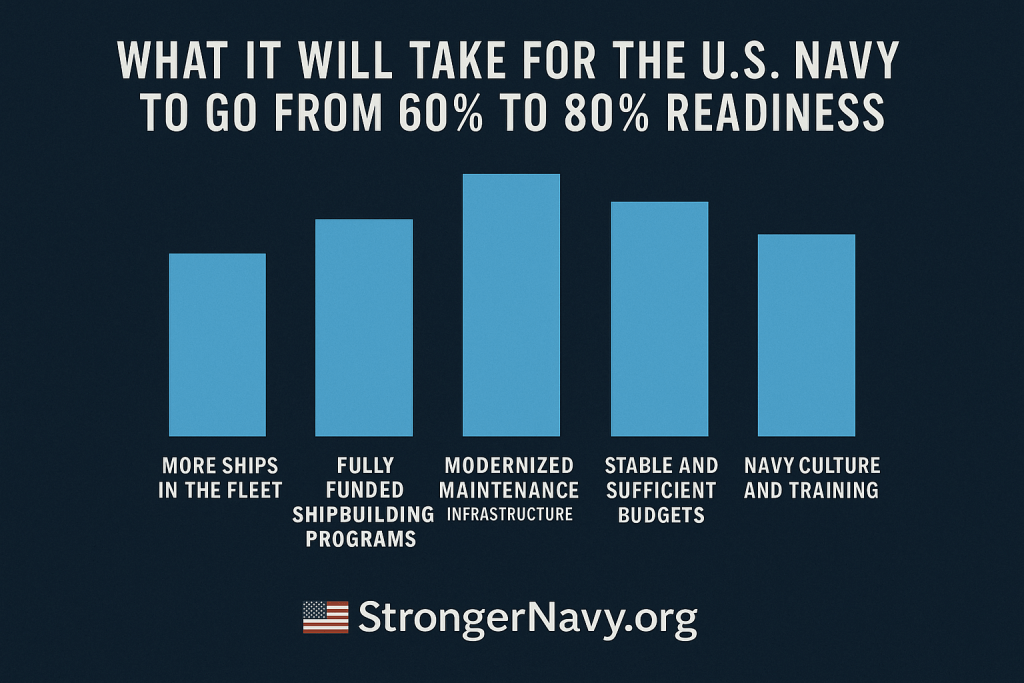
The U.S. Navy is aiming for 80% surge readiness by 2027—but it’s stuck at 60%. That 20% gap could determine whether America deters conflict—or invites one.

Brent Sadler, Senior Fellow for Naval Warfare and Advanced Technology at The Heritage Foundation and author of U.S. Naval Power in the 21st Century: A New Strategy for Facing the Chinese and Russian Threat, put it bluntly:

“It won’t happen until more ships enter the fleet to drive operational tempo down to 30%.”

Top Navy leaders have echoed this urgency. As one Navy official said plainly:

“We must increase our fleet readiness to 80% by 2027 to meet global security demands and deter peer-level threats.”

That’s the heart of the problem—and a major reason we’re sounding the alarm.

From the Indo-Pacific to the U.S. Southern border, the Navy is being stretched dangerously thin. The ships we have are aging, overworked, and under-maintained. Meanwhile, new construction is lagging—leaving sailors to shoulder an impossible burden, and the nation exposed.

At Americans for a Stronger Navy, we don’t advocate fear—we advocate responsibility. We believe war is preventable, but only if America wakes up and acts.

That’s why we launched Charting the Course: Voices That Matter—a 24-part educational series breaking down how we got here, what went wrong, and what must happen next. Our goal is simple: educate the public, connect the dots, and build the support needed to close the readiness gap before it’s too late.

Let’s move beyond slogans. Let’s build understanding, accountability, and strength—before the next crisis comes knocking.


Open Letter: Give the Navy the Tools—And Stop Leaving Us to Pick Up the Pieces

By Bill Cullifer
Founder, Americans for a Stronger Navy
Former U.S. Navy Destroyer Sailor (1970s)

There’s been a lively debate online between economic giants Larry Summers and David Sacks about tariffs, trade policy, and the consequences of decades of globalization. But while they spar over markets and presidential strategies, a bigger question goes largely unspoken:

Who picks up the pieces when economic policy becomes a national vulnerability?

As someone who served in the U.S. Navy in the 1970s and now leads Americans for a Stronger Navy, I’ve watched closely as the Navy quietly shoulders the consequences of decisions made far from the sea. While economists argue over the stock market’s reaction to tariffs, the Navy secures global trade routes, deters adversaries, and absorbs the burden of an offshored industrial base.

But the Navy isn’t alone. Entire sectors of American life—logistics, agriculture, energy, pharmaceuticals, entertainment, finance, and technology—depend on the smooth flow of global trade. From major ports and retailers to family farms and Fortune 500 companies, virtually every modern American business benefits from the stability the Navy helps provide.

The American economy is global because the U.S. Navy keeps it that way.

Yet in the recent debate, while Summers described trillions lost in market volatility and economic fallout, no one mentioned the ripple effects on military readiness, deterrence, or strategic capability. That absence reflects a dangerous blind spot.

When Wall Street stumbles, the Navy sails.
When diplomacy falters or trade routes are threatened, the Navy deploys.

But today it’s doing so with fewer ships, aging platforms, and underinvested shipyards—while our adversaries build, modernize, and maneuver.

This isn’t just a Navy issue. It’s a business issue. A national issue.

If your industry touches global trade—if you depend on international logistics, rare earth minerals, undersea cables, satellite access, shipping lanes, or simply consumer confidence—then you depend on a ready and capable Navy.

This is a message to American industry: You benefit. You must engage. You must contribute.

We need your voice—and your leadership—in support of:

  • Rebuilding our shipbuilding and repair base
  • Investing in drones, AI, and technologies that give our fleet an edge
  • Modernizing infrastructure and dry docks that sustain readiness
  • Funding advocacy and education to spark public awareness

The economic world order your industry thrives in exists because American sea power has kept the global commons safe for decades. That foundation is eroding—and silence is no longer an option.

At Americans for a Stronger Navy, we’re connecting the dots between civic awareness, economic strategy, and maritime strength. We’ve launched a 24-part educational initiative to help Americans understand what’s at stake and how to act.

Explore the series: Charting the Course – For Country. For Unity. For a Stronger Navy.

Whether you’re a CEO, policymaker, investor, teacher, or neighbor—this affects you. Now is the time to link economic resilience with strategic defense. To give the Navy the tools—not just praise—before the next storm arrives.

This is your moment to lead. Not from the sidelines—but from the front.

Use your platform. Leverage your influence. Show the next generation that prosperity is earned—and defended.

Because a secure economy doesn’t start with policy.
It starts with power. And power starts at sea.

Learn more at StrongerNavy.org and join the movement to educate, equip, and engage.

A stronger Navy requires a stronger America behind it. Let’s get to work.

Trump Signs Executive Order to Revitalize U.S. Shipbuilding


A Turning Point for America’s Maritime Strength

In a bold move aimed at restoring America’s maritime edge, President Donald Trump signed an executive order today (April 9, 2025) designed to revitalize the U.S. shipbuilding industry and reduce China’s growing control over the global shipping supply chain. The order calls for sweeping changes across trade, industry investment, and national security infrastructure—setting the stage for long-term renewal of America’s commercial and naval shipping capabilities.

What the Executive Order Includes

The new executive order establishes:

Maritime Security Trust Fund
A dedicated fund to provide stable, long-term investment in shipbuilding, shipyards, dry docks, and repair facilities. Potential funding sources include tariffs, fines, port fees, and other federal revenue streams.

Port Fees on Chinese-Linked Ships
Ships flagged by China or built in Chinese shipyards may soon face significant docking fees at U.S. ports. The U.S. Trade Representative (USTR) is expected to finalize this remedy by mid-April. Allies will also be encouraged to implement similar restrictions.

Tariffs on Chinese-Made Cargo Equipment
The order directs the USTR to consider imposing tariffs on ship-to-shore cranes and cargo handling gear manufactured or assembled in China—or made with Chinese-controlled components anywhere in the world.

Enforcement of Harbor Maintenance Fees
To prevent workarounds, Homeland Security will crack down on companies trying to avoid U.S. fees by routing shipments through Mexico and Canada before transporting them across land borders.

Incentives for U.S. Shipyard Investment
The executive order includes provisions for incentivizing private sector investment in new or revitalized U.S. shipyards, commercial ship components, and critical maritime infrastructure.

Why Americans Should Care

The United States currently produces less than 1% of the world’s commercial ships—while China builds about 50%. In 1999, China’s share was just 5%. This trend has massive implications not just for economic competitiveness, but for national security and maritime logistics.

As President Trump put it:
“We used to build a ship a day, and now we don’t build a ship a year, practically. We have the capacity to do it.”

This executive order is more than policy—it’s a call to action.

Implications for the Navy

While the executive order does not explicitly mention the U.S. Navy, its impact on naval readiness and strategic capability is unmistakable. Revitalizing America’s commercial shipbuilding infrastructure strengthens the industrial base the Navy relies on for new construction, maintenance, and repairs. Investments in dry docks, skilled labor, and cargo handling capabilities bolster our ability to support fleet operations—especially in times of crisis.

Moreover, reducing reliance on Chinese-built shipping equipment and infrastructure directly supports U.S. naval strategy. It limits vulnerabilities in ports and logistics chains, while reinforcing America’s control over critical maritime assets. A stronger shipbuilding sector means a stronger Navy, even if it’s not named in the order.

Implications for Our Allies

The executive order sends a message to America’s allies: We are serious about maritime strength and expect partners to do the same. With Chinese-built vessels operating across global supply chains, coordinated action could limit strategic vulnerabilities and encourage diversified, allied-aligned shipping infrastructure.

A Statement from Americans for a Stronger Navy

“This executive order is a long-overdue step toward restoring our nation’s ability to build and maintain the ships we depend on for both commerce and defense. The Navy does not operate in a vacuum—it needs a healthy, resilient industrial base. America must lead again on the seas, not just militarily, but commercially. This is how we secure freedom of navigation, economic stability, and peace through strength.”
— Bill Cullifer, founder, Americans for a Stronger Navy

Your Voice Matters

This is our moment. Let’s celebrate the executive order—but keep pushing until America leads on the seas again. Congress must act, industry must respond, and Americans must stay engaged.

Sign up to be part of the movement. It’s free. A stronger Navy begins with a stronger nation.


Shipbuilding, Repair, and Shore Support: Why SIOP Matters More Than Ever

Introduction

At this year’s Sea-Air-Space Expo, a powerful message came through loud and clear: shipbuilding and repair aren’t just logistics or budgeting issues—they are strategic priorities. With the U.S. Navy facing growing demands across the Indo-Pacific and beyond, the ability to maintain and sustain our fleet has never been more important. One of the most important announcements at #SAS2025 came from NAVFAC leadership, who shared critical updates on the Navy’s long-term infrastructure plan: the Shipyard Infrastructure Optimization Program (SIOP).

What Is SIOP? The Shipyard Infrastructure Optimization Program is the Navy’s comprehensive, decades-long effort to modernize its four public shipyards: Norfolk, Pearl Harbor, Portsmouth, and Puget Sound. These yards are essential to maintaining our nuclear-powered fleet, and many of their facilities date back a century or more. SIOP aims to upgrade dry docks, replace aging infrastructure, optimize layout and workflow, and improve productivity and quality of service for 37,000 shipyard workers.

Why This Matters Fleet readiness is impossible without reliable infrastructure. Every day a ship sits idle in maintenance delays is a day it can’t defend our interests. As Rear Adm. Dean VanderLey of NAVFAC stated at #SAS2025, shore infrastructure is the foundation of American maritime power. And without modern, capable shipyards, our ability to project sea power and maintain naval dominance is at risk.

Smart Construction, Smarter Strategy SIOP isn’t just about fixing what’s broken. It’s about doing things better. NAVFAC leaders highlighted new strategies like early contractor involvement, modular/offsite construction, and industrialized building techniques—all aimed at delivering faster results at lower cost. For example, the dry dock at Puget Sound Naval Shipyard will require twice the concrete used to build the Pentagon. That’s a massive, multiyear undertaking—and it shows the scale and urgency of the mission.

A Civilian-Military Partnership Shipyard revitalization is more than a military investment. It represents an opportunity for public-private collaboration, workforce development, and industrial revitalization. It’s a call to rebuild America’s maritime edge with the help of skilled labor, advanced engineering, and modern project delivery.

Conclusion: Time to Stay Focused At Americans for a Stronger Navy, we believe this is the kind of long-term, bipartisan initiative that can reset the trajectory of our Navy and our civilian maritime capability. Shipbuilding is strategy. Repair is readiness. And shore support is the glue that holds it all together.

Let’s make sure SIOP gets the support, oversight, and public awareness it deserves.

#StrongerNavy | StrongerNavy.org | #SAS2025 | #Shipbuilding | #SIOP | #NAVFAC | #SeaPower

An Open Letter to America: The Future of U.S. Shipbuilding and Naval Strength

Dear Fellow Americans,

We stand at a crossroads in our nation’s history—one that will determine the future of our Navy, our national security, and the very strength of our industrial base. The question before us is clear: Should we rebuild our naval shipbuilding capabilities here at home, seek foreign assistance, or attempt a hybrid approach?

This is not just a debate about policy. It’s a decision that affects every American—from those who serve at sea to the workers who build our ships, to the families and businesses that rely on safe and open trade routes secured by the U.S. Navy.

A Crisis Decades in the Making

The United States Navy, once unrivaled, now finds itself struggling to maintain a fleet large enough to meet global threats. At the same time, our domestic shipbuilding industry has shrunk to a fraction of its former strength.

  • Fewer Shipyards: During World War II, the U.S. built a ship a day. Now, we are lucky to produce a handful of warships per year due to limited shipyard capacity.
  • Aging Repair Facilities: The few remaining naval repair yards are overburdened and outdated, leading to costly maintenance delays.
  • Worker Shortages: The skilled workforce needed to build and maintain ships has dwindled, leaving shipyards struggling to meet demand.
  • Rising Threats: China now produces more naval tonnage every year than the U.S. does in a decade. Russia and other adversaries are also modernizing their fleets.

The urgency is real. The Navy’s shipbuilding plan is behind schedule, over budget, and falling short of strategic needs. Simply put, we need more ships, more shipyards, and more skilled workers to build and sustain them.

The Debate: Build Here, Look Abroad, or Both?

President-elect Donald Trump recently suggested leaning on allies to help build U.S. Navy ships. His words have sparked a debate with far-reaching consequences.

There are three paths forward:

1. Fully Rebuild U.S. Shipbuilding Capacity (America First Approach)

  • Invest in more shipyards and repair facilities to increase production.
  • Expand apprenticeship and workforce training programs to address skilled labor shortages.
  • Modernize naval infrastructure to improve efficiency and speed of delivery.

✅ Pros: Strengthens U.S. industry, creates jobs, ensures security.
❌ Cons: Takes time, requires significant investment.

2. Use Allied Shipyards for Basic Infrastructure (Hybrid Approach)

  • Partner with allies (e.g., Japan, South Korea, Italy) to build less complex vessels while reserving warship production for U.S. yards.
  • Temporarily relieve the burden on U.S. shipyards while domestic capacity is rebuilt.

✅ Pros: Speeds up production, allows time for U.S. shipbuilding expansion.
❌ Cons: Security risks, reliance on foreign suppliers, potential job losses.

3. Fully Outsource Basic Infrastructure (Foreign Assistance Approach)

  • Contract allied nations to build support ships and basic naval infrastructure abroad.
  • Focus U.S. shipyards solely on high-end warship production.

✅ Pros: Short-term boost in fleet numbers, cost savings.
❌ Cons: Weakens U.S. shipbuilding industry, risks foreign dependency.

What’s at Stake?

No matter which path we take, one fact remains: The U.S. Navy needs more ships—and we need them faster. The growing threats on the world stage do not wait for political debates or bureaucratic delays.

America must decide:

  • Do we commit to fully restoring our shipbuilding industry, investing in shipyards, repair facilities, and workforce training?
  • Do we pursue a temporary partnership with allies to fill immediate gaps?
  • Do we accept foreign-built support ships, potentially at the cost of domestic industry?

This is not just a decision for policymakers—it is a choice for every American. The strength of our Navy is the strength of our nation.

A Call to Action

We need a national shipbuilding strategy that prioritizes American security, economic resilience, and industrial strength.

  • Expand our domestic shipbuilding capacity.
  • Modernize and build more repair facilities.
  • Train and recruit more American workers to sustain naval readiness.
  • Ensure the Navy has the fleet it needs to protect global commerce and national security.

History shows us that when America builds, America wins. The decision before us will shape the Navy for generations to come. Let’s make sure it’s a future built on strength.
Americans for a Stronger Navy
StrongerNavy.org. Join the discussion on X.com/strongernavy


When America Ships, America Wins

Wake up, America—our destiny depends on it.

Bill Cullifer, Founder

Introduction

In our ongoing pursuit to strengthen America’s sea power, we must confront the challenges facing both our Navy and the broader maritime domain. Over the weekend, I immersed myself in key publications—from Captain Brent D. Sadler’s impassioned article, The Nation Needs a Shipbuilding Revolution (February 2025 Proceedings), to insightful analyses on platforms like War on the Rocks and legislative presentations regarding the SHIPS for America Act. In addition, I revisited the history and nuance of Naval versus Maritime Statecraft.

The conclusion is clear: our nation’s strength at sea relies on a transformative, integrated approach. In short, When America Ships, America Wins.

Why This Matters

For too long, the U.S. Navy has operated under a narrow warfighting mandate—a legacy of policies from the 1950s that prioritized combat readiness above all else. Yet history teaches us that true American sea power has always depended on two interlinked capabilities: a modern, formidable fleet and an engaged maritime domain that underpins commerce, diplomacy, and humanitarian efforts.

As Rep. Garamendi recently stated,
“Today, less than 200 oceangoing ships fly the American flag; the SHIPS for America Act will empower our shipyards and marine merchants to uphold our country’s status as a leader in the maritime industry.”

Meanwhile, Senator Mark Kelly emphasized,
“Strengthening America’s shipbuilding capacity and revitalizing our commercial maritime industry is critical to both our national security and economic resilience.”

These words capture the urgent need to reinvest in our naval statecraft while simultaneously enhancing our broader maritime strength.

Our Journey to Clarity
Throughout my review, several key insights emerged:

Dissecting the Sources: Captain Sadler’s article calls for a revolution in U.S. naval shipbuilding. He writes, “For too long, needed investment in and action to bolster our nation’s maritime industrial base have been elusive. That luxury is no longer feasible given the threat from a revanchist and massively invested Chinese military.” His words, combined with insights from War on the Rocks and historical reflections, remind us that our Navy must once again balance combat readiness with essential peacetime missions.

Clarifying Terminology: We now clearly distinguish between “naval statecraft”—focused on rebuilding our fleet and shipbuilding capacity—and “maritime statecraft,” which encompasses the broader economic, diplomatic, and logistical roles at sea. Recognizing that these two concepts are mutually reinforcing helps create a coherent strategic message.

Refining Our Message: After extensive review and discussion, our distilled, bold message is: When America Ships, America Wins. Coupled with the rallying cry, Wake up, America—our destiny depends on it, this encapsulates the urgent need to invest in our naval statecraft to secure our maritime future.

Key Takeaways and Implications

Integrated Mission for a Modern Era: A strong Navy is not just about preparing for war—it is the foundation of national security, economic prosperity, and global maritime influence. When America builds its ships, it reinforces its entire maritime domain.

Economic and Security Benefits: Investment in our shipbuilding industry creates high-quality jobs, revitalizes our manufacturing base, and ensures our fleet is capable of sustaining military operations and global trade. Without sufficient modern vessels, our ability to maintain critical supply chains is at risk.

Historical Lessons for Today: The interwar period showed that the U.S. Navy once balanced readiness for war with vital peacetime missions like humanitarian aid and diplomatic engagement. Recalling these lessons provides a blueprint for integrating naval and maritime statecraft in today’s complex environment.

In my efforts to understand the challenges facing the U.S. Navy and our maritime infrastructure, I have spent a fair amount of time reviewing the Jones Act and the range of views surrounding it. While there are differing opinions on how best to strengthen our domestic shipping industry, one thing is clear—America needs more ships, a stronger supporting infrastructure, and a Navy that is fully equipped to protect our national security. Regardless of where one stands on the specifics of maritime policy, we can all agree that a Stronger Navy is critical to American security and economic resilience. My focus remains on ensuring that we have the industrial capacity, shipbuilding capabilities, and logistics networks necessary to maintain U.S. maritime strength in an increasingly contested world.

Why Americans Should Care

For over two centuries, American maritime strength has been a cornerstone of our global leadership. Yet today, our domestic shipbuilding industry has shrunk from over 300 shipyards in the 1980s to just 20, and our U.S.-flagged commercial fleet has dwindled to fewer than 80 vessels. With China dominating global shipbuilding and maritime trade, the equation is simple: When America Ships, America Wins. Our shipyards are the engines powering our Navy, safeguarding our commerce, and securing our freedom.

Implications for the Navy and the Maritime Domain

For the Navy: Modernizing our fleet enhances operational readiness, supports a skilled and sustainable workforce, and allows the Navy to execute both war and peacetime missions. A modernized Navy is essential to deter adversaries and defend our national interests.

For the Maritime Domain: A thriving shipbuilding industry is vital for protecting American commerce, ensuring free navigation, and fostering economic resilience. Strengthening our maritime statecraft reinforces strategic partnerships and maintains our global influence.

The Legislative Response: SHIPS for America Act

Bipartisan efforts led by figures such as Senator Mark Kelly, Congressman Mike Waltz, Rep. Trent Kelly, and Rep. John Garamendi have culminated in the introduction of the Shipbuilding and Harbor Infrastructure for Prosperity and Security (SHIPS) for America Act. This comprehensive legislation proposes to:

  • Revive U.S. Shipbuilding: Offer tax incentives and targeted investments to rebuild our shipyards and attract private-sector growth.
  • Expand the U.S.-Flagged Merchant Fleet: Implement cargo preference laws to ensure more goods travel on American ships.
  • Strengthen National Security: Increase the supply of ships available for military logistics and rapid response.
  • Develop a New Maritime Workforce: Establish apprenticeships, trade school incentives, and recruiting programs to restore critical skills in ship maintenance and marine operations.
  • Forge Strategic Partnerships with Allies: Collaborate with trusted nations like Japan, South Korea, Finland, and Canada to enhance our shipbuilding capacity while ensuring American oversight.

This legislation is not about partisan politics—it’s about survival. With global supply chains vulnerable to disruption, the urgency to rebuild our maritime strength has never been greater.

Conclusion & Call to Action

History teaches us that nations fall when they lose control of the seas. Today, as our adversaries grow stronger and our industrial base shrinks, we cannot afford to dawdle. It’s not war we desire, but peace achieved through strength—and our enemies must know that America will not stand idly by.

Join us in this crucial mission. We call on policymakers, industry leaders, and every American who values freedom and prosperity to support transformative initiatives that invest in our naval statecraft. By strengthening our shipbuilding industry and modernizing our Navy, we secure a robust maritime future that benefits us all.

When American Ships, America Wins.
Wake up, America—our destiny depends on it.

Visit StrongerNavy.org to learn more, get involved, and help ensure that our nation’s shipbuilding efforts pave the way for a secure and prosperous future.

In service to a stronger America,
Bill

Strengthening America’s Maritime Future: A Wake-Up Call for Action

Bill Cullifer, Founder

At Americans for a Stronger Navy, we have long advocated for a robust maritime strategy that includes both a stronger U.S. Navy and a revitalized civilian maritime industry. Our commitment to this cause is rooted in a belief that America’s strength at sea is indispensable to its national security, economic stability, and global leadership.

Recently, the U.S. Trade Representative (USTR) released findings from an investigation into China’s dominance in the shipbuilding, maritime, and logistics sectors, revealing practices that undermine fair competition and threaten American interests. This news reaffirms the urgency of revitalizing our shipbuilding industry—a call echoed by U.S. legislators like Senator John Garamendi and others who are leading efforts to rebuild our maritime capabilities.

What the Investigation Found

The USTR investigation, launched in response to petitions by five unions, highlights how China’s aggressive industrial policies have positioned it as a global leader in shipbuilding. According to USTR Katherine Tai, China builds over 1,700 ships annually—dwarfing the fewer than five built by the United States. The report emphasizes that Beijing’s practices displace foreign firms, foster dependencies, and create significant economic and security risks for the U.S.

Quoting Katherine Tai:
“Beijing’s targeted dominance of these sectors undermines fair, market-oriented competition, increases economic security risks, and is the greatest barrier to revitalization of U.S. industries.”

Why This Matters

America’s maritime industry was once the backbone of our global influence and security. Today, it is a shadow of its former self, leaving us vulnerable to external dependencies. The decline of U.S. shipbuilding not only erodes our military readiness but also jeopardizes our economic security, particularly in the face of escalating geopolitical tensions with China.

The implications extend beyond shipbuilding. Logistics, supply chains, and the broader maritime ecosystem are critical to ensuring that America can sustain its global commitments and respond to crises effectively. As Alliance for American Manufacturing President Scott Paul aptly noted:
“Failing to take decisive action will leave our shipbuilding capabilities at the mercy of Beijing’s persistent predatory market distortions.”

Legislative Efforts to Revitalize U.S. Shipbuilding

Amid these challenges, leaders like Senator John Garamendi are working to reverse the tide. Garamendi, alongside Senators Mark Kelly and Todd Young, recently introduced the SHIPS for America Act—a comprehensive, bipartisan effort to rebuild the U.S. shipbuilding industry and expand the U.S.-flagged fleet. Key provisions of this legislation include:

  • Establishing a national maritime strategy and a White House Maritime Security Advisor.
  • Expanding the U.S.-flagged fleet by 250 ships over the next decade.
  • Rebuilding the shipyard industrial base with tax credits, financial incentives, and funding for workforce development.
  • Strengthening regulations to ensure government-funded cargo is transported on U.S.-flagged vessels.

These efforts align closely with our own calls for a balanced strategy that integrates the needs of both the Navy and civilian maritime industries.

What Needs to Be Done

The USTR’s findings, combined with the SHIPS for America Act and related initiatives, offer a roadmap to reclaim America’s maritime leadership. However, this will require decisive action from policymakers, industry leaders, and the American public. We need to:

  • Invest in shipbuilding infrastructure and workforce development.
  • Expand the U.S.-flagged fleet to reduce dependence on foreign shipping.
  • Foster innovation in shipbuilding technologies to compete globally.
  • Unite bipartisan support for maritime legislation that prioritizes national security and economic resilience.

A Call to Action: Wake Up, America!

The stakes have never been higher. As we outlined in our recent open letter, the decline of America’s maritime capabilities is not just an industry problem—it’s a national security crisis. For too long, we have allowed complacency to erode our standing as a maritime power. It’s time to wake up.

We urge you to contact your representatives and demand support for legislation like the SHIPS for America Act. Share this message with your community, and join us in advocating for a stronger Navy and a revitalized civilian maritime industry.

America’s future at sea depends on it. Let’s make it happen.

Credit to AFP for their reporting on the USTR investigation and to the Alliance for American Manufacturing for their continued advocacy.

“`

Honoring Our Veterans on Veterans Day

Bill Cullifer, Founder

As we reflect on the courage and resilience of our veterans this coming Monday, I want to share the incredible story of Captain Charlie Plumb.

Growing up as a farm kid from Kansas, he dreamed of seeing the world and serving his country. He joined the U.S. Navy, became a Top Gun pilot, and flew 74 combat missions. But on his last mission, just five days from returning home, his plane was shot down over Hanoi. Captured and held as a prisoner of war for nearly six years, he endured unimaginable hardships, surviving in an 8×8 cell and suffering brutal treatment, all while separated from his family.

When he was finally freed, Captain Plumb’s first flight home stopped at Clark Air Base in the Philippines. He called home, only to hear the devastating news that his wife, who had waited for five long years, had filed for divorce just three months before his release. It was yet another challenge, but he faced it as he had all the others—with strength, resilience, and the unshakeable will to move forward.

Captain Plumb’s story is a reminder of the extraordinary sacrifices our veterans make. He shows us that adversity is, as he says, a “horrible thing to waste,” encouraging us to face our own challenges with courage and hope.

To veterans everywhere thank you. Your resilience, and commitment inspire every day. I am forever grateful for your service and sacrifice.

U.S. Naval News Weekly Roundup: September 17- 25th, 2024

USS Harry S. Truman (CVN 75), departs Naval Station Norfolk, Virginia Sept. 23. U.S. Navy Photo

Introduction:

We take a break from this weeks series covereage on the U.S. Navy Project 33 for weekly U.S. Naval news. This week’s U.S. Navy news reflects the Navy’s continuous efforts to maintain maritime dominance, international collaborations, and strategic readiness. From enhanced partnerships in the Arctic and Pacific to expanding shipbuilding capabilities, the Navy remains committed to ensuring global security and operational effectiveness. This roundup captures the dynamic developments shaping the U.S. Navy’s mission and its response to emerging threats.

U.S. Navy Global Engagement and Readiness

USS Harry S. Truman Deploys Amidst Global Tensions The aircraft carrier USS Harry S. Truman and its strike group deployed from Naval Station Norfolk, Virginia, on September 23rd. While the Navy announced this as a regularly scheduled deployment to the European theater, previous East Coast carrier deployments have seen their plans uprooted due to ongoing conflicts, particularly between Israel and Hamas, which have threatened to broaden into a larger Middle Eastern conflict.

Chief of Naval Operations Meets Brazilian Navy Commander Adm. Lisa Franchetti, the Chief of Naval Operations, met with Commander of the Brazilian Navy Adm. Marcos Sampaio Olsen during the Inter-American Naval Conference in Rio de Janeiro, Brazil. They discussed strengthening naval partnerships, the significance of their 200 years of diplomatic relations, and the strategic importance of enhancing interoperability and regional security.

USS Leyte Gulf Decommissioned The USS Leyte Gulf (CG 55), a Ticonderoga-class guided-missile cruiser, held its decommissioning ceremony at Naval Station Norfolk on September 20th. The ceremony honored the ship’s 37 years of distinguished service, with Vice Adm. Eugene Black III, a former commanding officer of Leyte Gulf, serving as the keynote speaker.

Operations and Exercises

U.S. Navy, Coast Guard, and Intelligence Leaders Engage in Japan Vice Adm. Karl Thomas and other senior U.S. Navy and Coast Guard intelligence leaders visited Japan from September 9-14. They met with Admiral Akira Saito, Chief of Staff of Japan’s Maritime Self-Defense Force, to discuss enhancing maritime security in the Indo-Pacific and the importance of allied partnerships in maintaining a free and open region.

USS Sterett Deploys Near Alaska Amid Russian Activity In response to increased Russian and Chinese military operations near Alaska, the USS Sterett, a guided-missile destroyer, has been deployed to the Alaskan coast. Alongside the Sterett’s deployment, fighter squadrons and other aircraft in Alaska have been placed on heightened alert to counter Russian naval exercises and air operations near U.S. airspace.

U.S. Navy Participates in Barents Sea Operations Four U.S. Navy ships and a Royal Navy ship conducted maritime security operations in the challenging environment of the Barents Sea on September 18th. The deployment included Arleigh Burke-class Aegis destroyers USS Donald Cook (DDG 75), USS Porter (DDG 78), USS Roosevelt (DDG 80), and the fast combat support ship USNS Supply, along with the Royal Navy’s HMS Kent (F 78). This operation aimed to assert freedom of navigation and demonstrate seamless integration with allies above the Arctic Circle.

Innovation and Technology

WindBorne Partners with the Navy to Advance AI Forecasting Technology WindBorne has begun a six-month partnership with the U.S. Navy to enhance its AI weather forecasting model, WeatherMesh. This collaboration will improve subseasonal forecasting and optimize tropical cyclone prediction, helping the Navy prepare for hazardous weather events and bolstering its operational readiness.

BAE Systems Wins U.S. Navy Contract for Digital Interrogator Systems BAE Systems secured a $19 million contract to develop and implement the UPX-24 target data-processor capabilities into a single digital interrogator solution. This advanced technology will help identify nearby forces, reduce friendly-fire incidents, and enhance decision-making capabilities on Navy ships.

Navy Partners with Private Industry to Grow Submarine Industrial Base Capacity In a groundbreaking collaboration, the U.S. Navy has partnered with private industry to expand submarine production capabilities. The initiative aims to rebuild a manufacturing base that has shrunk to one-third of its capacity over the past 30 years, ensuring that the Navy can meet the construction demands for Columbia Class and Virginia Class submarines.

International Partnerships

Chief of Naval Operations Presents Arctic Service Medal to Submariners Adm. Lisa Franchetti presented the newly established Arctic Service Medal to the crew of the Virginia-class attack submarine USS Indiana (SSN 789) and others who contributed to operations in the Arctic region. This medal recognizes their exceptional service and dedication in navigating the challenging Arctic environment and underscores the Navy’s commitment to maintaining strategic capabilities in the region.

U.S. Navy Partners with Private Equity to Revitalize Alabama Shipyard The U.S. Navy entered into a public-private partnership with the United Submarine Alliance Qualified Opportunity Fund to modernize the Mobile Naval Yard in Alabama. This investment will support the production of Columbia and Virginia Class submarines, strengthening the Submarine Industrial Base and enhancing American maritime dominance.

Argentina Joins Combined Maritime Forces Argentina officially joined the Combined Maritime Forces (CMF), contributing to multinational efforts to secure international waters against piracy and terrorism. This move enhances the operational reach of the CMF and strengthens Argentina’s role in global maritime security.

Security and Deterrence

USNS Big Horn Damaged Off the Coast of Oman The USNS Big Horn, the lone U.S. Navy oil replenishment ship in the Middle East, sustained damage and was towed to safety off the coast of Oman. The incident, which is currently under investigation, highlights the ongoing challenges faced by the Navy in a region with persistent threats.

China’s Shipbuilding Capacity Poses Strategic Challenges for U.S. Navy Recent assessments reveal China’s shipbuilding capacity is over 200 times greater than that of the United States, raising concerns about the regional balance of power in the Indo-Pacific. Despite maintaining a significant advantage in aircraft carriers, the U.S. Navy faces the challenge of expanding its industrial base to meet emerging threats and match China’s rapid naval expansion.

China Watch

Chinese Warplanes Tail U.S. Navy Plane Through Taiwan Strait Chinese military aircraft closely followed a U.S. Navy P-8A Poseidon as it transited the Taiwan Strait. The U.S. maintains that such operations comply with international law, while China continues to claim sovereignty over the strait, viewing these transits as provocative.

Russia Watch

Russia Conducts Naval Exercises in the Arctic Russia’s recent naval exercises in the Arctic have demonstrated its intention to project power in the region, highlighting the increasing competition over Arctic resources and influence. The exercises underscore Russia’s goal to assert dominance in the high north, a region of growing strategic significance.

Iran Watch

Tensions Rise With Iran After USS Georgia Deployment Following the deployment of the USS Georgia to the Middle East, Iran has issued warnings against U.S. military actions in the region. Coupled with ongoing Houthi attacks on shipping lanes, this has further escalated tensions, with the U.S. Navy maintaining a strong presence to protect vital maritime routes in the Red Sea and Gulf of Oman.

Conclusion: This week’s news underscores the U.S. Navy’s commitment to maintaining readiness, fostering international partnerships, and adapting to evolving maritime challenges. The actions and engagements reflect a robust approach to addressing global security concerns while enhancing the capabilities that underpin the Navy’s mission.

Stay tuned for next week’s U.S. Naval News stories, underwritten by Americans for a Stronger Navy.